Easy DNA Replication Questions Practice Questions
Concept Explanation
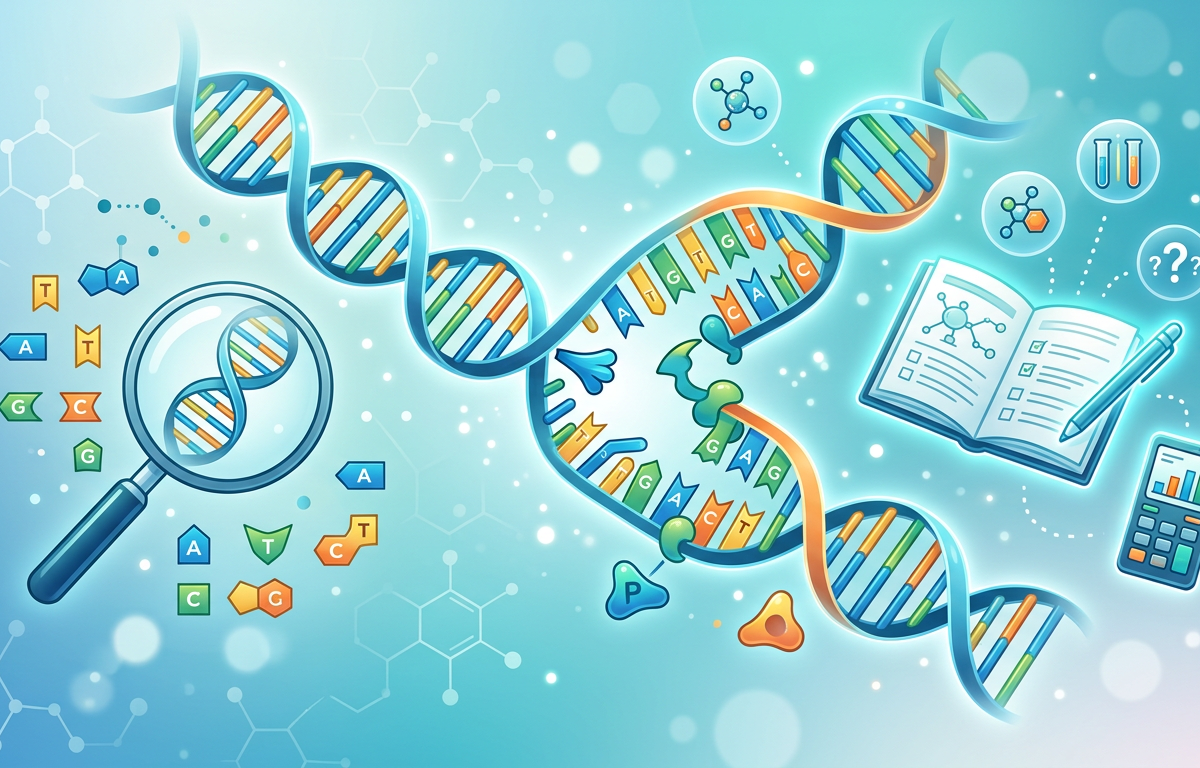
DNA replication is the biological process by which a cell creates an identical copy of its DNA before cell division occurs. This fundamental mechanism ensures that every new daughter cell receives a complete set of genetic instructions. The process is described as semi-conservative because each new DNA molecule consists of one original "parental" strand and one newly synthesized "daughter" strand. Key enzymes like helicase, which unzips the double helix, and DNA polymerase, which adds new nucleotides, work together at the replication fork to build these new strands following the rules of base pairing: Adenine (A) pairs with Thymine (T), and Cytosine (C) pairs with Guanine (G). Understanding these basics is essential for mastering genetics practice questions and broader biology topics.
Solved Examples
Reviewing these solved examples will help you understand how to apply base-pairing rules and identify the roles of specific enzymes during replication.
- Complementary Strand Prediction: Given a DNA template strand with the sequence 5'-A-T-G-C-C-G-3', what is the sequence of the newly synthesized complementary strand?
- Identify the base pairs: A pairs with T, and G pairs with C.
- Match each base: A → T, T → A, G → C, C → G, C → G, G → C.
- Determine directionality: Since DNA strands are antiparallel, the new strand will be 3'-T-A-C-G-G-C-5'.
- Enzyme Identification: A scientist observes a cell where the DNA double helix is unable to separate into two single strands. Which enzyme is likely malfunctioning?
- Recall the function of Helicase: It breaks the hydrogen bonds between nitrogenous bases to "unzip" the DNA.
- Since the strands cannot separate, Helicase is the enzyme that is either missing or non-functional.
- Semi-Conservative Model Calculation: If a single DNA molecule undergoes three rounds of replication in a medium containing radioactive markers, how many total DNA molecules will be present?
- Use the formula 2n, where n is the number of replication rounds.
- Calculate 23 = 2 × 2 × 2 = 8.
- There will be 8 DNA molecules in total after three rounds.
Practice Questions
Test your knowledge with these easy DNA replication questions designed to reinforce your understanding of the replication machinery and base-pairing logic.
- Which enzyme is responsible for adding new nucleotides to the growing DNA strand?
- What are the four nitrogenous bases found in DNA?
- DNA replication is called "semi-conservative." What does this term mean?
- In which direction does DNA polymerase always synthesize a new DNA strand?
- What is the name of the Y-shaped region where the DNA double helix is split open?
- If a DNA strand has 20% Adenine, what percentage of Thymine must it contain according to Chargaff's rules?
- Which enzyme acts like "glue" to join Okazaki fragments together on the lagging strand?
- Where does DNA replication take place in a eukaryotic cell?
- True or False: DNA replication happens during the Mitosis phase of the cell cycle.
- What type of chemical bond holds the two strands of DNA together between the nitrogenous bases?
Answers & Explanations
- DNA Polymerase: This enzyme reads the template strand and brings in the correct matching nucleotides to build the new strand. It also performs a proofreading function to minimize errors.
- Adenine, Thymine, Guanine, and Cytosine: These four bases form the "alphabet" of the genetic code. You can learn more about how these bases influence traits in our inheritance questions guide.
- One old strand and one new strand: Semi-conservative means that each resulting DNA molecule contains one original strand from the parent and one newly synthesized strand. This was famously proven by the Meselson-Stahl experiment, often cited in Nature Education.
- 5' to 3' direction: DNA polymerase can only add new nucleotides to the 3' end of an existing strand, meaning the new strand grows in the 5' to 3' direction.
- Replication Fork: This is the active area where helicase is unwinding the DNA, creating a structure that looks like a fork in a road.
- 20%: According to Chargaff's rules, Adenine always pairs with Thymine in equal amounts. If there is 20% A, there must be 20% T.
- DNA Ligase: While polymerase builds the fragments, Ligase is the "molecular glue" that seals the sugar-phosphate backbone to create a continuous strand. For more on cellular machinery, check out our easy organelles questions.
- The Nucleus: In eukaryotes, the DNA is housed inside the nucleus, so all replication machinery must operate there. In prokaryotes, it happens in the cytoplasm.
- False: DNA replication occurs during the S phase (Synthesis phase) of Interphase, which happens before Mitosis begins.
- Hydrogen Bonds: These are relatively weak bonds that allow the DNA strands to be easily "unzipped" by helicase and then "zipped" back together.
1. Which enzyme is responsible for unzipping the DNA double helix?
Frequently Asked Questions
What is the main goal of DNA replication?
The primary purpose is to ensure that when a cell divides, both resulting daughter cells have an exact and complete copy of the genetic material. This maintains genetic continuity across generations of cells.
Why does DNA replication only happen in the 5' to 3' direction?
DNA polymerase requires a free 3'-OH group to attach a new nucleotide. Because of this chemical requirement, the enzyme can only extend a DNA chain by adding to the 3' end, resulting in 5' to 3' growth.
What are Okazaki fragments?
Okazaki fragments are short sequences of DNA nucleotides synthesized discontinuously on the lagging strand. They are later joined together by the enzyme DNA ligase to form a complete strand.
Is DNA replication 100% accurate?
While extremely accurate, errors do occur at a rate of about one per billion nucleotides. DNA polymerase has a proofreading ability that catches most mistakes, and other repair mechanisms fix remaining errors.
What is the difference between the leading and lagging strand?
The leading strand is synthesized continuously toward the replication fork, while the lagging strand is synthesized in short, discontinuous bursts away from the replication fork.
Enjoyed this article?
Share it with others who might find it helpful.
Related Articles
Hard DNA Replication Questions Practice Questions
Challenge yourself with hard DNA replication questions. Explore enzymatic mechanisms, Okazaki fragments, and telomeres with solved examples and a quiz.
Apr 25, 2026
Medium DNA Replication Questions Practice Questions
Master medium-level DNA replication concepts with solved examples, detailed explanations, and a practice quiz to boost your biology exam scores.
Apr 25, 2026
Hard Microbiology Practice Questions Practice Questions
Hard Microbiology Practice Questions Practice Questions
Apr 26, 2026
Medium Microbiology Practice Questions Practice Questions
Master microbiology with our medium-level practice questions covering bacterial growth, genetics, and metabolism. Includes solved examples and a quick quiz.
Apr 26, 2026
Easy Microbiology Practice Questions Practice Questions
Easy Microbiology Practice Questions Practice Questions
Apr 26, 2026

Hard Enzyme Questions Practice Questions
Master complex biochemistry with these hard enzyme questions. Cover Michaelis-Menten kinetics, inhibition types, and Lineweaver-Burk plots with solved examples.
Apr 26, 2026
Medium Enzyme Questions Practice Questions
Master enzyme kinetics and regulation with our Medium Enzyme Questions Practice Questions. Includes solved examples, detailed explanations, and a quick quiz.
Apr 26, 2026
Enzyme Questions Practice Questions with Answers
Master enzyme kinetics and function with our comprehensive guide. Includes solved examples, practice questions, and detailed answers on biological catalysts.
Apr 26, 2026