Calculating Gas Mixes: Solving Dalton’s Law Without Math Errors
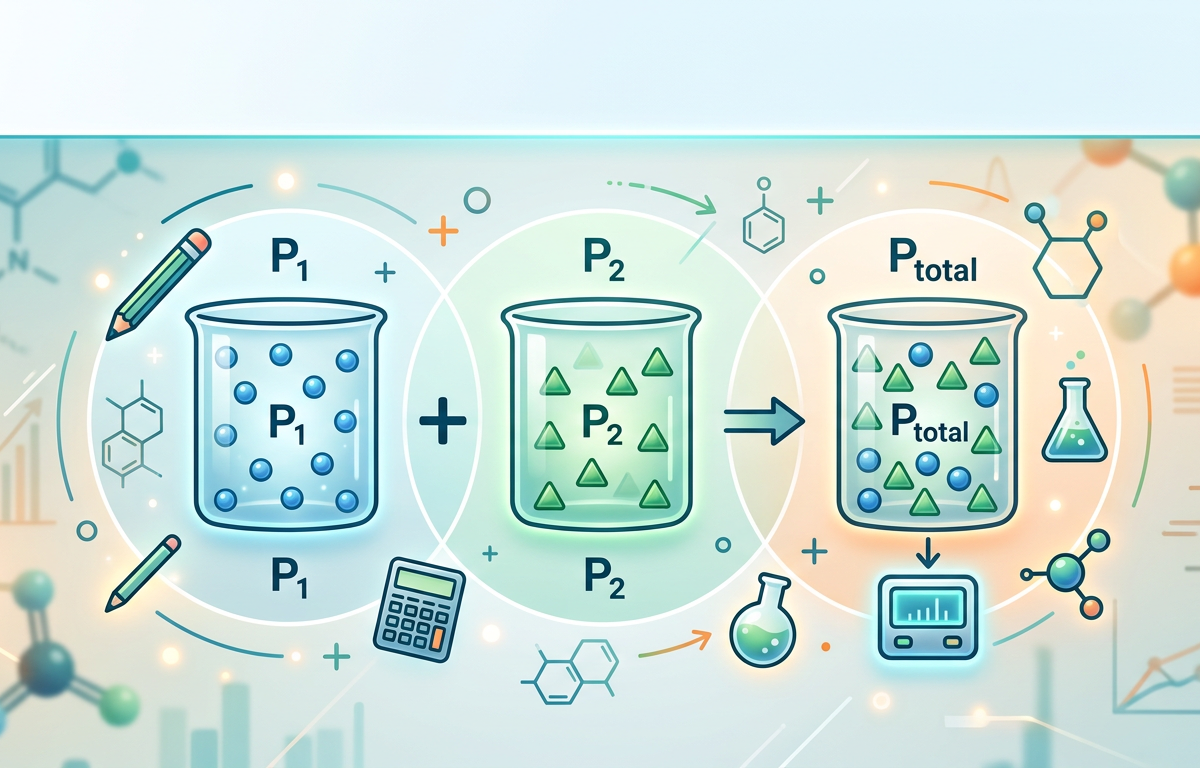
Imagine a scuba tank filled with nitrogen and oxygen. If you pump in more oxygen, the nitrogen molecules do not suddenly stop hitting the walls of the tank to make room. They continue to exert the exact same force they did when they were alone. This is the intuitive core of Dalton’s Law: in a non-reactive mixture, gases act like independent roommates who never interact, each contributing its own partial pressure to the total sum. Many students struggle not with the addition itself, but with the assumption that one gas somehow crowds out the pressure of another.
The most frequent error occurs when mixing units, such as adding 0.5 atm to 400 mmHg without converting them to a common scale first. To solve these problems successfully, you must ensure every individual pressure is expressed in the same units before applying the formula P total = P1 + P2 + ... + Pn. Whether you are subtracting water vapor pressure from a total or summing three different noble gases, the logic remains a simple matter of accounting for each independent contribution to the system.
The Additive Logic of Gas Mixtures
Dalton’s Law of Partial Pressures states that the total pressure exerted by a mixture of non-reactive gases is equal to the sum of the partial pressures of each individual gas in the mixture. This fundamental principle of chemistry, formulated by John Dalton in 1801, implies that each gas in a container behaves as if it were alone, occupying the entire volume and exerting its own specific pressure. When you are working with Easy Dalton’s Law Practice Questions, the core formula you will use is Ptotal = P1 + P2 + P3 + ... + Pn.
Understanding this law is crucial when dealing with gas mixtures in scenarios ranging from scuba diving tanks to atmospheric science. It also connects deeply with other gas behaviors, such as those found in Ideal Gas Law calculations. Beyond simple addition, Dalton's Law is often expressed using mole fractions: the partial pressure of a gas is equal to its mole fraction (the ratio of its moles to the total moles) multiplied by the total pressure of the system. This allows chemists to determine the composition of a gas mixture simply by measuring pressure changes.
Solved Examples
Review these step-by-step solutions to understand how to apply the formula in basic scenarios.
- Example 1: Finding Total Pressure
A container holds oxygen gas at a pressure of 0.50 atm and nitrogen gas at a pressure of 0.75 atm. What is the total pressure in the container?
- Identify the known values: PO2 = 0.50 atm, PN2 = 0.75 atm.
- Apply Dalton’s Law: Ptotal = PO2 + PN2.
- Calculate: Ptotal = 0.50 atm + 0.75 atm = 1.25 atm.
- Example 2: Finding a Missing Partial Pressure
The total pressure of a mixture of helium and neon is 900 mmHg. If the partial pressure of helium is 400 mmHg, what is the partial pressure of neon?
- Identify the known values: Ptotal = 900 mmHg, PHe = 400 mmHg.
- Rearrange the formula: PNe = Ptotal - PHe.
- Calculate: PNe = 900 mmHg - 400 mmHg = 500 mmHg.
- Example 3: Three Gas Mixture
A flask contains argon, krypton, and xenon. The partial pressures are 15 kPa, 25 kPa, and 10 kPa, respectively. What is the total pressure?
- List the pressures: PAr = 15 kPa, PKr = 25 kPa, PXe = 10 kPa.
- Sum the pressures: Ptotal = 15 + 25 + 10.
- Result: Ptotal = 50 kPa.
Practice Questions
Test your knowledge with these Easy Dalton’s Law Practice Questions. Ensure all units match before adding or subtracting.
1. A mixture of hydrogen and carbon dioxide has a total pressure of 2.5 atm. If the hydrogen exerts 1.2 atm, what is the partial pressure of the carbon dioxide?
2. A tank contains 300 torr of Gas A, 250 torr of Gas B, and 450 torr of Gas C. What is the total pressure in the tank?
3. A balloon is filled with oxygen (P = 0.3 atm), nitrogen (P = 0.5 atm), and helium (P = 0.2 atm). What is the total pressure inside the balloon?
Want unlimited practice questions like these?
Generate AI-powered questions with step-by-step solutions on any topic.
Try Question Generator Free →4. The air in a room has a total pressure of 760 mmHg. If the partial pressure of nitrogen is 593 mmHg and oxygen is 159 mmHg, what is the remaining pressure exerted by trace gases?
5. A sample of gas collected over water has a total pressure of 755 torr. If the water vapor pressure at that temperature is 24 torr, what is the pressure of the dry gas?
6. If a mixture contains four gases with partial pressures of 1.2 atm, 0.8 atm, 2.5 atm, and 0.5 atm, what is the total pressure?
7. A diver's tank contains oxygen and helium. The total pressure is 10.0 atm. If the oxygen pressure is 2.1 atm, find the helium pressure.
8. A 5.0 L container holds 2.0 atm of Gas X and 3.5 atm of Gas Y. If 1.0 atm of Gas Z is added without changing the volume or temperature, what is the new total pressure?
9. In a lab experiment, the total pressure of a gas mixture is 101.3 kPa. The mixture consists of nitrogen (78 kPa) and oxygen. What is the partial pressure of oxygen?
10. Convert 0.5 atm to mmHg and then find the total pressure if it is mixed with 400 mmHg of another gas. (Hint: 1 atm = 760 mmHg).
Answers & Explanations
Compare your results with the detailed solutions below to identify any errors in your calculations.
- 1. Answer: 1.3 atm
Explanation: Using Ptotal = PH2 + PCO2, we get 2.5 atm = 1.2 atm + PCO2. Subtracting 1.2 from 2.5 gives 1.3 atm. - 2. Answer: 1000 torr
Explanation: Sum the partial pressures: 300 + 250 + 450 = 1000 torr. - 3. Answer: 1.0 atm
Explanation: Sum the partial pressures: 0.3 + 0.5 + 0.2 = 1.0 atm. This is a common atmospheric pressure equivalent. - 4. Answer: 8 mmHg
Explanation: Ptrace = Ptotal - (PN2 + PO2). So, 760 - (593 + 159) = 760 - 752 = 8 mmHg. - 5. Answer: 731 torr
Explanation: This is a "gas over water" problem. Pdry gas = Ptotal - Pwater vapor. 755 - 24 = 731 torr. - 6. Answer: 5.0 atm
Explanation: 1.2 + 0.8 + 2.5 + 0.5 = 5.0 atm. - 7. Answer: 7.9 atm
Explanation: PHe = 10.0 atm - 2.1 atm = 7.9 atm. - 8. Answer: 6.5 atm
Explanation: Initial total pressure was 2.0 + 3.5 = 5.5 atm. Adding 1.0 atm of Gas Z brings the total to 6.5 atm. - 9. Answer: 23.3 kPa
Explanation: 101.3 kPa - 78 kPa = 23.3 kPa. - 10. Answer: 780 mmHg
Explanation: First, convert 0.5 atm to mmHg: 0.5 * 760 = 380 mmHg. Then add the second gas: 380 + 400 = 780 mmHg.
1. Which formula represents Dalton's Law of Partial Pressures?
Frequently Asked Questions
What is the main requirement for Dalton's Law to apply?
The gases in the mixture must be non-reactive, meaning they do not undergo a chemical reaction with one another when mixed. If they reacted, the number of moles would change, altering the pressure in ways the law cannot predict alone.
Does Dalton's Law work for real gases?
Dalton's Law is most accurate for ideal gases where intermolecular forces are negligible. For real gases under high pressure or low temperature, deviations may occur, though it remains a very strong approximation for most engineering and chemistry applications.
How do you calculate mole fraction in Dalton's Law?
The mole fraction is calculated by dividing the number of moles of a specific gas by the total number of moles in the mixture. This decimal value can then be multiplied by the total pressure to find that specific gas's partial pressure.
Why is Dalton's Law important in scuba diving?
It helps divers understand how the partial pressure of nitrogen and oxygen increases with depth, which is critical for preventing nitrogen narcosis and oxygen toxicity. Divers use these calculations to determine safe breathing gas mixtures at various underwater pressures.
Can I use different pressure units in the same calculation?
No, all pressure values must be converted to the same unit (such as atm, kPa, or mmHg) before adding or subtracting them. Mixing units will lead to mathematically incorrect results.
What is the relationship between Dalton's Law and the Ideal Gas Law?
Dalton's Law is essentially an extension of the Ideal Gas Law; since P = nRT/V, the total pressure is simply the sum of (nRT/V) for each individual gas component in the mixture. This relationship is often explored in Combined Gas Law studies as well.
Enjoyed this article?
Share it with others who might find it helpful.
Related Articles

Solving Time-Shift Algebra: How to Model Age Ratios and Sums
Master age problems with our comprehensive guide featuring solved examples, practice questions, and detailed algebraic explanations for all levels.
Apr 6, 2026
Predicting Voltage: Solving Nernst Equation Problems at Non-Standard State
Master the Nernst equation with our comprehensive practice guide. Includes solved examples, step-by-step calculations, and a quick quiz to test your knowledge.
Apr 3, 2026

Solving Arrhenius Problems Involving Two-Point Data and Ln Plots
Master advanced kinetics with these hard Arrhenius equation practice questions. Includes step-by-step solutions, theory explanations, and a quick quiz.
Apr 2, 2026
Mastering ΔH: From Hess’s Law Cycles to Calorimetry Math
Master enthalpy change with our comprehensive guide featuring solved examples, Hess's Law problems, calorimetry practice, and detailed answer explanations.
Mar 29, 2026

Mastering Ka and Kb: ICE Tables and Conjugate Pair Math
Master Ka and Kb calculations with this comprehensive guide, including detailed concept explanations, solved examples, and practice questions with answers.
Mar 28, 2026
![Converting [OH-] to pOH: Solving Logarithmic Base Scales](https://dsssdaeklwicrvdzxzza.supabase.co/storage/v1/render/image/public/blog-media/ai-generated/1774738420110-92953793-8536-46e8-aa53-f182141cd497.png?width=480&quality=65&resize=cover)
Converting [OH-] to pOH: Solving Logarithmic Base Scales
This guide provides a comprehensive overview of pOH calculation, including its definition, formulas, solved examples, and practice questions with detailed explanations.
Mar 28, 2026
Solving Multistep Concentration Problems: Density and Dilutions
Master advanced chemistry with these hard percent concentration practice questions. Learn to calculate mass, volume, and m/v percent with step-by-step solutions.
Mar 27, 2026

Decimal Conversion Practice Questions with Answers
Master decimal conversion with our comprehensive guide featuring solved examples, practice questions, and a quick quiz to sharpen your math skills.
Apr 6, 2026