Standard Deviation Practice Questions with Answers

Standard Deviation Practice Questions with Answers
Standard deviation is a statistical measure that quantifies the amount of variation or dispersion in a set of data values. When you encounter Standard Deviation Practice Questions with Answers, you are learning to evaluate how much individual data points deviate from the arithmetic mean of the group. A low standard deviation indicates that the data points tend to be very close to the mean, while a high standard deviation indicates that the data points are spread out over a wider range of values. This concept is fundamental in fields ranging from quantum mechanics to analytical chemistry, where precision and accuracy are paramount. For instance, when analyzing results from mass spectrometry practice questions, understanding the variance in peak intensities is crucial for reliable data interpretation.
Concept Explanation
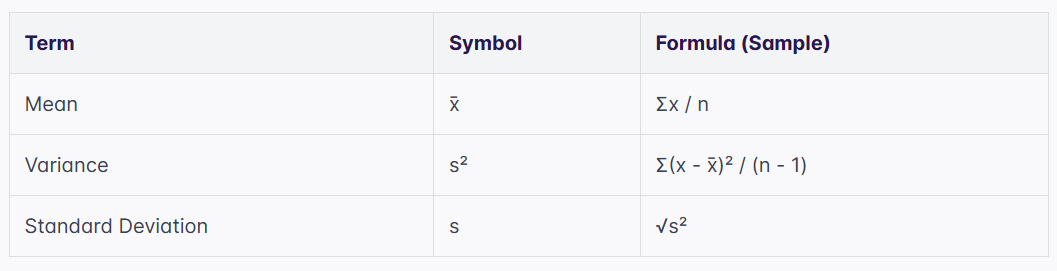
Standard deviation is the square root of the variance, representing the average distance of each data point from the mean in the same units as the original data. To calculate it, you must first determine the mean of the data set, find the difference between each data point and the mean, square those differences, average them (this is the variance), and finally take the square root. There are two primary types: population standard deviation (σ) and sample standard deviation (s). The distinction lies in the denominator of the variance formula: population uses N (total number of data points), while sample uses n - 1 (Bessel's correction) to provide an unbiased estimate of the population variance.
In the context of the Normal Distribution, approximately 68% of data falls within one standard deviation of the mean, 95% within two, and 99.7% within three. This is known as the Empirical Rule. Scientists use this to determine if an experimental result is an outlier or a statistically significant finding. Just as you might use NMR interpretation practice questions to ensure structural accuracy in chemistry, standard deviation ensures numerical reliability in statistics.
Solved Examples
Example 1: Calculating Sample Standard Deviation
Find the sample standard deviation for the data set: 4, 8, 12.
Calculate the mean (x̄): (4 + 8 + 12) / 3 = 8.
Subtract the mean from each value and square the result: (4-8)² = 16; (8-8)² = 0; (12-8)² = 16.
Sum the squared differences: 16 + 0 + 16 = 32.
Divide by (n - 1): 32 / (3 - 1) = 16 (This is the variance).
Take the square root: √16 = 4. The sample standard deviation is 4.
Example 2: Population Standard Deviation
A small class has 4 students with exam scores: 70, 80, 90, 100. Calculate the population standard deviation.
Mean (μ): (70 + 80 + 90 + 100) / 4 = 85.
Squared deviations: (70-85)²=225; (80-85)²=25; (90-85)²=25; (100-85)²=225.
Sum: 225 + 25 + 25 + 225 = 500.
Divide by N: 500 / 4 = 125.
Square root: √125 ≈ 11.18.
Example 3: Comparing Two Data Sets
Set A: {10, 10, 10} and Set B: {5, 10, 15}. Which has a higher standard deviation?
Set A mean = 10. All deviations are 0. Standard deviation = 0.
Set B mean = 10. Deviations are (5-10)=-5, (10-10)=0, (15-10)=5.
Squared deviations for B: 25, 0, 25. Sum = 50.
Sample variance for B: 50 / 2 = 25. Standard deviation = 5.
Set B has a higher standard deviation because its values are more spread out.
Practice Questions
1. Calculate the sample standard deviation for the following values: 2, 4, 6, 8, 10.
2. A biologist measures the heights of 5 plants (in cm) as 12, 15, 12, 18, 13. What is the sample standard deviation?
3. If a data set has a variance of 49, what is its standard deviation?
Want unlimited practice questions like these?
Generate AI-powered questions with step-by-step solutions on any topic.
Try Question Generator Free →4. Consider a population: 5, 5, 5, 5, 5. Without calculating, what is the population standard deviation?
5. A sample of 3 reaction times (ms) are 200, 210, and 220. Calculate the sample standard deviation.
6. If you add 10 to every value in a data set, how does the standard deviation change?
7. A data set has a mean of 50 and a standard deviation of 5. What is the z-score for a value of 60?
8. Calculate the population standard deviation for the set: 1, 3, 5.
9. Which data set is more consistent: Set X {10, 11, 12} or Set Y {5, 11, 17}?
10. Find the sample standard deviation for: -2, 0, 2.
Answers & Explanations
1. Answer: 3.16
Mean = (2+4+6+8+10)/5 = 6. Squared deviations: (2-6)²=16, (4-6)²=4, (6-6)²=0, (8-6)²=4, (10-6)²=16. Sum = 40. Sample variance = 40 / (5-1) = 10. √10 ≈ 3.16.
2. Answer: 2.55
Mean = 14. Squared deviations: (12-14)²=4, (15-14)²=1, (12-14)²=4, (18-14)²=16, (13-14)²=1. Sum = 26. Sample variance = 26 / 4 = 6.5. √6.5 ≈ 2.55.
3. Answer: 7
Standard deviation is the square root of variance. √49 = 7.
4. Answer: 0
Standard deviation measures spread. If all values are identical, there is no spread, so the standard deviation is zero.
5. Answer: 10
Mean = 210. Squared deviations: (200-210)²=100, (210-210)²=0, (220-210)²=100. Sum = 200. Sample variance = 200 / 2 = 100. √100 = 10.
6. Answer: It remains the same
Adding a constant to all values shifts the mean but does not change the distance between the values themselves, so the spread (standard deviation) is unchanged. This is a common property discussed in Khan Academy's statistics courses.
7. Answer: 2
Z-score = (Value - Mean) / Standard Deviation. (60 - 50) / 5 = 10 / 5 = 2. This means the value is 2 standard deviations above the mean.
8. Answer: 1.63
Mean = 3. Squared deviations: (1-3)²=4, (3-3)²=0, (5-3)²=4. Sum = 8. Population variance = 8 / 3 ≈ 2.67. √2.67 ≈ 1.63.
9. Answer: Set X
Consistency refers to lower variability. Set X has a smaller range and values closer to its mean compared to Set Y, resulting in a lower standard deviation.
10. Answer: 2
Mean = 0. Squared deviations: (-2-0)²=4, (0-0)²=0, (2-0)²=4. Sum = 8. Sample variance = 8 / (3-1) = 4. √4 = 2.
1. Which symbol represents the population standard deviation?
Frequently Asked Questions
What is the difference between sample and population standard deviation?
Population standard deviation is used when you have data for every member of a group, while sample standard deviation is used when you are estimating the population spread based on a subset. The sample formula uses n-1 in the denominator to correct for the tendency of samples to underestimate the true population variability.
Can a standard deviation be negative?
No, standard deviation cannot be negative because it is the square root of variance, which is a sum of squared numbers. It represents a distance or magnitude of spread, which is always zero or positive.
What does a standard deviation of 0 mean?
A standard deviation of 0 indicates that all values in the data set are exactly the same. Since there is no variation between the numbers, the distance from the mean for every point is zero.
Why do we square the deviations from the mean?
We square the deviations to ensure that negative differences (values below the mean) do not cancel out positive differences (values above the mean). This process makes all values positive so they can be summed to represent total variability, a concept also useful when analyzing molecular data in IR spectroscopy practice questions.
How is standard deviation used in real life?
Standard deviation is used in finance to measure investment risk, in manufacturing to control product quality, and in weather forecasting to determine the reliability of models. It helps professionals understand the "noise" or uncertainty within any given set of measurements.
Want unlimited practice questions like these?
Generate AI-powered questions with step-by-step solutions on any topic.
Try Question Generator Free →
Want unlimited practice questions like these?
Generate AI-powered questions with step-by-step solutions on any topic.
Try Question Generator Free →Enjoyed this article?
Share it with others who might find it helpful.
Related Articles
Medium Standard Deviation Practice Questions
Master standard deviation with our comprehensive guide. Features clear explanations, solved examples, and medium-difficulty practice questions with detailed answers.
Apr 5, 2026
Easy Standard Deviation Practice Questions
Master the basics of a key statistical concept with easy standard deviation practice questions. Learn the formula, follow worked examples, and test your skills.
Apr 5, 2026
Hard Confidence Interval Practice Questions
Challenge your statistical skills with hard confidence interval practice questions. This guide covers complex scenarios like two-sample tests and sample size determination.
Apr 5, 2026
Medium Sampling Distribution Practice Questions
Master the sampling distribution with clear explanations, worked examples, and medium-difficulty practice questions on the Central Limit Theorem and standard error.
Apr 5, 2026

Medium Hypothesis Testing Practice Questions
Master hypothesis testing with our comprehensive guide. This page includes solved examples, practice questions with detailed answers, a quiz, and FAQs.
Apr 5, 2026

Medium Confidence Interval Practice Questions
Master the art of estimating population parameters with our comprehensive guide. This page features medium-level confidence interval practice questions with full solutions.
Apr 5, 2026
Easy Sampling Distribution Practice Questions
Master the fundamentals of the sampling distribution with easy-to-understand explanations, solved examples, and practice questions. Learn how to apply the Central Limit Theorem.
Apr 5, 2026

Easy Normal Distribution Practice Questions
Easy Normal Distribution Practice Questions
Apr 5, 2026