NCLEX Substance Abuse Practice Questions with Answers
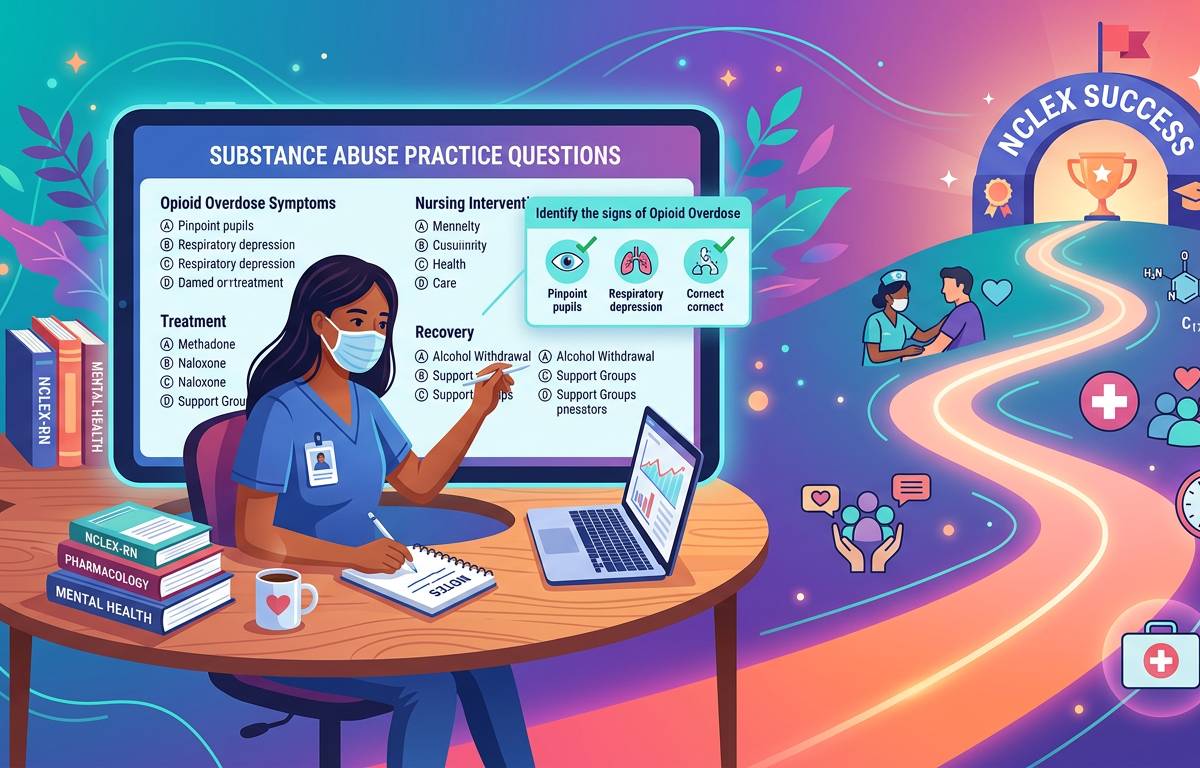
NCLEX Substance Abuse Practice Questions with Answers
Substance abuse nursing care is a critical component of the licensure examination, focusing on the identification, intervention, and management of patients with chemical dependencies. Mastering NCLEX Substance Abuse Practice Questions with Answers requires a deep understanding of withdrawal protocols, behavioral changes, and pharmacological treatments for addiction. According to the Substance Abuse and Mental Health Services Administration (SAMHSA), early intervention and evidence-based nursing care significantly improve patient outcomes in recovery. This guide provides the essential knowledge and practice needed to excel in this psychiatric-mental health domain.
Concept Explanation
NCLEX substance abuse concepts center on the physiological and psychological effects of psychoactive substances, ranging from alcohol and opioids to stimulants and sedatives. Nurses must prioritize safety, particularly during the acute withdrawal phase, which can be life-threatening in cases of alcohol or benzodiazepine cessation. Key nursing responsibilities include monitoring for symptoms using standardized tools like the Clinical Institute Withdrawal Assessment for Alcohol (CIWA-Ar) and administering medications such as methadone, buprenorphine, or disulfiram. Assessment often reveals defense mechanisms like denial, projection, and rationalization, which nurses must navigate using therapeutic communication. Understanding these dynamics is as vital as mastering fundamental nursing principles when preparing for the exam.
Key Categories of Substances
- Depressants: Alcohol, benzodiazepines, and barbiturates. These slow down the Central Nervous System (CNS). Withdrawal can cause tremors, seizures, and delirium tremens (DTs).
- Opioids: Heroin, morphine, and oxycodone. Overdose leads to respiratory depression and pinpoint pupils. Withdrawal is painful but rarely fatal.
- Stimulants: Cocaine and amphetamines. These cause tachycardia, hypertension, and dilated pupils. Withdrawal often results in "crashing" or severe depression.
- Hallucinogens: LSD and PCP. These cause altered perceptions and potential violent behavior.
When studying these topics, utilizing an AI Question Generator can help create tailored scenarios that mimic the complexity of the actual board exam. Nurses must also be aware of the "impaired nurse" phenomenon, where a colleague may show signs of substance use disorder, requiring specific reporting protocols to ensure patient safety.
Solved Examples
- Alcohol Withdrawal Assessment: A patient admitted for a fractured femur begins to experience tremors, tachycardia, and diaphoresis 24 hours after admission. What is the nurse's priority action?
- The nurse first recognizes these as early signs of alcohol withdrawal.
- Assess the patient using the CIWA-Ar scale to quantify the severity.
- Notify the healthcare provider and prepare to administer a benzodiazepine (e.g., lorazepam) as prescribed to prevent seizure activity.
- Opioid Overdose Intervention: A client is found unresponsive with a respiratory rate of 6 breaths per minute and constricted pupils. What should the nurse do immediately?
- Identify the signs of opioid toxicity (respiratory depression and miosis).
- Call for help/Rapid Response Team and maintain the airway.
- Administer naloxone (Narcan) as ordered, typically via IV or intranasal route, to reverse the opioid effects.
- Disulfiram Education: A client is prescribed disulfiram (Antabuse) for alcohol abstinence. What is the most important teaching point?
- Explain the mechanism: Disulfiram causes a severe adverse reaction if alcohol is ingested.
- Instruct the patient to avoid all sources of hidden alcohol, including mouthwash, aftershave, and certain sauces.
- Advise that the medication remains in the system for up to 14 days after the last dose.
Practice Questions
1. A nurse is caring for a client experiencing alcohol withdrawal delirium. Which of the following manifestations should the nurse expect? Select all that apply.
- Bradycardia
- Visual hallucinations
- Paranoid delusions
- Hypotension
- Coarse tremors
2. A client is admitted to the emergency department for a cocaine overdose. Which assessment finding is the priority for the nurse to address?
- Dilated pupils
- Agitation
- Chest pain
- Hyperthermia
3. A nurse is providing teaching to a client with a new prescription for methadone. Which statement by the client indicates an understanding of the teaching?
- "I can stop taking this medication as soon as my cravings go away."
- "This medication will help prevent the withdrawal symptoms from heroin."
- "I should take this medication only when I feel the urge to use opioids."
- "This drug will make me feel high like the heroin did."
Your NCLEX prep should adapt to you.
Bevinzey analyzes your performance and helps you focus on weak areas automatically.
Try Adaptive Practice4. A nurse is assessing a client for Wernicke-Korsakoff syndrome. Which of the following findings is associated with this condition?
- Ascites
- Ataxia and confusion
- Increased appetite
- Hyperreflexia
5. A nurse is caring for a client who has been using phencyclidine (PCP). What is the primary nursing intervention for this client?
- Encourage group therapy participation immediately.
- Provide a high-stimulation environment to keep the client awake.
- Monitor for aggressive behavior and maintain a low-stimulus environment.
- Administer naloxone to reverse the effects.
6. Which of the following symptoms is a hallmark of opioid withdrawal?
- Constipation
- Piloerection (goosebumps)
- Drowsiness
- Pinpoint pupils
7. A nurse suspects a fellow nurse is working while impaired. What is the first action the nurse should take?
- Confront the nurse privately about the suspicion.
- Report the observations to the nursing supervisor or manager.
- Call the state board of nursing immediately.
- Wait until the nurse makes a medication error to have proof.
8. A patient is being treated for a benzodiazepine overdose. Which medication should the nurse have available as an antidote?
- Flumazenil
- Naloxone
- Acetylcysteine
- Protamine sulfate
Answers & Explanations
- Answer: B, C, E. Alcohol withdrawal delirium (delirium tremens) is characterized by autonomic hyperactivity (tachycardia, hypertension), visual or tactile hallucinations, paranoid delusions, and coarse tremors. Bradycardia and hypotension are not typical; instead, vital signs usually increase.
- Answer: C. Cocaine is a potent stimulant that causes massive vasoconstriction. Chest pain can indicate myocardial ischemia or infarction, which is a life-threatening complication of cocaine use. While the other symptoms are common, cardiac stability is the priority.
- Answer: B. Methadone is an opioid agonist used for maintenance therapy to prevent withdrawal symptoms and reduce cravings in individuals with opioid use disorder. It is taken daily and does not produce a "high" when used at therapeutic doses.
- Answer: B. Wernicke-Korsakoff syndrome is caused by a thiamine (Vitamin B1) deficiency, often seen in chronic alcohol use. Symptoms include ataxia, nystagmus, and confusion (Wernicke's encephalopathy) followed by memory loss and confabulation (Korsakoff's psychosis). This is as distinct a neurological issue as those found in neurology-specific nursing care.
- Answer: C. PCP users can become extremely violent, unpredictable, and sensitive to stimuli. A low-stimulus environment is essential to prevent agitation. Naloxone is for opioids, not PCP.
- Answer: B. Opioid withdrawal symptoms are often described as "flu-like" and include piloerection (goosebumps), rhinorrhea, lacrimation, yawning, and diarrhea. Constipation and pinpoint pupils are signs of intoxication, not withdrawal.
- Answer: B. The nurse's legal and ethical duty is to protect patient safety. Reporting suspicions to a supervisor ensures that the situation is handled through the proper chain of command and that the impaired nurse receives help while patients remain safe.
- Answer: A. Flumazenil is the specific antagonist for benzodiazepine overdose. Naloxone is for opioids, acetylcysteine is for acetaminophen, and protamine sulfate is for heparin.
1. Which vitamin deficiency is the primary cause of Wernicke-Korsakoff syndrome in chronic alcoholics?
Frequently Asked Questions
What is the CIWA-Ar scale used for?
The CIWA-Ar (Clinical Institute Withdrawal Assessment for Alcohol) is a validated tool used by nurses to monitor the severity of alcohol withdrawal symptoms. It assesses ten categories, including nausea, tremors, and anxiety, to determine the need for medication intervention.
Can opioid withdrawal be fatal?
While opioid withdrawal is extremely uncomfortable and involves symptoms like vomiting and diarrhea, it is rarely life-threatening for healthy adults. However, it can lead to complications like dehydration or electrolyte imbalances if not managed properly.
What are the signs of an impaired nurse in the workplace?
Signs may include frequent absences, mood swings, documented wasting of controlled substances, or volunteering to give medications for other nurses' patients. Protecting the public is the priority, as detailed in NCSBN guidelines.
How does Naloxone work?
Naloxone is an opioid antagonist that binds to mu-opioid receptors with higher affinity than agonists like heroin or morphine. It displaces the opioids, effectively reversing respiratory depression and sedation within minutes.
Why is Thiamine given to patients with alcohol use disorder?
Thiamine is administered to prevent or treat Wernicke’s encephalopathy, a neurological emergency caused by thiamine deficiency. Because alcohol interferes with thiamine absorption, supplementation is vital during acute treatment and recovery.
What is the difference between physical dependence and addiction?
Physical dependence involves physiological adaptation to a substance where withdrawal occurs upon cessation, whereas addiction (Substance Use Disorder) is a chronic brain disease characterized by compulsive drug seeking despite harmful consequences.
Your NCLEX prep should adapt to you.
Bevinzey analyzes your performance and helps you focus on weak areas automatically.
Try Adaptive PracticeEnjoyed this article?
Share it with others who might find it helpful.
Related Articles

Hard NCLEX Substance Abuse Practice Questions
Master high-difficulty NCLEX substance abuse questions with our comprehensive guide featuring solved examples, practice questions, and detailed explanations.
May 21, 2026

Medium NCLEX Substance Abuse Practice Questions
Master Medium NCLEX Substance Abuse Practice Questions with our guide. Learn about withdrawal management, overdose interventions, and therapeutic care.
May 21, 2026
Easy NCLEX Substance Abuse Practice Questions
Easy NCLEX Substance Abuse Practice Questions
May 21, 2026

Hard NCLEX Prenatal Care Practice Questions
Hard NCLEX Prenatal Care Practice Questions
May 21, 2026

Medium NCLEX Prioritization Practice Questions
Medium NCLEX Prioritization Practice Questions
May 21, 2026

Medium NCLEX Pediatric Practice Questions
Medium NCLEX Pediatric Practice Questions
May 21, 2026

Hard NCLEX Mixed Medication Practice Questions
Master high-difficulty NCLEX mixed medication questions with our comprehensive guide featuring solved examples, practice questions, and expert explanations.
May 21, 2026

Hard NCLEX Mixed SATA Practice Questions
Hard NCLEX Mixed SATA Practice Questions
May 21, 2026