Mixture Problems Practice Questions with Answers
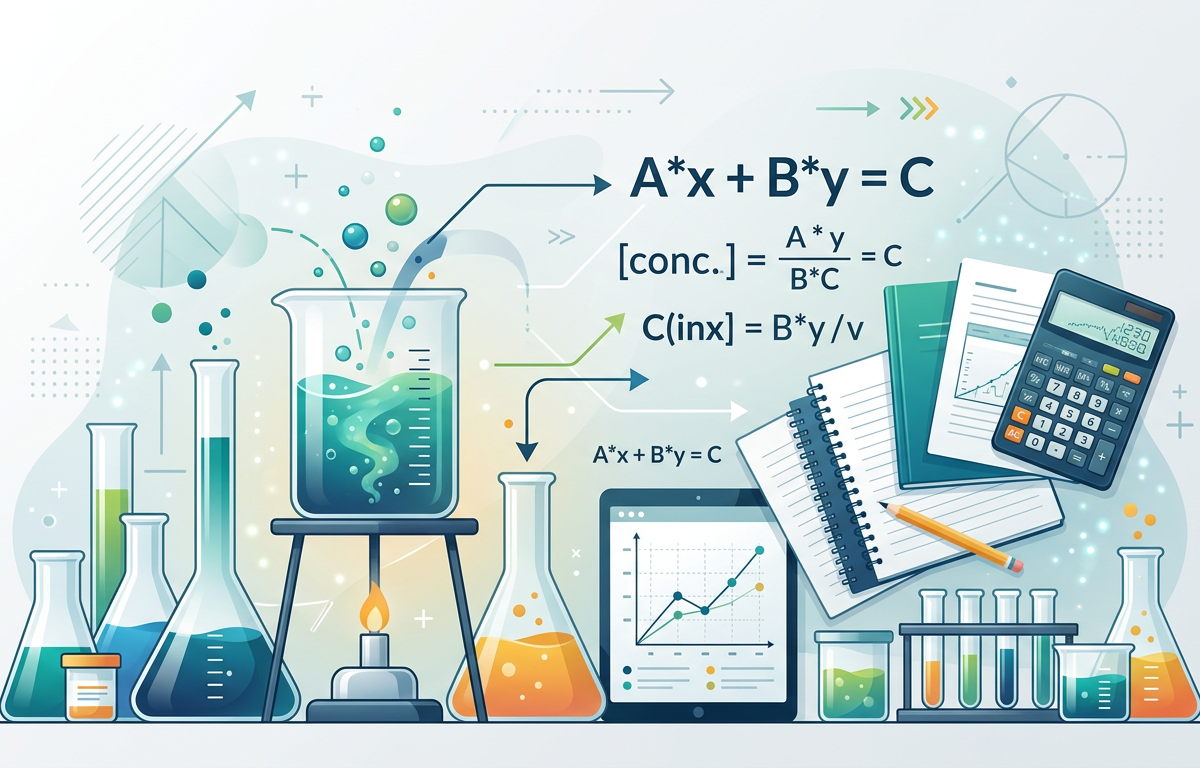
Mastering Mixture Problems is a vital skill for students in algebra and chemistry, as these problems require combining different concentrations or prices of substances to reach a specific target. Whether you are mixing chemical solutions in a lab or calculating the cost of a coffee blend, the underlying mathematical principles remain the same. This guide provides comprehensive Mixture Problems Practice Questions with Answers to help you build confidence in setting up and solving these equations efficiently.
Concept Explanation
Mixture problems are mathematical word problems that involve combining two or more substances with different characteristics, such as concentration, price, or percentage, to create a new mixture with a specific overall characteristic. The fundamental principle used to solve these problems is the Law of Conservation of Mass, which states that the total amount of a specific component (like salt, acid, or cost) in the individual parts must equal the total amount of that component in the final mixture.
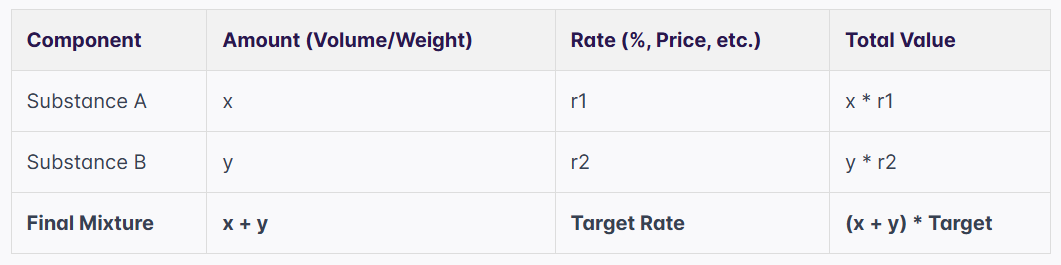
To solve these efficiently, you typically use the formula: Amount × Rate = Total Value. For example, if you are mixing liquids, the volume of the liquid multiplied by the percentage of the substance (like alcohol) gives you the total amount of that substance. Most problems can be organized using a table to track the individual components and the final result. This often leads to a system of linear equations where one equation represents the total volume and the second represents the total concentration or value.
According to Wikipedia's entry on Mixture Problems, these are standard applications of first-degree equations. You can also find more advanced variations in chemistry contexts on Khan Academy.
Solved Examples
Below are step-by-step solutions to common types of mixture problems found in algebra and chemistry courses.
Example 1: Mixing Percentages
How many liters of a 20% acid solution must be mixed with 10 liters of a 50% acid solution to get a 30% acid solution?
Let x be the liters of 20% solution.
The total volume of the final mixture will be x + 10 liters.
Set up the equation based on the amount of pure acid: 0.20(x) + 0.50(10) = 0.30(x + 10).
Distribute: 0.2x + 5 = 0.3x + 3.
Subtract 0.2x from both sides: 5 = 0.1x + 3.
Subtract 3 from both sides: 2 = 0.1x.
Divide by 0.1: x = 20.
Answer: 20 liters.
Example 2: Adding Pure Water (0% concentration)
A chemist has 400 mL of a 15% salt solution. How much water should be added to dilute it to a 10% solution?
Let w be the amount of water added. Water has 0% salt.
The original amount of salt is 0.15 * 400 = 60 mL.
The final volume is 400 + w. The final salt concentration is 10%.
Equation: 60 + 0(w) = 0.10(400 + w).
60 = 40 + 0.1w.
20 = 0.1w.
w = 200.
Answer: 200 mL of water.
Practice Questions
Test your knowledge with these mixture problems. They range from basic percentage mixtures to complex multi-variable scenarios.
A 50-gallon tank is filled with a 20% chlorine solution. How many gallons of pure chlorine must be added to increase the concentration to 25%?
A jeweler melts 100g of 14-karat gold (58% pure) with some 24-karat gold (100% pure) to create an 18-karat gold alloy (75% pure). How much 24-karat gold is needed?
How many ounces of a 40% sugar syrup must be mixed with 20 ounces of a 10% sugar syrup to obtain a 25% sugar syrup?
Want unlimited practice questions like these?
Generate AI-powered questions with step-by-step solutions on any topic.
Try Question Generator Free →A technician needs to mix a 30% antifreeze solution with a 70% antifreeze solution to get 10 liters of a 40% solution. How many liters of each should be used?
Walnuts cost $6 per pound and Cashews cost $10 per pound. How many pounds of cashews should be added to 12 pounds of walnuts to create a mix that costs $7 per pound?
A 2-liter bottle of 5% vinegar is mixed with a 3-liter bottle of 10% vinegar. What is the concentration of the resulting mixture?
A pharmacist has 150 mL of a 20% alcohol solution. How much pure alcohol should be added to make it a 40% solution?
How many liters of water must be evaporated from 50 liters of a 3% salt solution to make it a 5% salt solution?
Answers & Explanations
Check your work against the detailed explanations below. If you struggled with the algebra, you might want to review simplifying expressions to improve your equation-handling skills.
Answer: 3.33 gallons.
Equation: 0.20(50) + 1.00(x) = 0.25(50 + x). 10 + x = 12.5 + 0.25x. 0.75x = 2.5. x = 2.5 / 0.75 = 10/3 or 3.33.Answer: 68 grams.
Equation: 0.58(100) + 1.0(x) = 0.75(100 + x). 58 + x = 75 + 0.75x. 0.25x = 17. x = 17 / 0.25 = 68.Answer: 20 ounces.
Equation: 0.40(x) + 0.10(20) = 0.25(x + 20). 0.4x + 2 = 0.25x + 5. 0.15x = 3. x = 3 / 0.15 = 20.Answer: 7.5L of 30% and 2.5L of 70%.
Let x = liters of 30%. Then 10 - x = liters of 70%. Equation: 0.3x + 0.7(10 - x) = 0.4(10). 0.3x + 7 - 0.7x = 4. -0.4x = -3. x = 7.5.Answer: 4 pounds.
Equation: 6(12) + 10(x) = 7(12 + x). 72 + 10x = 84 + 7x. 3x = 12. x = 4.Answer: 8%.
Total volume = 2 + 3 = 5 liters. Total vinegar = 0.05(2) + 0.10(3) = 0.1 + 0.3 = 0.4. Concentration = 0.4 / 5 = 0.08 or 8%.Answer: 50 mL.
Equation: 0.20(150) + x = 0.40(150 + x). 30 + x = 60 + 0.4x. 0.6x = 30. x = 50.Answer: 20 liters.
Salt amount stays the same: 0.03(50) = 1.5. Let x be water evaporated. Final volume = 50 - x. Equation: 1.5 = 0.05(50 - x). 1.5 = 2.5 - 0.05x. -1 = -0.05x. x = 20.
1. If you add pure water to a 20% acid solution, what happens to the concentration?
Frequently Asked Questions
What is the basic formula for mixture problems?
The basic formula is (Amount 1 × Rate 1) + (Amount 2 × Rate 2) = (Total Amount × Final Rate). This balances the total quantity of the specific ingredient before and after mixing.
How do you handle evaporating water in a mixture problem?
You treat evaporation as subtracting an amount with a 0% concentration of the solute. The total volume decreases, but the amount of the solute (like salt or sugar) remains constant.
Can mixture problems have more than two components?
Yes, mixture problems can involve three or more substances. You simply add more (Amount × Rate) terms to the left side of the equation and ensure the total amount on the right is the sum of all individual amounts.
What is the difference between a concentration mixture and a price mixture?
Concentration mixtures deal with percentages of a substance in a liquid, while price mixtures deal with the unit cost of solid goods. Mathematically, they are identical; only the units and labels change.
Why is it helpful to use a table for these problems?
A table helps organize the given information into columns for Amount, Rate, and Total Value, making it easier to visualize the relationship and prevent errors when setting up the final equation.
Want unlimited practice questions like these?
Generate AI-powered questions with step-by-step solutions on any topic.
Try Question Generator Free →Enjoyed this article?
Share it with others who might find it helpful.
Related Articles
Hard Le Chatelier’s Principle Practice Questions
Master Hard Le Chatelier’s Principle Practice Questions with our comprehensive guide featuring solved examples, practice problems, and detailed explanations.
Mar 30, 2026
Hard Reaction Quotient (Q) Practice Questions
Hard Reaction Quotient (Q) Practice Questions
Mar 30, 2026
Grams to Moles Practice Questions with Answers
Master grams to moles conversions with our comprehensive guide. Includes step-by-step examples, practice questions, and detailed answers for chemistry students.
Mar 26, 2026
Avogadro’s Number Practice Questions with Answers
Master the mole concept with our Avogadro’s Number practice questions. Includes step-by-step solved examples, a quick quiz, and detailed explanations.
Mar 26, 2026
Empirical Formulas: Solving Ratios from Mass and Percent Data
Master empirical formula calculations with 10 practice questions, worked answers, and a free step-by-step calculator for mass, percentage, and combustion problems.
Mar 26, 2026