Medium NCLEX Infection Control Practice Questions

Medium NCLEX Infection Control Practice Questions
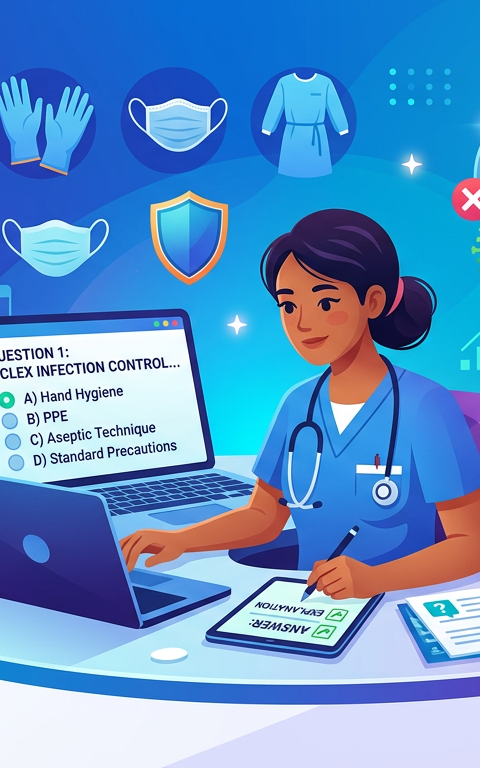
Mastering Medium NCLEX Infection Control Practice Questions is essential for nursing students because infection prevention is a core competency tested across all sections of the licensure exam. This guide provides detailed explanations of isolation precautions, personal protective equipment (PPE), and aseptic techniques to help you prepare for the clinical scenarios you will face on test day.
Concept Explanation
Infection control in nursing refers to the evidence-based practices and procedures used to prevent the spread of pathogenic microorganisms within healthcare settings. These practices are categorized into Standard Precautions, which apply to all patients, and Transmission-Based Precautions, which are used for patients known or suspected to be infected with specific pathogens. According to the Centers for Disease Control and Prevention (CDC), the primary goal is to break the "chain of infection" at various points, such as the portal of entry or the mode of transmission. Nurses must be proficient in selecting the correct PPE—gloves, gowns, masks, and eye protection—based on the specific route of transmission: contact, droplet, or airborne. Understanding these concepts is a fundamental part of NCLEX Fundamentals Practice Questions and ensures patient safety in diverse clinical environments.
Solved Examples
- Scenario: A nurse is preparing to enter the room of a patient diagnosed with Clostridioides difficile (C. diff). What is the priority infection control measure?
- Identify the precaution type: C. diff requires Contact Precautions.
- Select PPE: The nurse must don a gown and gloves before entering.
- Hand Hygiene: After exiting, the nurse must wash hands with soap and water, as alcohol-based hand rubs are ineffective against C. diff spores.
- Solution: The nurse dons a gown and gloves and performs hand hygiene with soap and water upon exit.
- Scenario: A patient is admitted with suspected pulmonary tuberculosis (TB). Which room assignment and PPE are required?
- Identify the transmission route: TB is spread via the airborne route.
- Determine room type: The patient requires a private, negative-pressure room (Airborne Infection Isolation Room).
- Select respiratory protection: The nurse must wear a fitted N95 respirator.
- Solution: Place the patient in a negative-pressure room and wear a fitted N95 respirator.
- Scenario: A nurse is caring for a patient on Droplet Precautions for seasonal influenza. At what distance is the risk of transmission highest?
- Define droplet transmission: Large particles that travel short distances (typically 3 to 6 feet).
- Identify required PPE: A surgical mask is required when working within 3-6 feet of the patient.
- Solution: Wear a surgical mask when providing care within 3-6 feet of the patient.
Practice Questions
1. A nurse is caring for a client with a large abdominal wound infected with Methicillin-resistant Staphylococcus aureus (MRSA). Which action by the nurse is most appropriate?
2. A nurse is assigned to four clients. Which client should be placed in a private room to maintain proper infection control?
3. While preparing to change a sterile dressing, the nurse notices the sterile field has been touched by the corner of the patient's bedsheet. What is the nurse's next action?
Train under NCLEX-style pressure.
Use timed NCLEX practice questions and adaptive quizzes to improve speed, accuracy, and confidence.
Start Timed Practice4. A nurse is removing PPE after caring for a patient on Contact and Droplet Precautions. What is the correct sequence for doffing?
5. Which intervention is most effective in preventing catheter-associated urinary tract infections (CAUTI)?
6. A client with disseminated Herpes Zoster requires which type of precautions?
7. The nurse is teaching a group of unlicensed assistive personnel (UAP) about hand hygiene. Which statement by a UAP indicates a need for further teaching?
8. A nurse is caring for a patient with Neisseria meningitidis. Which PPE is required when performing an assessment within 3 feet of the patient?
9. A nurse is preparing an educational program about NCLEX Patient Safety Practice Questions. Which population should be identified as having the highest risk for healthcare-associated infections (HAIs)?
10. When transporting a patient on Airborne Precautions to the radiology department, what is the most important action for the nurse to take?
Answers & Explanations
- Answer: Wear a gown and gloves when providing direct care. MRSA in a wound requires Contact Precautions. This prevents the spread of the bacteria via direct contact with the patient or contaminated surfaces.
- Answer: A client with Neutropenia. While patients with infections need private rooms, a neutropenic patient requires a private room (often with positive pressure/protective environment) to protect them from pathogens carried by others. This is a key concept in NCLEX Oncology Practice Questions.
- Answer: Discard the supplies and start over with a new sterile kit. Once a sterile field is touched by a non-sterile object (the bedsheet), it is considered contaminated. Safety is maintained by starting the procedure over.
- Answer: Gloves, goggles/face shield, gown, mask. The standard doffing sequence is designed to remove the most contaminated items first. Always perform hand hygiene immediately after removing all PPE.
- Answer: Removing the catheter as soon as it is no longer medically necessary. The duration of catheterization is the strongest risk factor for CAUTI. Nurses should advocate for early removal.
- Answer: Airborne and Contact Precautions. While localized shingles only requires Contact Precautions (if the lesions can be covered), disseminated Herpes Zoster requires both Airborne and Contact Precautions until the lesions are crusted.
- Answer: "I should use alcohol-based hand rub after caring for a patient with diarrhea." If the diarrhea is caused by C. difficile, alcohol-based rubs are ineffective. Soap and water must be used to mechanically remove spores.
- Answer: Surgical mask and gloves. Meningococcal meningitis is spread via large droplets. A surgical mask is required for anyone entering the room or working closely with the patient.
- Answer: Older adults with multiple chronic comorbidities. Older adults often have weakened immune systems and may have invasive devices (like IVs or catheters), making them highly susceptible to HAIs.
- Answer: Place a surgical mask on the patient. To prevent the spread of airborne particles during transport, the patient should wear a surgical mask. The nurse does not need to wear an N95 during transport if the patient is masked, but the receiving department must be notified.
1. Which of the following diseases requires the nurse to wear a respirator (N95)?
Frequently Asked Questions
What is the difference between medical and surgical asepsis?
Medical asepsis, or "clean technique," focuses on reducing the number of organisms and preventing their spread, while surgical asepsis, or "sterile technique," involves procedures to eliminate all microorganisms from an object or area. Nurses use medical asepsis for daily tasks like changing bed linens and surgical asepsis for invasive procedures like catheter insertion.
When should a nurse use soap and water instead of hand sanitizer?
Soap and water must be used when hands are visibly soiled, before eating, after using the restroom, and specifically after caring for patients with spore-forming organisms like C. difficile or Norovirus. Alcohol-based sanitizers do not kill spores and are only appropriate for non-spore-forming bacterial contamination.
What are the key components of Airborne Precautions?
Airborne Precautions require a private room with monitored negative air pressure that discharges through HEPA filters, keeping the door closed at all times. Healthcare providers must wear a fit-tested N95 or higher-level respirator, and the patient must wear a surgical mask during transport.
How does a nurse prioritize patients with infections during room assignments?
Nurses must avoid placing a contagious patient in a room with an immunocompromised patient or one with an open wound. Ideally, patients with the same organism (cohorting) can share a room if private rooms are unavailable, but this is a secondary option to individual isolation.
What is the most common cause of healthcare-associated infections?
The most common cause of HAIs is the failure of healthcare workers to perform proper hand hygiene. Contaminated hands are the primary vector for transmitting pathogens between patients and from the environment to the patient, as highlighted in NCLEX Infection Control Practice Questions with Answers.
Train under NCLEX-style pressure.
Use timed NCLEX practice questions and adaptive quizzes to improve speed, accuracy, and confidence.
Start Timed PracticeEnjoyed this article?
Share it with others who might find it helpful.
Related Articles

Hard NCLEX Infection Control Practice Questions
Challenge yourself with these hard NCLEX infection control practice questions. Master isolation precautions, PPE sequencing, and sterile technique protocols.
May 21, 2026

Easy NCLEX Infection Control Practice Questions
Master the basics of infection control with our easy NCLEX practice questions. Learn about PPE, transmission-based precautions, and hand hygiene for the exam.
May 21, 2026
NCLEX Infection Control Practice Questions with Answers
Master NCLEX Infection Control with our comprehensive guide featuring solved examples, practice questions, and detailed explanations on isolation precautions.
May 20, 2026

Hard NCLEX Prenatal Care Practice Questions
Hard NCLEX Prenatal Care Practice Questions
May 21, 2026

Medium NCLEX Prioritization Practice Questions
Medium NCLEX Prioritization Practice Questions
May 21, 2026

Medium NCLEX Pediatric Practice Questions
Medium NCLEX Pediatric Practice Questions
May 21, 2026

Hard NCLEX Mixed Medication Practice Questions
Master high-difficulty NCLEX mixed medication questions with our comprehensive guide featuring solved examples, practice questions, and expert explanations.
May 21, 2026

Hard NCLEX Mixed SATA Practice Questions
Hard NCLEX Mixed SATA Practice Questions
May 21, 2026