Medium NCLEX Hygiene Practice Questions
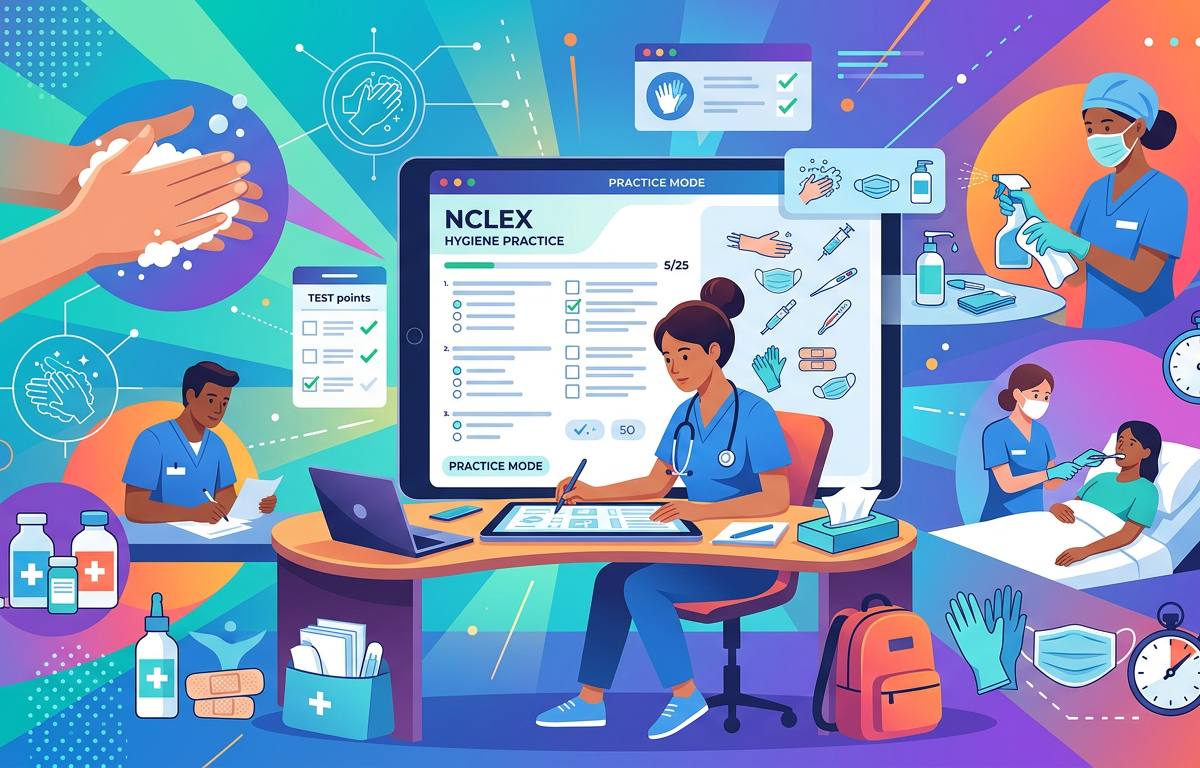
Mastering hygiene protocols is essential for nursing students, as these fundamental tasks directly impact patient safety, infection prevention, and overall comfort. These Medium NCLEX Hygiene Practice Questions are designed to test your clinical judgment regarding skin care, oral health, and the maintenance of a therapeutic environment.
Hygiene is more than just keeping a patient clean; it is a critical opportunity for the nurse to perform a comprehensive physical assessment. While assisting with a bath or oral care, you are scanning for signs of pressure injuries, circulation issues, and nutritional deficiencies. Understanding the nuances of hygiene—such as the specific needs of diabetic patients or those with sensory deficits—is a hallmark of a prepared nurse. For a broader overview of nursing basics, you can explore our NCLEX Fundamentals Practice Questions with Answers.
Concept Explanation
Hygiene in nursing refers to the set of practices and procedures performed to maintain cleanliness, preserve skin integrity, and prevent the transmission of pathogens within the healthcare setting. This concept encompasses skin care (bathing), oral hygiene, perineal care, foot and nail care, and hair care. Effective hygiene management follows the principles of medical asepsis to reduce the microbial load on the patient’s body and their immediate surroundings.
Key components of nursing hygiene include:
- Skin Integrity: Maintaining the skin as the body's first line of defense. This involves using warm (not hot) water, mild cleansers, and ensuring the skin is thoroughly dried, especially in skin folds.
- Infection Control: Adhering to standard precautions and specific techniques, such as washing from "cleanest to dirtiest" areas to prevent cross-contamination. This is closely linked to NCLEX Infection Control Practice Questions with Answers.
- Individualized Care: Adapting hygiene routines based on the patient's condition. For example, a patient with peripheral neuropathy requires specialized foot care to prevent undetected injuries.
- Patient Safety: Implementing safety measures such as using non-slip mats, ensuring the bed is at a working height for the nurse, and never leaving a dependent patient unattended during a bath. You can find more on this in our NCLEX Patient Safety Practice Questions with Answers.
According to the Centers for Disease Control and Prevention (CDC), proper hygiene practices are fundamental to stopping the spread of healthcare-associated infections (HAIs). Nurses must also be proficient in NCLEX Mobility Practice Questions with Answers to safely reposition patients during hygiene tasks.
Solved Examples
Review these worked examples to understand the rationale behind common hygiene-related NCLEX questions.
- Example: Diabetic Foot Care
A nurse is providing discharge teaching to a client with Type 2 diabetes regarding foot care. Which instruction is most appropriate?
Solution: The nurse should instruct the client to inspect their feet daily using a mirror. Patients with diabetes often have peripheral neuropathy and may not feel injuries. Daily visual inspection is the primary way to detect redness, blisters, or cuts early. - Example: Unconscious Oral Care
How should the nurse position an unconscious patient to perform oral hygiene?
Solution: The nurse should place the patient in a side-lying (lateral) position with the head of the bed slightly elevated. This position allows secretions to drain out of the mouth by gravity, significantly reducing the risk of aspiration. - Example: Perineal Care Direction
When performing perineal care for a female patient, in which direction should the nurse wipe?
Solution: The nurse must wipe from front to back (pubis to anus). This direction prevents the migration of fecal bacteria, such as E. coli, into the urethral opening, which helps prevent urinary tract infections.
Practice Questions
Test your knowledge with these Medium NCLEX Hygiene Practice Questions. Pay close attention to the specific needs of each patient scenario.
1. A nurse is preparing to provide a bed bath for a client who has a fractured right arm in a cast. Which action should the nurse take first when removing the client's gown?
2. While performing oral care for an unconscious client, the nurse should prioritize which of the following pieces of equipment to ensure safety?
3. A nurse is teaching a group of nursing students about the benefits of a back massage during evening care. Which statement by a student indicates a need for further teaching?
Train under NCLEX-style pressure.
Use timed NCLEX practice questions and adaptive quizzes to improve speed, accuracy, and confidence.
Start Timed Practice4. When providing foot care for a client with peripheral vascular disease (PVD), which action by the nurse is contraindicated?
5. A nurse is assisting a client with a total hip replacement with a sponge bath. The client asks why the nurse is using long, firm strokes from the ankles toward the thighs. What is the nurse's best response?
6. An elderly client with extremely dry skin (xerosis) is being admitted. Which intervention should the nurse include in the plan of care regarding hygiene?
7. A nurse is caring for a client with a significant hearing impairment who wears a hearing aid. Which action is correct when performing hygiene for this client?
8. During a bed bath, the nurse notices a reddened area on the client's sacrum that does not blanch when pressed. What is the nurse’s priority action?
9. A nurse is providing perineal care to an uncircumcised male client. Which action is essential for the nurse to perform?
10. When cleaning the eyes during a bed bath, the nurse should use which technique?
Answers & Explanations
- Answer: Remove the gown from the unaffected (left) arm first.
Rationale: When removing clothing or a gown from a patient with an injured or restricted limb, always start with the unaffected side. This provides more room and flexibility to gently slide the garment off the affected side (the right arm in the cast) without causing pain or further injury. - Answer: Suction equipment.
Rationale: The highest risk for an unconscious patient during oral care is aspiration. Having a functioning suction machine at the bedside allows the nurse to immediately remove excess fluids or secretions from the oral cavity, protecting the airway. - Answer: "A back massage is recommended for clients with suspected deep vein thrombosis (DVT)."
Rationale: Massaging a client with suspected or confirmed DVT is strictly contraindicated because the pressure and friction could dislodge a blood clot, leading to a pulmonary embolism. Back massages are otherwise useful for promoting relaxation and circulation. - Answer: Soaking the feet in warm water for 20 minutes.
Rationale: For patients with PVD or diabetes, soaking the feet is contraindicated because it can macerate the skin (soften it too much), leading to skin breakdown and infection. It also increases the risk of burns if the patient has decreased sensation. - Answer: "This technique helps promote venous return to the heart."
Rationale: Washing from distal to proximal (ankles to thighs) applies gentle pressure that assists the valves in the veins, encouraging blood flow back toward the heart and reducing the risk of venous stasis. - Answer: Limit the frequency of full baths and use alcohol-free moisturizers.
Rationale: Frequent bathing with hot water and soap strips the skin of natural oils, worsening xerosis. Using tepid water, mild cleansers, and applying moisturizers while the skin is still damp helps retain hydration. - Answer: Remove the hearing aid before the bath and clean the ear canal gently.
Rationale: Hearing aids are electronic devices and can be damaged by water or cleaning solutions. They should be removed before any hygiene involving the head or ears. - Answer: Position the client to remove pressure from the area and document the finding.
Rationale: A non-blanchable reddened area indicates a Stage 1 pressure injury. The priority is to implement pressure-relieving measures immediately. Massaging the area is contraindicated as it can cause further tissue damage. - Answer: Retract the foreskin, clean the glans, and then return the foreskin to its natural position.
Rationale: Retracting the foreskin allows for the removal of smegma and bacteria. Failing to return the foreskin to its original position can lead to paraphimosis, a condition where the foreskin becomes constricted and cuts off blood flow to the glans. - Answer: Wipe from the inner canthus to the outer canthus using a different section of the washcloth for each eye.
Rationale: Cleaning from the inner to the outer canthus prevents secretions from entering the nasolacrimal duct. Using a fresh section of the cloth for each eye prevents the spread of microorganisms from one eye to the other.
1. Which of the following is the most important reason for the nurse to perform a skin assessment during a bed bath?
Frequently Asked Questions
Why is hygiene considered a priority in the NCLEX?
Hygiene is prioritized because it is a fundamental intervention for infection control and skin integrity. The NCLEX tests your ability to protect patients from secondary complications like hospital-acquired infections and pressure ulcers.
What is the most common mistake made during perineal care?
The most common mistake is wiping from back to front, which introduces fecal bacteria into the urinary tract. Nurses must always use a "clean to dirty" workflow to maintain safety.
How does the nurse handle a patient who refuses a bath?
The nurse should first assess the reason for refusal, as it may be due to pain, fatigue, or cultural preferences. If the patient still refuses after education, the nurse must respect their autonomy and document the refusal and the education provided.
Are there specific hygiene considerations for elderly patients?
Yes, elderly patients often have thinner, drier skin and decreased subcutaneous fat. Nurses should use tepid water, avoid harsh soaps, and minimize the frequency of full baths to prevent skin tearing and irritation.
Can hygiene tasks be delegated to Unlicensed Assistive Personnel (UAP)?
Yes, hygiene tasks like bed baths and oral care can typically be delegated to UAPs. However, the nurse remains responsible for the initial assessment of the skin and the overall evaluation of the patient's response to the care.
Train under NCLEX-style pressure.
Use timed NCLEX practice questions and adaptive quizzes to improve speed, accuracy, and confidence.
Start Timed PracticeEnjoyed this article?
Share it with others who might find it helpful.
Related Articles

Hard NCLEX Hygiene Practice Questions
Hard NCLEX Hygiene Practice Questions
May 21, 2026

Easy NCLEX Hygiene Practice Questions
Easy NCLEX Hygiene Practice Questions
May 21, 2026
Hard NCLEX Prenatal Care Practice Questions
Hard NCLEX Prenatal Care Practice Questions
May 21, 2026

Medium NCLEX Prioritization Practice Questions
Medium NCLEX Prioritization Practice Questions
May 21, 2026

Medium NCLEX Pediatric Practice Questions
Medium NCLEX Pediatric Practice Questions
May 21, 2026

Hard NCLEX Mixed Medication Practice Questions
Master high-difficulty NCLEX mixed medication questions with our comprehensive guide featuring solved examples, practice questions, and expert explanations.
May 21, 2026

Hard NCLEX Mixed SATA Practice Questions
Hard NCLEX Mixed SATA Practice Questions
May 21, 2026

Hard NCLEX Mixed Practice Questions Practice Questions
Hard NCLEX Mixed Practice Questions Practice Questions
May 21, 2026