Medium NCLEX GI Practice Questions

Concept Explanation
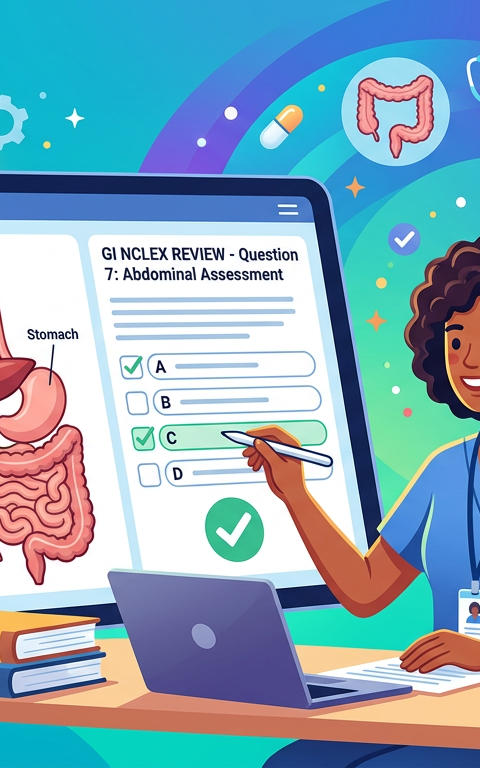
Gastrointestinal (GI) nursing care focuses on the assessment, diagnosis, and management of disorders affecting the digestive tract, ranging from the esophagus to the rectum, as well as accessory organs like the liver and pancreas. Understanding these conditions requires a firm grasp of fluid and electrolyte balance, nutritional support, and surgical interventions. In the context of the NCLEX, candidates must prioritize interventions based on the risk of complications such as perforation, hemorrhage, or malnutrition. Mastery of NCLEX GI practice questions involves recognizing clinical cues like rebound tenderness, which may indicate peritonitis, or assessing the patency of a nasogastric (NG) tube. Nurses play a critical role in managing chronic conditions like Crohn’s disease and acute emergencies like intestinal obstruction. Success on the exam depends on applying the nursing process to maintain airway patency during vomiting, monitoring intake and output, and educating patients on dietary modifications for conditions like GERD or Celiac disease.
Solved Examples
- A client with acute pancreatitis is admitted to the unit. Which provider order should the nurse implement first?
- Start an IV infusion of 0.9% Normal Saline at 125 mL/hr.
- Administer Hydromorphone 0.5 mg IV push every 4 hours as needed for pain.
- Maintain NPO (nothing by mouth) status.
- Insert a nasogastric (NG) tube to low intermittent suction.
- The correct answer is 3. Maintaining NPO status is the priority to stop the stimulation of pancreatic enzymes, which are causing autodigestion and inflammation.
- While pain management (Option 2) and hydration (Option 1) are essential, the underlying pathophysiology is driven by enzyme release triggered by oral intake.
- NG tube insertion (Option 4) is used if the client has persistent vomiting or paralytic ileus but follows the NPO order.
- The nurse is caring for a client 4 hours post-colonoscopy. Which finding requires immediate notification of the healthcare provider?
- Abdominal cramping and flatulence.
- A small amount of bright red blood on the toilet tissue after the first bowel movement.
- A blood pressure of 90/54 mmHg and a heart rate of 112 bpm.
- Groggy appearance and report of a "dry mouth."
- The correct answer is 3. Hypotension and tachycardia are signs of potential hemorrhage or perforation, which are serious complications of a colonoscopy.
- Cramping and gas (Option 1) are expected due to the air instilled during the procedure.
- Minor spotting (Option 2) can occur if a biopsy was taken.
- Groginess (Option 4) is expected post-sedation.
- A nurse is teaching a client with Gastroesophageal Reflux Disease (GERD) about lifestyle modifications. Which statement by the client indicates a need for further teaching?
- "I will wait at least 3 hours after eating before I lie down."
- "I should stop smoking to help reduce my symptoms."
- "I will eat three large meals a day to keep my stomach full."
- "I will sleep with the head of my bed elevated on blocks."
- The correct answer is 3. Clients with GERD should eat small, frequent meals rather than large ones to prevent gastric distention, which increases reflux risk.
- Waiting 3 hours (Option 1), smoking cessation (Option 2), and HOB elevation (Option 4) are all correct interventions for GERD.
Practice Questions
1. A client with cirrhosis is prescribed lactulose. Which assessment finding indicates that the medication has achieved the desired therapeutic effect?
2. The nurse is preparing to administer a tube feeding via a Percutaneous Endoscopic Gastrostomy (PEG) tube. What is the priority nursing action before starting the infusion?
3. A client is admitted with a suspected small bowel obstruction. Which clinical manifestation should the nurse expect to find during the assessment?
Train under NCLEX-style pressure.
Use timed NCLEX practice questions and adaptive quizzes to improve speed, accuracy, and confidence.
Start Timed Practice4. The nurse is providing discharge instructions to a client with a new ileostomy. Which statement by the client shows an understanding of the dietary requirements?
5. A client with a history of peptic ulcer disease presents with sudden, severe upper abdominal pain that radiates to the shoulder. The nurse notes a rigid, board-like abdomen. What is the nurse's priority action?
6. While assessing a client with ulcerative colitis, the nurse should be most concerned by which of the following findings?
7. A nurse is caring for a client who is receiving total parenteral nutrition (TPN). The TPN bag is empty, and the next bag is not yet available from the pharmacy. Which IV fluid should the nurse hang in the meantime?
8. The nurse is monitoring a client with Cholecystitis. Which finding indicates that the bile duct is likely obstructed?
Answers & Explanations
- Answer: Improved mental status/decreased confusion. Lactulose is given in cirrhosis to reduce serum ammonia levels by trapping ammonia in the gut and expelling it via laxative effects. Since high ammonia leads to hepatic encephalopathy, improved cognition is the goal. For more on managing complex metabolic needs, see our NCLEX endocrine practice questions.
- Answer: Verify tube placement and check gastric residual volume. Ensuring the tube is in the stomach and checking residuals prevents aspiration and assesses for delayed gastric emptying. If you are also studying calculations for these infusions, check out the medium NCLEX dosage calculation practice questions.
- Answer: Projectile vomiting and abdominal distention. Small bowel obstructions typically present with rapid onset of nausea, vomiting, and colicky abdominal pain. You can use the AI Question Generator to practice more on bowel sounds and obstructions.
- Answer: "I will drink at least 2 to 3 liters of fluid daily." An ileostomy involves the removal of the large intestine, where most water absorption occurs. Clients are at high risk for dehydration and must maintain high fluid intake.
- Answer: Notify the healthcare provider immediately and prepare for emergency surgery. These are classic signs of perforation and peritonitis, a life-threatening emergency. This requires the same level of urgency as a neurological emergency, which you can study in our NCLEX neurology practice questions.
- Answer: Abdominal distention and fever. These may indicate toxic megacolon, a life-threatening complication of ulcerative colitis where the colon becomes paralyzed and dilates.
- Answer: 10% Dextrose in Water (D10W). TPN contains high concentrations of glucose. If it is stopped abruptly, the client is at risk for rebound hypoglycemia. D10W provides enough glucose to maintain blood sugar levels until the new bag arrives.
- Answer: Clay-colored stools and dark urine. When the common bile duct is obstructed, bile cannot reach the intestines to color the stool brown, and excess bilirubin is excreted by the kidneys, darkening the urine. This is often seen alongside other systemic issues, similar to those found in NCLEX renal practice questions.
1. A client with Crohn's disease is experiencing an acute exacerbation. Which diet is most appropriate?
Frequently Asked Questions
What are the primary signs of peritonitis on the NCLEX?
Peritonitis is characterized by a rigid, board-like abdomen, severe pain, and rebound tenderness. According to the National Institute of Diabetes and Digestive and Kidney Diseases, this condition is a medical emergency often resulting from a perforated organ.
How do I differentiate between Ulcerative Colitis and Crohn’s Disease?
Ulcerative colitis typically affects the colon and rectum with continuous inflammation and bloody diarrhea. Crohn’s disease can occur anywhere in the GI tract, often features "skip lesions," and is more likely to cause fistulas and malabsorption.
What is the priority care for a client with an active GI bleed?
The priority is maintaining hemodynamic stability through IV fluid resuscitation and monitoring vital signs. Nurses must also ensure airway protection if the client is hematemetic and prepare for diagnostic endoscopy as noted by Mayo Clinic guidelines.
Why is TPN administered through a central line?
TPN is a hypertonic solution with a high glucose and amino acid content that can cause phlebitis and damage to small peripheral veins. Administering it through a central line with high blood flow prevents vessel irritation and allows for safer delivery of concentrated nutrients.
What is the significance of the dumping syndrome after gastric surgery?
Dumping syndrome occurs when high-osmolar food moves too quickly from the stomach into the small intestine, causing fluid shifts that lead to dizziness, sweating, and diarrhea. Management includes eating small meals, lying down after eating, and avoiding high-sugar foods as recommended by MedlinePlus.
Train under NCLEX-style pressure.
Use timed NCLEX practice questions and adaptive quizzes to improve speed, accuracy, and confidence.
Start Timed PracticeEnjoyed this article?
Share it with others who might find it helpful.
Related Articles

Hard NCLEX GI Practice Questions
Hard NCLEX GI Practice Questions
May 21, 2026
Easy NCLEX GI Practice Questions
Master the basics of gastrointestinal nursing with our Easy NCLEX GI Practice Questions, featuring solved examples, detailed explanations, and a quick quiz.
May 21, 2026

NCLEX GI Practice Questions with Answers
Master the Gastrointestinal section of the NCLEX with our comprehensive practice questions, detailed explanations, and clinical pearls for nursing students.
May 21, 2026

Hard NCLEX Prenatal Care Practice Questions
Hard NCLEX Prenatal Care Practice Questions
May 21, 2026

Medium NCLEX Prioritization Practice Questions
Medium NCLEX Prioritization Practice Questions
May 21, 2026

Medium NCLEX Pediatric Practice Questions
Medium NCLEX Pediatric Practice Questions
May 21, 2026

Hard NCLEX Mixed Medication Practice Questions
Master high-difficulty NCLEX mixed medication questions with our comprehensive guide featuring solved examples, practice questions, and expert explanations.
May 21, 2026

Hard NCLEX Mixed SATA Practice Questions
Hard NCLEX Mixed SATA Practice Questions
May 21, 2026