Medium Metabolism Questions Practice Questions
Concept Explanation
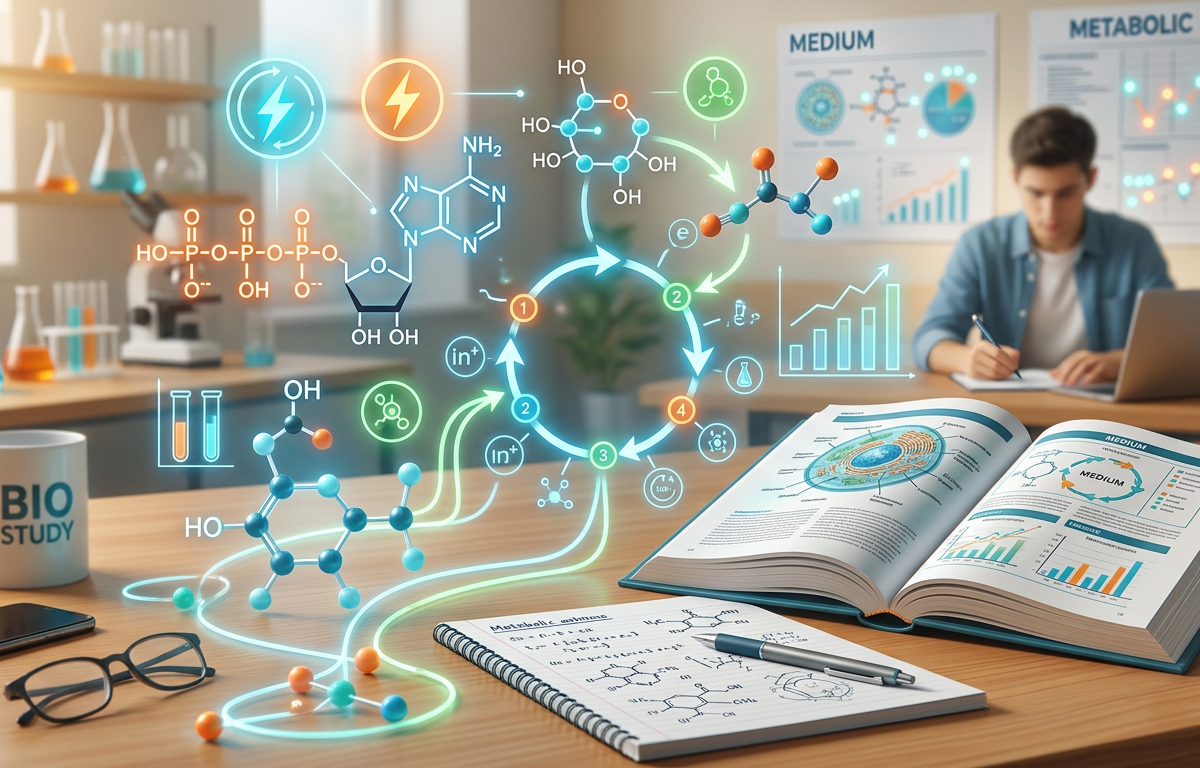
Metabolism is the sum of all chemical reactions that occur within a living organism to maintain life, encompassing both the breakdown of molecules to obtain energy and the synthesis of compounds needed by cells. These biochemical pathways are categorized into catabolism, which releases energy by breaking down complex organic substances like glucose, and anabolism, which uses energy to construct components such as proteins and nucleic acids.
Understanding these processes requires knowledge of enzyme kinetics, thermodynamics, and the specific pathways like glycolysis, the citric acid cycle, and oxidative phosphorylation. Just as we study medium organelles questions to understand cellular structure, metabolism explains the functional energy exchange that powers those structures. Key regulators include hormones like insulin and glucagon, as well as the energy-sensing molecule ATP, which acts as the universal energy currency. For a deeper look at the molecular machinery involved, you can explore resources from Khan Academy or the Nature Education Scitable.
Solved Examples
Calculating Net ATP from Glycolysis: Determine the net yield of ATP molecules when one molecule of glucose is converted into two molecules of pyruvate.
Identify the investment phase: 2 ATP molecules are consumed to phosphorylate glucose and fructose-6-phosphate.
Identify the payoff phase: 4 ATP molecules are produced via substrate-level phosphorylation.
Calculate the net gain: 4 ATP (produced) - 2 ATP (invested) = 2 ATP net.
Identifying Redox Reactions: In the conversion of Pyruvate to Acetyl-CoA, identify which molecule is oxidized and which is reduced.
Observe the reactants: Pyruvate and NAD+.
Identify electron transfer: Pyruvate loses electrons (and a carboxyl group as CO2) to become Acetyl-CoA.
Identify the carrier: NAD+ gains electrons and a proton to become NADH.
Conclusion: Pyruvate is oxidized, and NAD+ is reduced.
Enzyme Inhibition Analysis: If a competitive inhibitor is added to a metabolic reaction, how does it affect the Km and Vmax?
Define competitive inhibition: The inhibitor binds to the active site, competing with the substrate.
Analyze Vmax: With enough substrate, the inhibitor can be outcompeted, so the maximum velocity (Vmax) remains unchanged.
Analyze Km: More substrate is required to reach half of Vmax, so the Michaelis constant (Km) increases.
Practice Questions
Which metabolic pathway occurs in the cytosol of every living cell and does not require oxygen?
During the Citric Acid Cycle (Krebs Cycle), how many molecules of CO2 are released per single turn of the cycle?
Explain the role of Phosphofructokinase-1 (PFK-1) as a rate-limiting enzyme and name one allosteric inhibitor of this enzyme.
Start Learning Smarter Today
Join thousands of students using AI-powered study tools to achieve better results.
Get Started FreeIn oxidative phosphorylation, what is the final electron acceptor at the end of the electron transport chain?
How does the process of gluconeogenesis differ from the simple reversal of glycolysis?
What is the primary purpose of the Pentose Phosphate Pathway in rapidly dividing cells?
Describe the "chemiosmotic coupling" mechanism used by ATP synthase to produce ATP.
Compare the energy yield of Beta-oxidation for a 16-carbon fatty acid versus the oxidation of one glucose molecule.
Which hormone predominates during the post-absorptive (fasting) state to stimulate glycogenolysis in the liver?
Identify the specific mitochondrial compartment where the Citric Acid Cycle enzymes are located.
Answers & Explanations
Glycolysis: This pathway is universal because it occurs in the cytoplasm and functions under both aerobic and anaerobic conditions. It breaks glucose down into pyruvate, providing a base for further energy extraction.
Two molecules of CO2: During one turn of the Citric Acid Cycle, two carbons enter as Acetyl-CoA and two carbons are released as CO2 during the decarboxylation steps (Isocitrate to alpha-ketoglutarate and alpha-ketoglutarate to Succinyl-CoA).
PFK-1: This enzyme catalyzes the phosphorylation of fructose-6-phosphate. It is the key regulatory step of glycolysis. High levels of ATP or Citrate act as allosteric inhibitors, signaling that the cell has sufficient energy and should slow down glucose breakdown.
Oxygen (O2): Oxygen acts as the final electron acceptor, combining with electrons and protons to form water (H2O). Without oxygen, the electron transport chain stalls.
Bypassing Irreversible Steps: Gluconeogenesis is not a direct reversal because glycolysis has three irreversible steps (hexokinase, PFK-1, and pyruvate kinase). Gluconeogenesis uses unique enzymes like Pyruvate Carboxylase and Glucose-6-Phosphatase to bypass these barriers.
NADPH and Ribose-5-phosphate: The pathway provides NADPH for reductive biosynthesis (like fatty acid synthesis) and Ribose-5-phosphate, which is essential for nucleotide synthesis in dividing cells.
Proton Gradient: The electron transport chain pumps protons into the intermembrane space, creating a gradient. As protons flow back into the matrix through ATP synthase, the mechanical energy of their flow drives the phosphorylation of ADP to ATP.
Fatty Acids yield more energy: A 16-carbon fatty acid (Palmitate) yields approximately 106-108 ATP, whereas one glucose molecule (6 carbons) yields about 30-32 ATP. Fats are more reduced and thus contain more chemical energy per carbon.
Glucagon: Produced by the alpha cells of the pancreas, glucagon signals the liver to break down glycogen into glucose to maintain blood sugar levels during fasting.
Mitochondrial Matrix: Unlike the electron transport chain located in the inner membrane, the enzymes for the Citric Acid Cycle are dissolved within the matrix, the innermost aqueous compartment of the mitochondria.
1. Which molecule acts as the "spent" version of the primary energy currency in the cell?
Frequently Asked Questions
What is the difference between aerobic and anaerobic metabolism?
Aerobic metabolism requires oxygen to produce energy through the citric acid cycle and oxidative phosphorylation, yielding a high amount of ATP. Anaerobic metabolism occurs without oxygen, relying on glycolysis and fermentation to produce a much smaller amount of ATP quickly.
Why is ATP called the energy currency of the cell?
ATP is called the energy currency because it stores energy in high-energy phosphate bonds that can be easily broken to power various cellular activities. Its structure allows it to be readily recycled from ADP, making it a versatile and efficient medium for energy transfer.
How do enzymes affect metabolic reactions?
Enzymes act as biological catalysts that speed up metabolic reactions by lowering the activation energy required for the reaction to proceed. They are highly specific, meaning each enzyme typically interacts with only one type of substrate to facilitate a specific chemical change.
What happens to metabolism during exercise?
During exercise, the metabolic rate increases significantly to meet the higher demand for ATP in muscle cells. The body initially uses stored ATP and creatine phosphate, then transitions to anaerobic glycolysis and eventually aerobic respiration of glucose and fatty acids. Understanding this transition is as vital as knowing cardiovascular system questions for fitness science.
What is the role of NADH and FADH2 in cellular respiration?
NADH and FADH2 act as electron carriers that transport high-energy electrons from the breakdown of glucose and fats to the electron transport chain. These electrons are then used to create a proton gradient that drives the mass production of ATP. This molecular transport is a key component of organ system questions regarding metabolic health.
Start Learning Smarter Today
Join thousands of students using AI-powered study tools to achieve better results.
Get Started FreeEnjoyed this article?
Share it with others who might find it helpful.
Related Articles
Hard Le Chatelier’s Principle Practice Questions
Master Hard Le Chatelier’s Principle Practice Questions with our comprehensive guide featuring solved examples, practice problems, and detailed explanations.
Mar 30, 2026
Hard Reaction Quotient (Q) Practice Questions
Hard Reaction Quotient (Q) Practice Questions
Mar 30, 2026
Grams to Moles Practice Questions with Answers
Master grams to moles conversions with our comprehensive guide. Includes step-by-step examples, practice questions, and detailed answers for chemistry students.
Mar 26, 2026
Avogadro’s Number Practice Questions with Answers
Master the mole concept with our Avogadro’s Number practice questions. Includes step-by-step solved examples, a quick quiz, and detailed explanations.
Mar 26, 2026
Empirical Formulas: Solving Ratios from Mass and Percent Data
Master empirical formula calculations with 10 practice questions, worked answers, and a free step-by-step calculator for mass, percentage, and combustion problems.
Mar 26, 2026