Medium Le Chatelier’s Principle Practice Questions
Concept Explanation
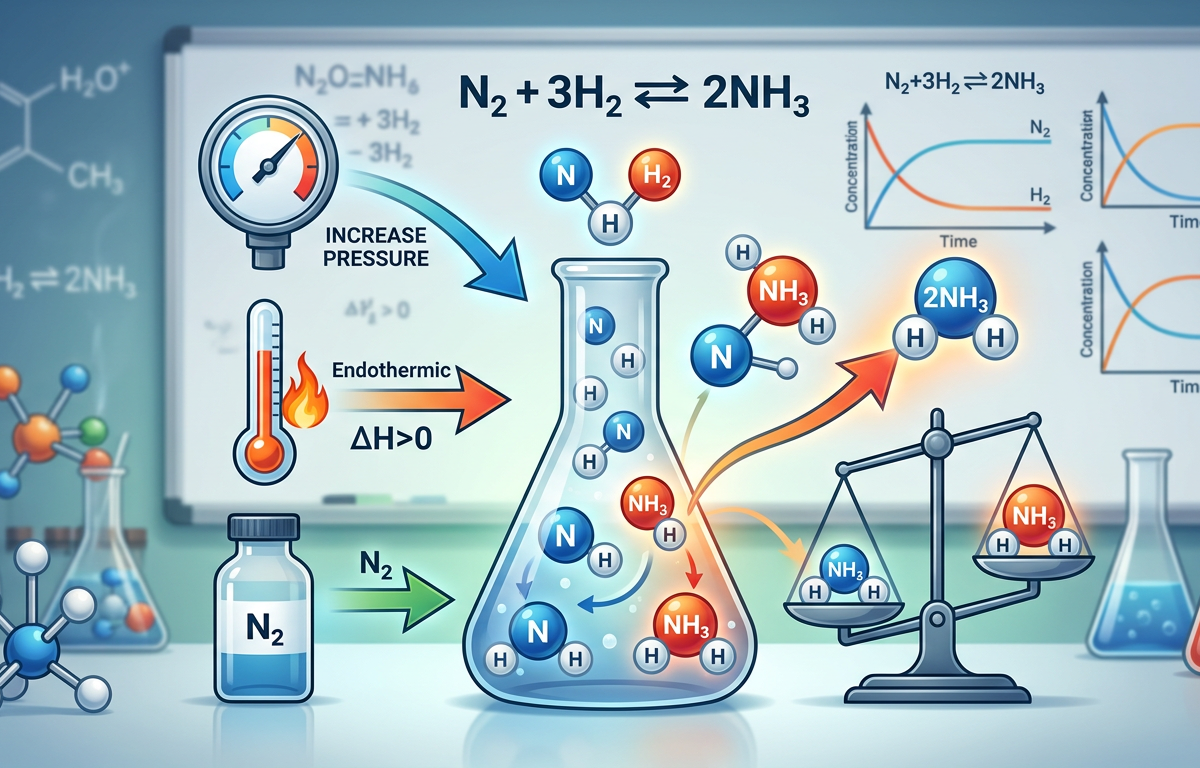
Le Chatelier’s Principle states that if a dynamic equilibrium is disturbed by changing the conditions, the position of equilibrium moves to counteract the change. This fundamental rule in chemistry allows us to predict how a chemical system will respond to changes in concentration, temperature, or pressure. When a stress is applied to a system at equilibrium, the system adjusts itself to minimize that stress and reach a new state of equilibrium.
To master Medium Le Chatelier’s Principle Practice Questions, you must understand the three primary types of disturbances:
Concentration: Adding a reactant or removing a product shifts the equilibrium toward the side that consumes the added substance or replaces the removed one.
Pressure/Volume: Increasing pressure (decreasing volume) shifts the equilibrium toward the side with fewer moles of gas. Decreasing pressure shifts it toward the side with more gaseous moles.
Temperature: For an exothermic reaction (heat is a product), increasing temperature shifts the equilibrium to the left. For an endothermic reaction (heat is a reactant), increasing temperature shifts it to the right.
It is also important to remember that adding a catalyst increases the rate of both the forward and reverse reactions equally, meaning it has no effect on the position of equilibrium. For more advanced thermodynamic concepts, you might also be interested in Medium Enthalpy Change Practice Questions to see how energy relates to chemical stability. Organizations like the American Chemical Society provide extensive resources on these chemical foundations.
Solved Examples
Example 1: Concentration Changes
Consider the reaction: . What happens if more is added?
Identify the stress: Concentration of a reactant () is increased.
Apply the principle: The system will try to decrease the concentration of .
Determine the shift: The reaction shifts to the right (products) to consume the extra hydrogen.
Result: More is produced.
Example 2: Temperature and Exothermic Reactions
The reaction $2SO_{2}(g) + O_{2}(g) \rightleftharpoons 2SO_{3}(g)$ has a $\Delta H = -198 \text{ kJ/mol}$. How does increasing the temperature affect the yield of ?
Identify the reaction type: is negative, so the reaction is exothermic. Heat is a product.
Identify the stress: Temperature is increased (adding heat).
Apply the principle: The system shifts to the left to absorb the excess heat.
Result: The yield of decreases as the equilibrium shifts toward the reactants.
Example 3: Pressure and Volume
For the equilibrium , what is the effect of decreasing the volume of the container?
Count gaseous moles: Reactants = 1 mole; Products = 2 moles.
Identify the stress: Decreasing volume increases the total pressure.
Apply the principle: The system shifts toward the side with fewer moles of gas to reduce pressure.
Result: The equilibrium shifts to the left (toward ).
Practice Questions
Consider the endothermic reaction: . If the temperature is increased, in which direction will the equilibrium shift?
In the system $2NO_{2}(g) \rightleftharpoons N_{2}O_{4}(g)$, the forward reaction is exothermic. If the container is cooled, what happens to the concentration of ?
For the reaction , what is the effect of adding a catalyst on the equilibrium position?
Start Learning Smarter Today
Join thousands of students using AI-powered study tools to achieve better results.
Get Started Free
Start Learning Smarter Today
Join thousands of students using AI-powered study tools to achieve better results.
Get Started FreeThe decomposition of nitrosyl chloride occurs as follows: $2NOCl(g) \rightleftharpoons 2NO(g) + Cl_{2}(g)$. How will the equilibrium shift if the pressure is increased by injecting an inert gas like Argon at constant volume?
In the reaction , if $HI$ is continuously removed from the system, how does the rate of the forward reaction change initially?
Consider , where . If the volume is doubled and the temperature is decreased simultaneously, can we definitively predict the direction of the shift?
For the aqueous equilibrium , what happens to the color intensity (red) if $NaOH$ is added, causing to precipitate?
In the Haber process, , why is a high pressure used industrially despite the costs?
How does the value of the equilibrium constant () change for an endothermic reaction when the temperature is decreased?
Given , what is the effect of adding more solid carbon to the equilibrium mixture?
Answers & Explanations
Right (Products): Since the reaction is endothermic, heat acts as a reactant. Increasing temperature drives the reaction to consume that heat, favoring the formation of $CaO$ and .
Decreases: Cooling an exothermic reaction removes heat (a product). The system shifts right to produce more heat, consuming in the process.
No Effect: A catalyst speeds up both the forward and reverse reactions equally. It helps reach equilibrium faster but does not change the concentrations of species at equilibrium.
No Shift: Adding an inert gas at constant volume increases total pressure but does not change the partial pressures of the reacting gases. Therefore, the equilibrium position remains unchanged.
Shifts Right: Removing a product ($HI$) creates a stress that the system counteracts by shifting to the right to produce more $HI$.
Indeterminate without specific values: Increasing volume (decreasing pressure) shifts the reaction to the side with more moles (right). Decreasing temperature for an endothermic reaction shifts it to the left. These two stresses oppose each other.
Decreases: Precipitating removes a reactant from the solution. The equilibrium shifts left to replace the , reducing the concentration of the red complex.
Increases Yield: There are 4 moles of gas on the reactant side and 2 moles on the product side. High pressure shifts the equilibrium to the right, maximizing production according to Le Chatelier's Principle.
Decreases: For endothermic reactions, temperature and $K$ are directly proportional. Decreasing temperature shifts the equilibrium toward the reactants, making the denominator of the $K$ expression larger and the numerator smaller.
No Effect: Carbon is a pure solid. Changing the amount of a pure solid or liquid does not change its \"concentration\" or activity in the equilibrium expression, so the position of equilibrium does not shift. If you are studying energy changes in such reactions, check out Medium Heat of Reaction Practice Questions.
1. Which of the following will change the value of the equilibrium constant (K)?
Frequently Asked Questions
What does Le Chatelier’s Principle predict?
It predicts the qualitative direction in which a chemical equilibrium will shift when subjected to a change in concentration, temperature, or pressure. It helps chemists optimize conditions to maximize the yield of a desired product in industrial processes.
Does a catalyst affect the equilibrium position?
No, a catalyst does not change the position of equilibrium or the value of the equilibrium constant. It only decreases the time required for the system to reach equilibrium by lowering the activation energy for both forward and reverse reactions.
Why does temperature change the equilibrium constant?
Temperature is the only factor that changes the equilibrium constant because it alters the kinetic energy of the molecules and the ratio of the rate constants for the forward and reverse reactions. This is explained further in the LibreTexts Chemistry archives.
How do solids and liquids affect equilibrium shifts?
Pure solids and liquids have constant concentrations and are not included in the equilibrium constant expression. Adding or removing them does not cause a shift in the equilibrium position, provided some amount of the substance remains present.
What happens if you add an inert gas at constant volume?
Adding an inert gas at constant volume increases the total pressure but does not change the partial pressures of the reacting species. Since the frequency of successful collisions between reactants remains the same, the equilibrium position does not shift.
Can Le Chatelier's Principle be applied to physical changes?
Yes, it applies to physical equilibria such as phase changes. For example, increasing pressure on a mixture of ice and water shifts the equilibrium toward the liquid phase because water is denser than ice. You can explore similar energy-related shifts in Medium Calorimetry Practice Questions.
Start Learning Smarter Today
Join thousands of students using AI-powered study tools to achieve better results.
Get Started FreeEnjoyed this article?
Share it with others who might find it helpful.
Related Articles
Hard Le Chatelier’s Principle Practice Questions
Master Hard Le Chatelier’s Principle Practice Questions with our comprehensive guide featuring solved examples, practice problems, and detailed explanations.
Mar 30, 2026
Hard Reaction Quotient (Q) Practice Questions
Hard Reaction Quotient (Q) Practice Questions
Mar 30, 2026
Grams to Moles Practice Questions with Answers
Master grams to moles conversions with our comprehensive guide. Includes step-by-step examples, practice questions, and detailed answers for chemistry students.
Mar 26, 2026
Avogadro’s Number Practice Questions with Answers
Master the mole concept with our Avogadro’s Number practice questions. Includes step-by-step solved examples, a quick quiz, and detailed explanations.
Mar 26, 2026
Empirical Formulas: Solving Ratios from Mass and Percent Data
Master empirical formula calculations with 10 practice questions, worked answers, and a free step-by-step calculator for mass, percentage, and combustion problems.
Mar 26, 2026