Medium Cell Potential Calculations Practice Questions
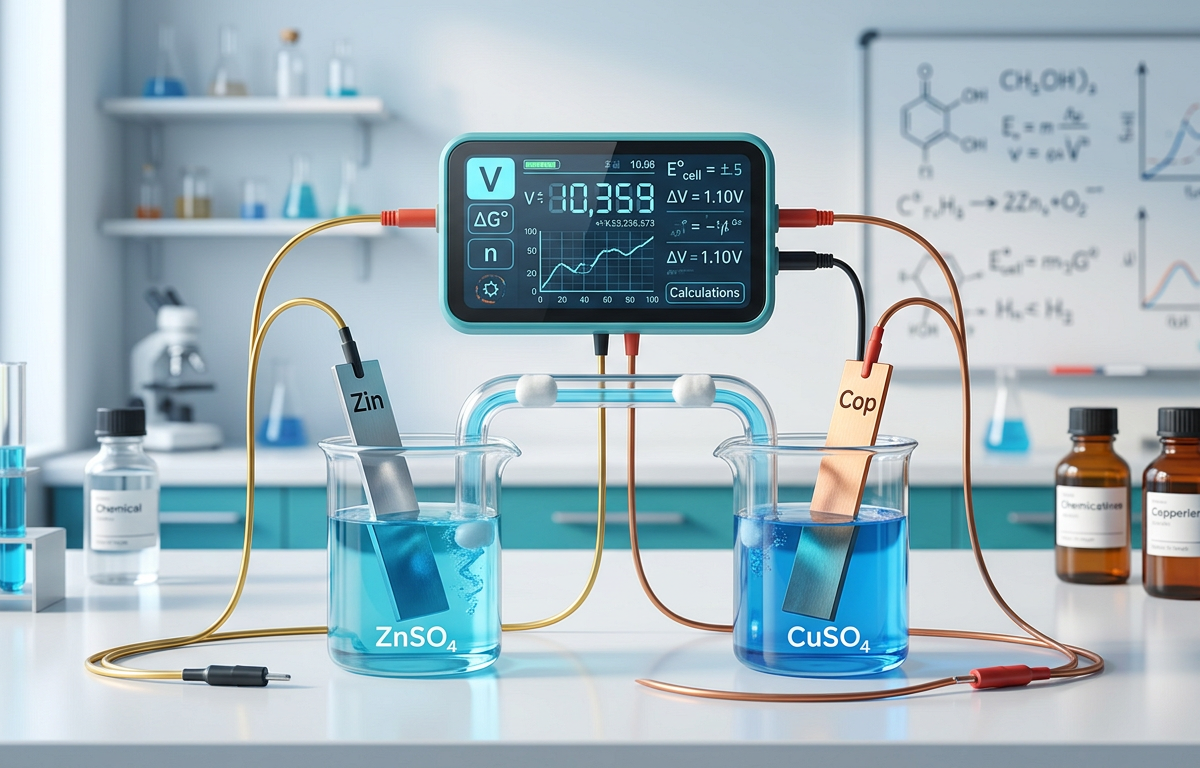
Concept Explanation
Cell potential, often referred to as electromotive force (EMF), is the measure of the potential difference between two half-cells in an electrochemical cell. This value represents the driving force that pushes electrons through an external circuit, moving from the anode to the cathode. To calculate the standard cell potential (), scientists use standard reduction potentials measured at 25°C, 1 atm, and 1 M concentration. The fundamental formula is , where both values are expressed as reduction potentials. A positive indicates a spontaneous reaction under standard conditions, which is essential for the operation of batteries and fuel cells.
Understanding these calculations requires a firm grasp of redox reaction practice questions, as you must correctly identify which species is being oxidized and which is being reduced. The cathode is the site of reduction (gain of electrons), while the anode is the site of oxidation (loss of electrons). Standard reduction potentials are typically found in reference tables provided by organizations like the International Union of Pure and Applied Chemistry (IUPAC). When conditions deviate from the standard 1.0 M concentration, the Nernst Equation practice questions become relevant to determine the non-standard cell potential ().
Solved Examples
Calculating Standard Cell Potential for a Zn-Cu Cell: Calculate the for a cell where Zinc is oxidized and Copper (II) ions are reduced. Given: and .
Identify the cathode and anode. Reduction occurs at the cathode (), and oxidation occurs at the anode ().
Apply the formula: .
Substitute values: .
Calculate the final result: .
Determining Spontaneity: Will a reaction between and $Fe$ occur spontaneously under standard conditions? Given: and .
Set up the potential reaction: $2Ag^+ + Fe \rightarrow 2Ag + Fe^{2+}$.
Identify components: is reduced (cathode), $Fe$ is oxidized (anode).
Calculate potential: .
Conclusion: Since is positive, the reaction is spontaneous.
Calculating Potential with Stoichiometry: Find the for the reaction: $3Mg(s) + 2Al^{3+}(aq) \rightarrow 3Mg^{2+}(aq) + 2Al(s)$. Given: and .
Identify the reduction: (Cathode).
Identify the oxidation: (Anode).
Apply the formula: .
Result: . Note: We do not multiply the potentials by stoichiometric coefficients.
Practice Questions
1. Calculate the standard cell potential for a voltaic cell consisting of a half-cell and a half-cell. (, )
2. A galvanic cell is constructed using Aluminum and Lead electrodes. Determine the and identify which electrode is the cathode. (, )
3. Calculate the standard potential for the following reaction: . (, )
Want unlimited practice questions like these?
Generate AI-powered questions with step-by-step solutions on any topic.
Try Question Generator Free →4. Determine if the following reaction is spontaneous under standard conditions: . (, )
5. Calculate for the reaction $2Au^{3+}(aq) + 3Ca(s) \rightarrow 2Au(s) + 3Ca^{2+}(aq)$. (, )
6. In a standard Hydrogen electrode (SHE) setup combined with a Silver electrode, the cell potential is measured at 0.80 V. If Silver is being reduced, what is the for the half-reaction?
7. Calculate the for: . (, )
8. What is the standard cell potential for a cell employing the and couples? (, )
9. A cell has a standard potential of 0.46 V. If the cathode is (), what is the standard reduction potential of the anode half-reaction?
10. Predict whether can oxidize to under standard conditions. (, )
Answers & Explanations
1. 0.60 V. The couple has the higher reduction potential (-0.14 V vs -0.74 V), so it is the cathode. . This process is spontaneous.
2. 1.53 V; Lead is the cathode. Reduction occurs at the electrode with the more positive (less negative) potential. .
3. 0.29 V. Chlorine is reduced (cathode) and Bromide is oxidized (anode). . Refer to Wikipedia's standard electrode potential data for more values.
4. Spontaneous (+0.15 V). . A positive value confirms spontaneity.
5. 4.37 V. . Though the coefficients are large, they do not affect the voltage of the half-cells.
6. 0.80 V. . Since SHE is the anode (0.00 V), $0.80 = E^\circ_{Ag} - 0.00$. Thus, .
7. 0.74 V. Permanganate is reduced at the cathode, and is oxidized at the anode. . Mastering this requires balancing redox practice questions skills to ensure electron counts match.
8. 5.92 V. Fluorine is the strongest oxidizing agent and Lithium is the strongest reducing agent in this pair. .
9. -0.12 V. . $0.46 = 0.34 - E^\circ_{anode}$. Solving for gives .
10. No. For to oxidize , must be the cathode and the anode. . A negative potential means the reaction is non-spontaneous.
1. Which of the following conditions is NOT part of standard state for cell potential?
Frequently Asked Questions
What is the difference between E and E° in electrochemistry?
E° represents the cell potential under standard conditions (1 M, 1 atm, 25°C), while E represents the potential under any other non-standard conditions. You calculate E using the Nernst equation based on the reaction quotient and temperature.
Why don't we multiply E° values by stoichiometric coefficients?
Cell potential is an intensive property, meaning it does not depend on the amount of substance present. It represents the energy per unit charge, so increasing the number of electrons transferred does not change the voltage itself.
How do you identify the cathode in a table of reduction potentials?
In a spontaneous galvanic cell, the half-reaction with the more positive (higher) standard reduction potential will act as the cathode. The species with the lower potential will be forced to undergo oxidation at the anode.
What is the role of the salt bridge in a galvanic cell?
The salt bridge maintains electrical neutrality by allowing ions to flow between the two half-cells. This prevents the buildup of charge that would otherwise stop the flow of electrons and halt the reaction.
Can a cell potential be measured for a single half-cell?
No, it is impossible to measure the absolute potential of an isolated half-cell because a circuit must be completed to measure voltage. All potentials are measured relative to the Standard Hydrogen Electrode (SHE), which is assigned a value of 0.00 V.
Want unlimited practice questions like these?
Generate AI-powered questions with step-by-step solutions on any topic.
Try Question Generator Free →
Want unlimited practice questions like these?
Generate AI-powered questions with step-by-step solutions on any topic.
Try Question Generator Free →Enjoyed this article?
Share it with others who might find it helpful.
Related Articles

Hard Cell Potential Calculations Practice Questions
Master hard cell potential calculations with this comprehensive guide. Includes Nernst equation problems, solved examples, and advanced practice questions.
Apr 4, 2026

Easy Cell Potential Calculations Practice Questions
Master easy cell potential calculations with our guide. Learn the E°cell = E°cathode - E°anode formula through solved examples and practice questions.
Apr 4, 2026

Medium Cell Membrane Questions Practice Questions
Medium Cell Membrane Questions Practice Questions
Apr 25, 2026
Hard Cell Membrane Questions Practice Questions
Master advanced cell biology with our hard cell membrane practice questions. Test your knowledge on electrochemical gradients, transport mechanisms, and more.
Apr 25, 2026

Hard Cell Structure Practice Questions Practice Questions
Challenge your understanding of cell biology with these hard cell structure practice questions, complete with solved examples, detailed answers, and a quick quiz.
Apr 25, 2026
Medium Cell Transport Problems Practice Questions
Master cell transport with our practice problems. This guide covers water potential, tonicity, and osmosis to help you solve medium-difficulty biology questions.
Apr 25, 2026

Medium Cell Structure Practice Questions Practice Questions
Master cell biology with these medium cell structure practice questions. Get detailed explanations and solved examples to boost your understanding.
Apr 25, 2026

Easy Cell Transport Problems Practice Questions
Master the fundamentals of cell biology with our easy cell transport problems. This guide includes clear explanations, solved examples, and practice questions on osmosis and tonicity.
Apr 25, 2026