Medium Anatomy Practice Questions Practice Questions
Concept Explanation
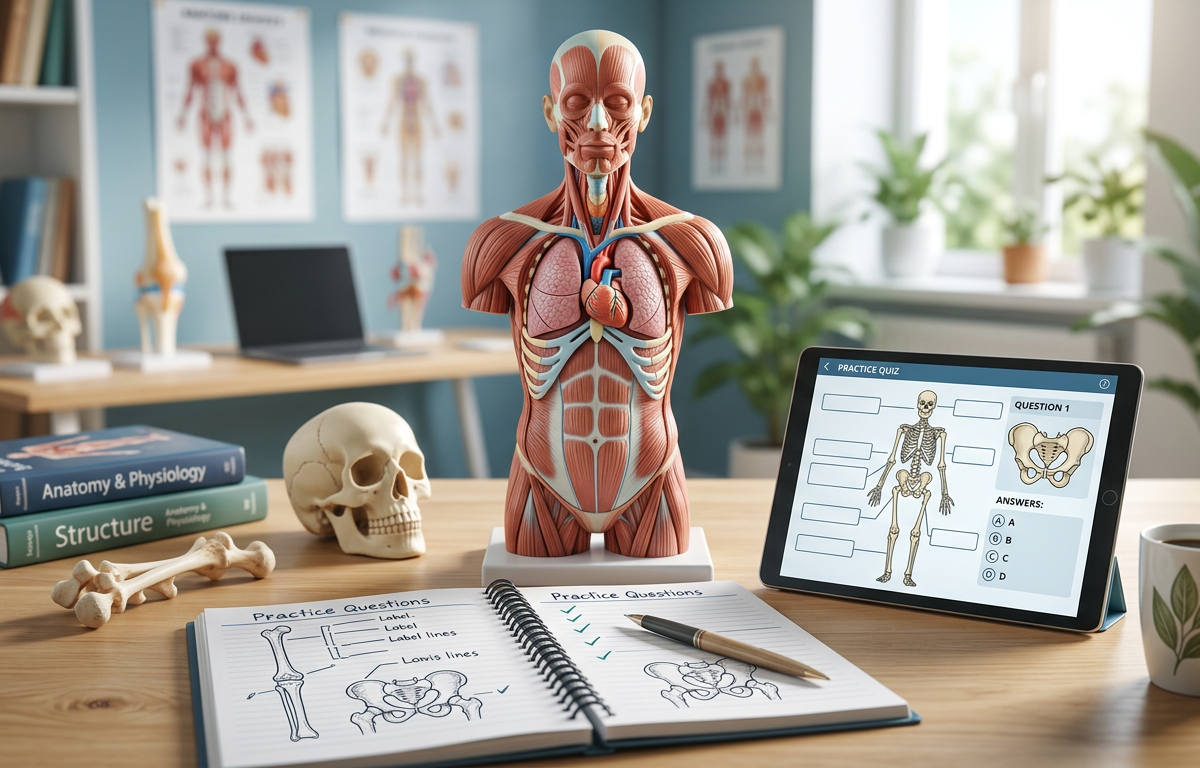
Anatomy is the scientific study of the structure of organisms and their parts, focusing on the identification and description of the physical body components. While basic anatomy involves learning simple bone names or organ locations, Medium Anatomy Practice Questions require an understanding of how these structures relate to one another spatially and functionally within the human body.
This level of study bridges the gap between simple identification and the complex physiological interactions found in our Organ System Questions Practice Questions with Answers. To master medium-level anatomy, students must be familiar with anatomical terminology (such as proximal, distal, medial, and lateral), the classification of tissues, and the specific landmarks of the skeletal and muscular systems. According to the National Archives and various medical educational standards, a firm grasp of human structural organization is essential for any clinical or biological career. Understanding anatomy also involves recognizing the microscopic structures that support life, which you can explore further in our Medium Cell Structure Practice Questions.
Solved Examples
Question: Identify the correct sequence of the vertebral column regions from superior to inferior and state the number of vertebrae in each.
Solution:Cervical: 7 vertebrae (located in the neck).
Thoracic: 12 vertebrae (associated with the ribs).
Lumbar: 5 vertebrae (lower back).
Sacral: 5 fused vertebrae (forming the sacrum).
Coccygeal: 4 fused vertebrae (the tailbone).
Question: Describe the anatomical position of the kidneys relative to the peritoneum and the spinal column.
Solution:The kidneys are "retroperitoneal," meaning they are located behind the peritoneum.
They are situated on either side of the vertebral column between the T12 and L3 vertebrae.
The right kidney is usually slightly lower than the left because of the space occupied by the liver.
Question: Explain the layers of the heart wall from the outermost to the innermost layer.
Solution:Epicardium: The visceral layer of the serous pericardium.
Myocardium: The thick middle layer composed of cardiac muscle tissue.
Endocardium: The smooth inner lining of the heart chambers and valves.
Practice Questions
1. Which specific type of epithelial tissue lines the urinary bladder and allows for distension?
2. Name the three bones that fuse together to form the coxal (hip) bone in an adult.
3. In the forearm, which bone is located laterally when the body is in the standard anatomical position?
Start Learning Smarter Today
Join thousands of students using AI-powered study tools to achieve better results.
Get Started Free
Start Learning Smarter Today
Join thousands of students using AI-powered study tools to achieve better results.
Get Started Free4. Which cranial nerve is responsible for transmitting visual information from the retina to the brain?
5. Identify the structure that separates the thoracic cavity from the abdominal cavity and serves as the primary muscle of respiration.
6. What are the four primary tissue types found in the human body?
7. Which specific part of the neuron receives incoming signals from other neurons?
8. List the three parts of the small intestine in the order that food passes through them.
9. Which endocrine gland is located in the sella turcica of the sphenoid bone?
10. What is the name of the fibrous connective tissue that connects bone to bone?
Answers & Explanations
Transitional Epithelium: This specialized tissue is designed to stretch; its cells change shape (from cuboidal to flattened) as the bladder fills with urine.
Ilium, Ischium, and Pubis: These three separate bones in infants fuse completely by early adulthood to form the sturdy hip bone.
Radius: In the anatomical position (palms facing forward), the radius is on the thumb side (lateral), while the ulna is on the pinky side (medial).
Optic Nerve (Cranial Nerve II): This nerve carries sensory nerve impulses from the photoreceptors of the eye to the visual cortex.
Diaphragm: This dome-shaped muscle contracts to increase thoracic volume, facilitating inhalation.
Epithelial, Connective, Muscle, and Nervous: These categories encompass all the specialized cells and extracellular matrices in the body. For more on how these tissues form complex circuits, see our Nervous System Questions Practice Questions.
Dendrites: These branched projections act like antennas to pick up chemical signals from neighboring cells.
Duodenum, Jejunum, Ileum: Digestion begins primarily in the duodenum, while absorption continues through the jejunum and ileum.
Pituitary Gland: Often called the \"master gland,\" it sits in this bony depression at the base of the brain.
Ligament: Ligaments provide stability to joints by connecting bones, whereas tendons connect muscle to bone.
1. Which of the following is considered a "long bone" in the human body?
Frequently Asked Questions
What is the difference between gross anatomy and microscopic anatomy?
Gross anatomy involves the study of structures that can be seen with the naked eye, such as organs and bones. Microscopic anatomy, or histology, requires magnification to view cells and tissues, as detailed on Nature.com.
Why is the anatomical position important in medical study?
The anatomical position provides a consistent standard of reference for describing the location of body parts regardless of the patient's actual posture. It ensures that terms like \"superior\" or \"lateral\" have a universal meaning among healthcare professionals.
What are the three main planes of the body?
The three primary planes are the sagittal plane (dividing left and right), the frontal or coronal plane (dividing front and back), and the transverse or horizontal plane (dividing top and bottom). These planes help clinicians navigate 3D imaging like CT scans.
How do tendons and ligaments differ in function?
Tendons are tough bands of connective tissue that attach muscle to bone to facilitate movement. Ligaments are similar structures that attach bone to bone, primarily serving to stabilize joints and prevent excessive movement.
What constitutes the axial skeleton?
The axial skeleton forms the central axis of the body and includes the skull, vertebral column, and thoracic cage (ribs and sternum). It protects the vital organs of the head and torso, while the appendicular skeleton handles movement.
Start Learning Smarter Today
Join thousands of students using AI-powered study tools to achieve better results.
Get Started FreeEnjoyed this article?
Share it with others who might find it helpful.
Related Articles
Easy Anatomy Practice Questions Practice Questions
Easy Anatomy Practice Questions Practice Questions
Apr 25, 2026
Hard Anatomy Practice Questions Practice Questions
Master advanced human anatomy with our comprehensive guide featuring hard practice questions, detailed solved examples, and clinical correlations for medical students.
Apr 25, 2026
Anatomy Practice Questions Practice Questions with Answers
Anatomy Practice Questions Practice Questions with Answers
Apr 25, 2026
Hard Microbiology Practice Questions Practice Questions
Hard Microbiology Practice Questions Practice Questions
Apr 26, 2026

Medium Microbiology Practice Questions Practice Questions
Master microbiology with our medium-level practice questions covering bacterial growth, genetics, and metabolism. Includes solved examples and a quick quiz.
Apr 26, 2026

Easy Microbiology Practice Questions Practice Questions
Easy Microbiology Practice Questions Practice Questions
Apr 26, 2026

Hard Enzyme Questions Practice Questions
Master complex biochemistry with these hard enzyme questions. Cover Michaelis-Menten kinetics, inhibition types, and Lineweaver-Burk plots with solved examples.
Apr 26, 2026

Medium Enzyme Questions Practice Questions
Master enzyme kinetics and regulation with our Medium Enzyme Questions Practice Questions. Includes solved examples, detailed explanations, and a quick quiz.
Apr 26, 2026