Medium ACT Statistics Practice Questions

Mastering medium ACT statistics practice questions is essential for students aiming to score in the 25–30 range on the math section. Statistics on the ACT goes beyond simple averages; it requires a deep understanding of how data sets change when numbers are added, how weighted averages function, and the relationship between mean, median, and mode in various contexts.
To perform well, you must be comfortable with data interpretation and the logical application of statistical formulas. For a broader look at the math section, you can explore ACT Math Practice Questions with Answers to see how statistics fits into the overall exam structure. This guide will provide the rigorous practice needed to handle the multi-step statistics problems that frequently appear in the middle of the test.
Concept Explanation
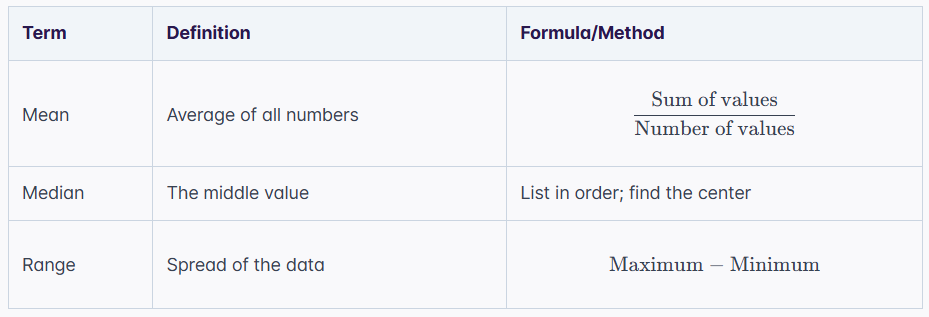
ACT statistics focuses on the measures of central tendency (mean, median, and mode) and measures of spread (range and standard deviation) within a set of data. The mean is the arithmetic average, calculated by dividing the sum of all terms by the number of terms. The median is the middle value when the data is ordered from least to greatest. If there is an even number of terms, the median is the average of the two middle terms. The mode is the value that appears most frequently. On medium-level questions, the ACT often tests how these values shift when a new data point is introduced or when a set is modified.
Another critical concept is the weighted average, where different groups contribute differently to the final mean based on their size. For example, if one class of 20 students has a certain average and another class of 30 students has a different average, you cannot simply average the two means; you must account for the total number of students. Understanding these nuances is a core part of comprehensive ACT Prep.
For more specific practice on logic-based math, check out ACT Word Problems Practice Questions with Answers, as many statistics questions are presented as narratives. You can also utilize an AI Question Generator to create additional sets of data for practice.
Solved Examples
These examples demonstrate how to approach multi-step statistics problems logically.
Example 1: Finding a Missing Value
A student has taken 4 tests and has an average score of 85. What score must the student earn on the 5th test to raise their overall average to 88?
Calculate the current total points: .
Calculate the required total points for 5 tests: .
Subtract the current total from the required total: .
The student must score 100 on the 5th test.
Example 2: Weighted Average
In a certain class, 10 students scored an average of 90 on a quiz, and 15 students scored an average of 80. What is the average score for the entire class of 25 students?
Find the total points for the first group: .
Find the total points for the second group: .
Add the totals together: .
Divide by the total number of students: .
Example 3: Median with Frequency Tables
A survey asked 10 people how many pets they own. The results were: 0, 0, 1, 1, 1, 2, 2, 3, 4, 5. What is the median number of pets?
The data is already ordered: 0, 0, 1, 1, 1, 2, 2, 3, 4, 5.
Since there are 10 values (an even number), the median is the average of the 5th and 6th values.
The 5th value is 1 and the 6th value is 2.
Calculate the average: .
Practice Questions
Test your skills with these medium ACT statistics practice questions. These are similar in difficulty to questions 30–50 on a typical ACT math section.
1. The average of five consecutive integers is 12. What is the value of the largest integer in this set?
2. A set of 7 numbers has a mean of 14. If two numbers, 18 and 22, are removed from the set, what is the mean of the remaining 5 numbers?
3. In a data set of 12 numbers, the mean is 20 and the median is 18. If every number in the set is increased by 5, what are the new mean and median?
Want a higher ACT score?
Practice with AI-powered ACT questions, personalized quizzes, and smart study tools designed to help you improve faster.
Start ACT Prep Free4. A basketball team scored an average of 62 points per game over their first 10 games. If they score 80 points in their 11th game, what is their new average score per game? (Round to the nearest tenth).
5. A data set consists of the numbers {4, 8, 12, 16, 20}. If a new number, , is added to the set, the new mean becomes 13. What is the value of ?
6. The weights of five boxes are 12, 15, 18, 20, and 25 pounds. If a sixth box weighing 30 pounds is added, how much does the median weight increase?
7. A teacher calculates the mean grade for a class of 20 students to be 78. She later discovers that one student's grade was recorded as 60 instead of 80. What is the correct mean for the class?
8. For a set of 5 positive integers, the mean is 10, the median is 10, and the mode is 12. What is the smallest possible value that could be in this set?
9. A set of data contains 10 values. If the sum of the values is 150, and the range is 20, what is the mean of the set?
10. If the average of and is 15, and the average of and is 20, what is the average of and ?
Answers & Explanations
Answer: 14. Let the integers be . The average of consecutive integers is always the middle value. Thus, . The largest integer is .
Answer: 11.6. The original sum is . Subtract the removed numbers: . The new mean is .
Answer: Mean 25, Median 23. When a constant is added to every value in a set, the mean and median both increase by that same constant. and . For more on number shifts, see ACT Number Properties Practice Questions.
Answer: 63.6. Original total points: . New total: . New average: , which rounds to 63.6.
Answer: 18. The sum of the first five numbers is . For 6 numbers to have a mean of 13, the sum must be . Thus, .
Answer: 1 pound. The original median of {12, 15, 18, 20, 25} is 18. The new set is {12, 15, 18, 20, 25, 30}. The new median is the average of the 3rd and 4th terms: . The increase is .
Answer: 79. The initial sum was . The difference in the error is . The correct sum is . The correct mean is .
Answer: 4. The sum of the 5 integers is . Since the mode is 12 and the median is 10, the set looks like {x, y, 10, 12, 12}. To minimize , we maximize . Since must be less than or equal to the median (10), let . Sum: . Wait, if , then could be smaller? Let's check: {x, 10, 10, 12, 12}. Sum is . If we use {4, 10, 10, 12, 12}, the sum is 48 (too low). The smallest possible value is 6.
Answer: 15. Mean is simply total sum divided by the number of values. . The range is irrelevant information here.
Answer: 27.5. Sum of . Sum of . Therefore, . The average of and is .
1. If the mean of a set of 6 numbers is 12, what is the sum of the numbers?
Frequently Asked Questions
How does the ACT test standard deviation?
The ACT rarely asks you to calculate standard deviation using the complex formula found on Wikipedia. Instead, it tests your conceptual understanding of spread; for instance, knowing that a set with values spread far apart has a higher standard deviation than a set with values clustered near the mean.
What is the difference between mean and median on the ACT?
The mean is the calculated average, while the median is the physical middle of the data. The ACT often asks which value is more affected by an "outlier," or a number much larger or smaller than the rest of the set, which is always the mean.
How do I handle weighted averages?
To solve weighted averages, multiply each value by its corresponding weight (or count), sum those products, and divide by the total number of items. This is a common feature in problems involving different class sizes or mixed percentages, similar to concepts in ACT Percentage Practice Questions.
Can I use a calculator for statistics questions?
Yes, the ACT allows calculators, and many have built-in statistical functions. However, for most medium-difficulty questions, it is faster to use the "Sum = Average × Number of Items" formula manually than to input data lists into a calculator.
What is a "bimodal" data set?
A bimodal data set is one that has two modes, meaning two different values appear with the same highest frequency. If a question asks for "the" mode of such a set, you would list both values, though the ACT typically avoids this ambiguity or asks for the sum of the modes.
Want a higher ACT score?
Practice with AI-powered ACT questions, personalized quizzes, and smart study tools designed to help you improve faster.
Start ACT Prep FreeTags
Enjoyed this article?
Share it with others who might find it helpful.
Related Articles

Hard ACT Statistics Practice Questions
Hard ACT Statistics Practice Questions
Jun 7, 2026

Medium ACT Statistics Interpretation Practice Questions
Medium ACT Statistics Interpretation Practice Questions
Jun 8, 2026

Easy ACT Statistics Interpretation Practice Questions
Easy ACT Statistics Interpretation Practice Questions
Jun 8, 2026

Predicting How Data Shifts: ACT Mean, Median, and Spread
Master ACT Statistics Interpretation with our guide featuring solved examples, practice questions on mean, median, and standard deviation, and detailed answers.
Jun 8, 2026

Easy ACT Probability Practice Questions
Easy ACT Probability Practice Questions
Jun 7, 2026

Hard ACT Probability Practice Questions
Hard ACT Probability Practice Questions
Jun 7, 2026

Medium ACT Probability Practice Questions
Medium ACT Probability Practice Questions
Jun 7, 2026

Hard ACT Mixed Subject Practice Questions
Hard ACT Mixed Subject Practice Questions
Jun 8, 2026