MCAT Immune System Practice Questions with Answers
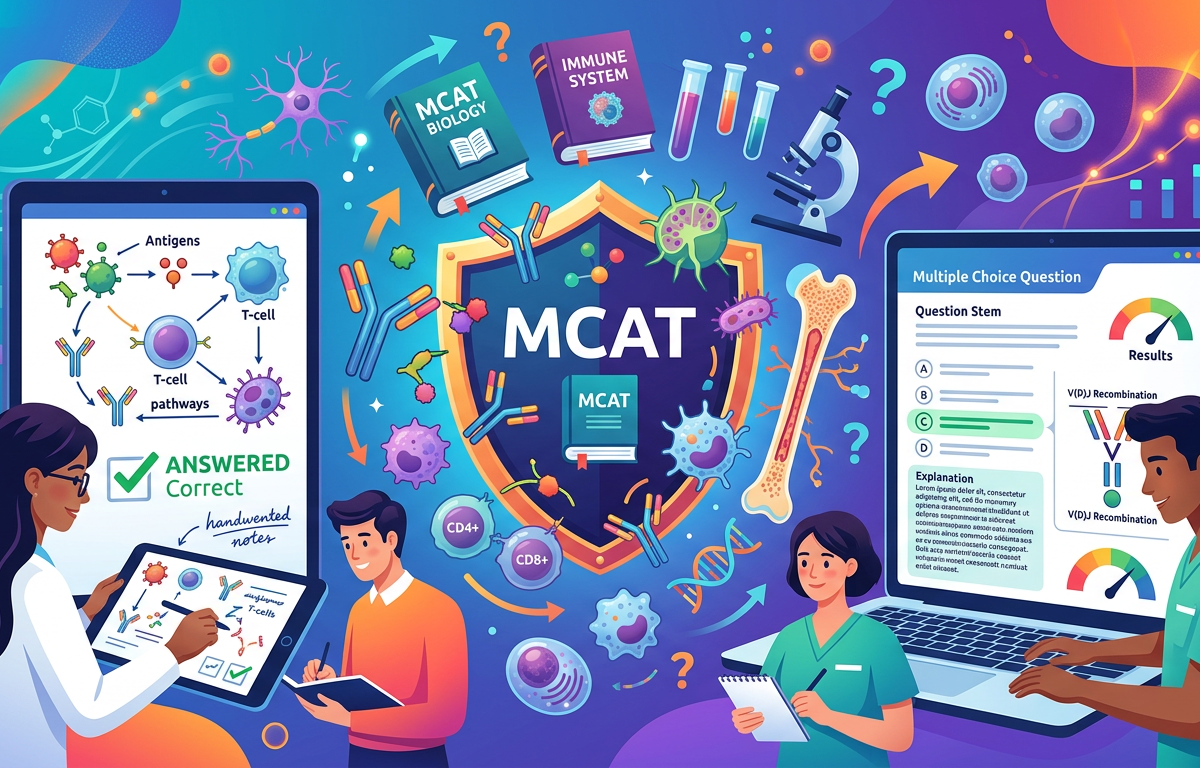
Mastering the MCAT Immune System is essential for success in the Biological and Biochemical Foundations of Living Systems section, as it requires a deep understanding of how the body distinguishes self from non-self. This complex system integrates cellular biology, genetics, and physiology to protect the organism from pathogens, ranging from simple bacteria to complex viruses. By working through these practice questions, you will solidify your knowledge of innate and adaptive immunity, lymphocyte maturation, and the role of the lymphatic system in maintaining homeostasis.
Concept Explanation
The immune system is a sophisticated network of cells, tissues, and organs that provides biological defense against infection and disease through two primary branches: innate (non-specific) immunity and adaptive (specific) immunity. Innate immunity serves as the first line of defense, utilizing physical barriers like the skin and chemical signals like cytokines to provide immediate, non-specific protection. In contrast, adaptive immunity involves highly specialized cells called B-cells and T-cells that recognize specific antigens and develop a memory of the encounter, allowing for a more robust response upon subsequent exposures. This process is heavily dependent on Major Histocompatibility Complex (MHC) molecules, which present antigens to T-cells to trigger an immune response.
Key components of the immune system include:
- Innate Immunity: Includes macrophages, neutrophils, dendritic cells, and the complement system. These act quickly but do not confer long-term immunity.
- Adaptive Immunity: Divided into humoral immunity (B-cells producing antibodies) and cell-mediated immunity (T-cells directly attacking infected cells).
- Lymphatic System: A network of vessels and nodes that filters lymph, houses lymphocytes, and facilitates the interaction between antigens and immune cells.
- Primary Lymphoid Organs: The bone marrow (B-cell maturation) and thymus (T-cell maturation).
- Secondary Lymphoid Organs: The spleen and lymph nodes, where immune responses are initiated.
To excel on the MCAT, you must understand the mechanisms of clonal selection, the difference between MHC-I and MHC-II, and the roles of various cytokines. Utilizing retrieval practice for medical students can significantly enhance your ability to recall these intricate pathways during the high-pressure environment of the exam.
Solved Examples
Review these examples to understand the logic required for MCAT-style immunology questions.
- Question: A patient is unable to produce MHC-I molecules on the surface of their nucleated cells. Which immune cell type would be most directly hindered in its ability to detect intracellular viral infections in this patient?
Solution:- Identify the role of MHC-I: MHC-I molecules present endogenous antigens (proteins produced inside the cell) to the immune system.
- Identify the target cell: Cytotoxic T-cells () specifically recognize antigens presented on MHC-I.
- Analyze the impact: If MHC-I is missing, T-cells cannot identify which cells are infected with a virus.
- Conclusion: The cytotoxic T-cell response is most directly hindered.
- Question: Explain why the secondary immune response is faster and more robust than the primary immune response.
Solution:- Recall the primary response: During the first exposure, naive B-cells and T-cells must be activated, which takes several days.
- Recall the role of memory cells: After the primary infection, memory B and T cells remain in the body.
- Analyze the secondary exposure: Upon re-exposure, these memory cells perform clonal expansion much more rapidly without the need for initial activation steps.
- Conclusion: The presence of memory cells ensures a quicker, higher-affinity antibody production.
- Question: A researcher discovers a drug that inhibits the function of the thymus. Which specific cell population will be most affected?
Solution:- Identify the function of the thymus: The thymus is the site of T-cell maturation and selection.
- Identify the cells involved: T-lymphocytes (both helper and cytotoxic).
- Analyze the drug's effect: Inhibiting the thymus prevents the maturation of T-cells, though B-cell maturation (occurring in the bone marrow) would remain largely unaffected.
- Conclusion: Mature T-lymphocytes will be the most depleted population.
Practice Questions
Test your knowledge with these MCAT immune system practice questions. Aim to apply active recall, a core component of retrieval practice, to improve your long-term retention.
- Which of the following is an example of innate immunity?
- Production of IgG antibodies
- Activation of cytotoxic T-cells
- Lysozyme in saliva breaking down bacterial cell walls
- Memory B-cell proliferation
- A mutation in the gene encoding for the heavy chain of antibodies would most likely affect which of the following?
- The ability of the antibody to bind to a specific antigen
- The isotype of the antibody (e.g., IgA vs. IgE)
- The ability of MHC-II to present antigens
- The maturation of T-cells in the thymus
- Which cell type is responsible for the secretion of cytokines that coordinate the overall immune response by activating other immune cells?
- Helper T-cells ()
- Cytotoxic T-cells ()
- Plasma B-cells
- Natural Killer (NK) cells
Ready to boost your MCAT score?
Practice smarter with Bevinzey’s AI-powered MCAT quizzes, explanations, and personalized study tools.
Start MCAT Prep Free- Opsonization is a process that enhances phagocytosis. Which of the following molecules are primarily involved in opsonization?
- Interferons
- Antibodies and complement proteins
- Histamines
- Perforins and granzymes
- The "clonal selection" theory of antibody diversity suggests that:
- Antigens choose which B-cell will proliferate based on the specificity of the B-cell's receptors.
- The body produces one type of antibody that adapts to fit any antigen.
- T-cells convert into B-cells upon contact with a pathogen.
- Stem cells in the bone marrow are programmed by pathogens to produce specific antibodies.
- MHC-II molecules are primarily found on which of the following cell types?
- All nucleated cells
- Red blood cells
- Professional antigen-presenting cells (APCs) like macrophages and B-cells
- Only T-lymphocytes
- What is the primary function of the spleen in the context of the immune system?
- Site of T-cell maturation
- Filtering blood and providing a site for B-cell activation
- Production of all white blood cells
- Storage of bile for digestion
- During an allergic reaction, which granulocyte is primarily responsible for releasing histamine?
- Neutrophils
- Eosinophils
- Basophils (and Mast cells)
- Monocytes
- Which statement regarding the lymphatic system is FALSE?
- It returns excess interstitial fluid to the circulatory system.
- It transports chylomicrons from the digestive tract.
- It is a closed-loop system similar to the cardiovascular system.
- It contains lymph nodes that act as checkpoints for pathogens.
- A deficiency in the complement system would most likely lead to:
- Inability to produce antibodies
- Impaired ability to lyse bacterial cells via the Membrane Attack Complex (MAC)
- Overproduction of T-cells
- Failure of the skin barrier
Answers & Explanations
Review the detailed explanations below to correct any misconceptions. This is an excellent opportunity to use retrieval practice vs practice tests strategies to evaluate your performance.
- Answer: Lysozyme in saliva breaking down bacterial cell walls. Innate immunity is non-specific and immediate. Lysozyme is a chemical barrier present from birth. Antibodies and T-cell activation are parts of the adaptive (specific) immune system.
- Answer: The isotype of the antibody (e.g., IgA vs. IgE). The heavy chain constant region determines the isotype (class) of the antibody. The variable region (which involves both heavy and light chains) determines antigen specificity.
- Answer: Helper T-cells (). Helper T-cells are the "generals" of the immune system. They secrete cytokines that activate B-cells to produce antibodies and help activate cytotoxic T-cells.
- Answer: Antibodies and complement proteins. Opsonization involves "tagging" a pathogen for destruction. Both antibodies (specifically the Fc region) and certain complement proteins (like C3b) act as opsonins that phagocytes recognize.
- Answer: Antigens choose which B-cell will proliferate based on the specificity of the B-cell's receptors. Clonal selection posits that a pool of B-cells with diverse receptors exists; when an antigen binds to a specific receptor, that B-cell is "selected" to clone itself and produce antibodies.
- Answer: Professional antigen-presenting cells (APCs) like macrophages and B-cells. While MHC-I is on all nucleated cells, MHC-II is restricted to APCs (macrophages, dendritic cells, and B-cells) to facilitate the activation of helper T-cells.
- Answer: Filtering blood and providing a site for B-cell activation. The spleen filters the blood (removing old RBCs) and serves as a secondary lymphoid organ where B-cells can encounter antigens and become activated.
- Answer: Basophils (and Mast cells). Basophils and mast cells contain granules filled with histamine, which is released during inflammatory and allergic responses.
- Answer: It is a closed-loop system similar to the cardiovascular system. This is false. The lymphatic system is an open-ended system that collects fluid from tissues and dumps it into the venous circulation via the thoracic duct and right lymphatic duct.
- Answer: Impaired ability to lyse bacterial cells via the Membrane Attack Complex (MAC). The complement system is a cascade of proteins that can directly kill bacteria by forming pores (MAC) in their membranes, in addition to promoting inflammation and opsonization.
1. Which MHC class is recognized by \( CD8^+ \) T-cells?
Frequently Asked Questions
What is the difference between humoral and cell-mediated immunity?
Humoral immunity is mediated by B-cells and the production of antibodies that circulate in the blood and lymph to neutralize extracellular pathogens. Cell-mediated immunity is driven by T-cells, which directly attack infected or abnormal host cells and do not involve antibodies.
How does the body prevent the immune system from attacking its own cells?
The body uses a process called self-tolerance, where developing B and T cells that react strongly to "self" antigens are eliminated or inactivated during maturation. This occurs through negative selection in the bone marrow for B-cells and in the thymus for T-cells.
What is the role of the Membrane Attack Complex (MAC)?
The MAC is a structure typically formed by the activation of the complement system that punches holes in the plasma membranes of target bacteria. This disruption of the osmotic gradient leads to the lysis and death of the pathogen.
Why are dendritic cells considered the link between innate and adaptive immunity?
Dendritic cells act as messengers by phagocytosing pathogens (innate function) and then migrating to lymph nodes to present those antigens on MHC-II molecules to naive T-cells (initiating adaptive immunity). They are among the most potent professional antigen-presenting cells in the body.
What is the function of the variable region of an antibody?
The variable region, located at the tips of the "Y" shape, contains the antigen-binding site that provides the antibody with its unique specificity. This region allows the immune system to recognize an almost infinite variety of distinct antigenic determinants or epitopes.
How does the lymphatic system assist in lipid absorption?
The lymphatic system contains specialized vessels called lacteals located in the villi of the small intestine. These lacteals absorb fats in the form of chylomicrons, bypassing the initial hepatic portal circulation and eventually delivering them to the bloodstream via the thoracic duct.
Ready to boost your MCAT score?
Practice smarter with Bevinzey’s AI-powered MCAT quizzes, explanations, and personalized study tools.
Start MCAT Prep FreeReviewed by
Michael Danquah, MS, PhD
Dr. Michael Danquah is a professor of pharmaceutical sciences and founder of several educational technology platforms focused on improving student learning and performance.
Enjoyed this article?
Share it with others who might find it helpful.
Related Articles

Hard MCAT Immune System Practice Questions
Master the complexities of the immune system with these hard MCAT practice questions covering MHC restriction, clonal selection, and the complement system.
May 9, 2026
Hard MCAT Endocrine System Practice Questions
Hard MCAT Endocrine System Practice Questions
May 9, 2026

Hard MCAT Philosophy Passage Practice Questions
Master Hard MCAT Philosophy Passage Practice Questions with our comprehensive guide featuring solved examples, practice questions, and expert explanations.
May 17, 2026

Hard MCAT Humanities Passage Practice Questions
Master Hard MCAT Humanities Passage Practice Questions with our comprehensive guide featuring solved examples, practice questions, and expert strategies.
May 17, 2026

Hard MCAT Critical Analysis Practice Questions
Hard MCAT Critical Analysis Practice Questions
May 17, 2026

Hard MCAT Reading Comprehension Practice Questions
Hard MCAT Reading Comprehension Practice Questions
May 17, 2026

Hard MCAT CARS Passage Practice Questions
Master high-difficulty MCAT CARS passages with our expert guide featuring solved examples, practice questions, and detailed logical analysis.
May 17, 2026

Hard MCAT CARS Practice Questions
Master Hard MCAT CARS Practice Questions with our comprehensive guide featuring solved examples, practice passages, and expert reasoning strategies.
May 17, 2026