MCAT Psych/Soc Practice: Distinguishing Theory from Application
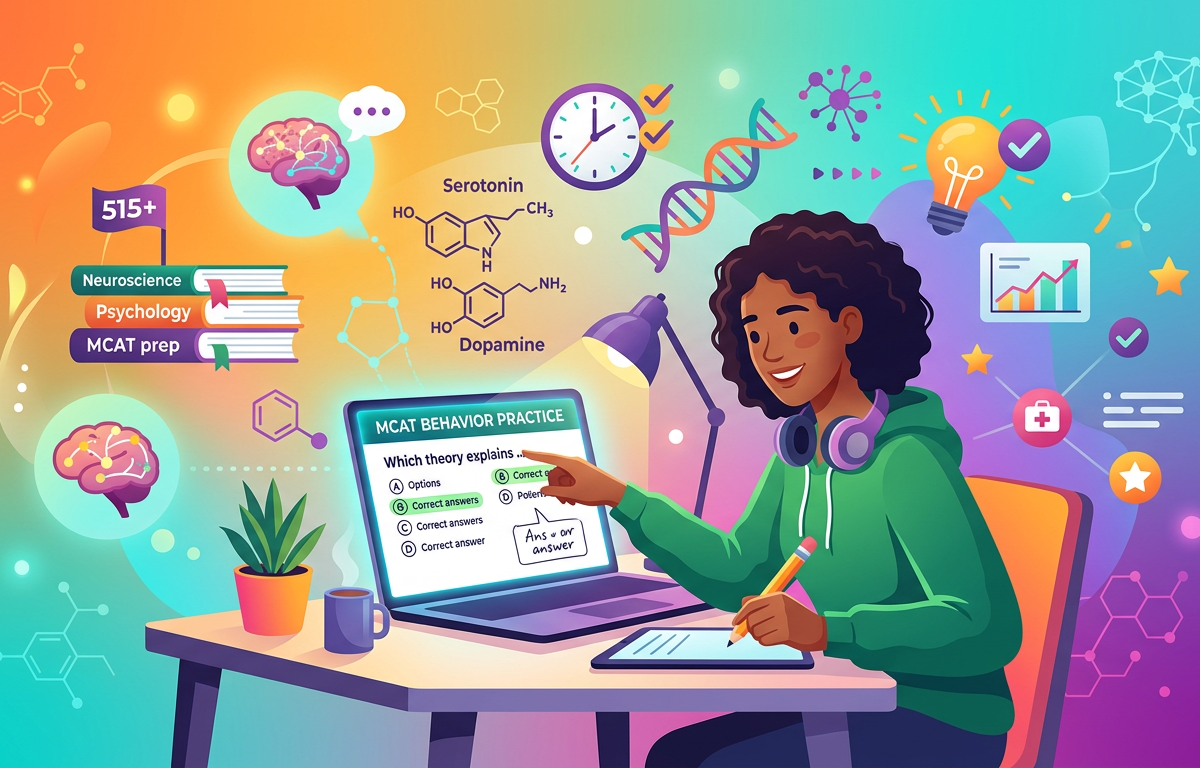
When a student watches a peer fail an exam and immediately labels them as lazy, they are demonstrating the Fundamental Attribution Error. This common psychological shortcut ignores the external variables, such as a family emergency or a lack of sleep, that often dictate human performance. On the MCAT, you are not just memorizing definitions; you are required to differentiate between these internal dispositional factors and the situational pressures that shape patient behavior in a clinical setting.
The difficulty in the Behavioral Sciences section often stems from the subtle overlap between Variable-Ratio and Fixed-Interval reinforcement schedules. Many students incorrectly assume that any unpredictable reward is variable, forgetting that the distinction lies in whether the reward is triggered by the number of actions or the passage of time. To score highly, you must look past the narrative of the passage and identify the precise mechanism of learning or social influence at play. These practice questions focus on those exact inflection points where simple concepts become complex applications.
Decoding Psychological and Social Paradigms
MCAT behavior encompasses the psychological, social, and biological foundations of human actions, focusing on how individuals perceive, interact with, and adapt to their environments. This domain, primarily tested in the Psychological, Social, and Biological Foundations of Behavior section, requires students to understand the interplay between internal mental processes and external social structures. Key concepts include learning theories (classical and operant conditioning), social cognition, personality theories, and the biological bases of behavior such as the endocrine system and brain structure. Understanding these principles is essential for medical students, as patient health outcomes are often heavily influenced by behavioral factors and social determinants.
To master this section, one must differentiate between various psychological frameworks. For example, behavioral psychology focuses on observable actions and environmental stimuli, while cognitive psychology examines internal thought processes. Furthermore, the MCAT frequently tests the distinction between sociologically-driven behaviors (like groupthink or deindividuation) and individual-driven behaviors (like trait-based personality). Just as students must master physics principles to understand bodily mechanics, they must master behavioral theories to understand patient compliance and the doctor-patient relationship.
Key Behavioral Paradigms
- Classical Conditioning: A learning process that occurs through associations between an environmental stimulus and a naturally occurring stimulus.
- Operant Conditioning: A method of learning that occurs through rewards and punishments for behavior.
- Social Cognitive Theory: Emphasizes the importance of observing, modeling, and imitating the behaviors, attitudes, and emotional reactions of others.
- Biological Perspective: Focuses on the physical bases of behavior, including the brain, nervous system, and hormonal influences.
Solved Examples
- Example: Identifying Reinforcement Schedules
A researcher gives a rat a food pellet after a random number of lever presses, averaging about one pellet every 10 presses. Which reinforcement schedule is being used?- Identify the type of reward: The reward is a food pellet (reinforcement).
- Determine if the schedule is based on time (interval) or number of responses (ratio): It is based on lever presses, so it is a ratio schedule.
- Determine if the requirement is fixed or changing: The number of presses is random/variable.
- Conclusion: This is a Variable-Ratio schedule, which is known for producing high, steady rates of response.
- Example: Fundamental Attribution Error
A student sees a peer fail a test and immediately assumes the peer is "lazy" rather than considering the peer might have been ill. What bias is this?- Analyze the observer's focus: The observer focuses on the peer's personality (internal/dispositional factors).
- Analyze the omitted factors: The observer ignores the situation (external/situational factors).
- Apply the definition: The tendency to overemphasize internal traits and underemphasize external situations is the Fundamental Attribution Error.
- Example: Cognitive Dissonance
A heavy smoker reads a study about the dangers of tobacco and feels intense discomfort. To resolve this, they claim the study was "biased." How does this illustrate cognitive dissonance?- Identify the conflicting cognitions: "I smoke" vs. "Smoking is deadly."
- Identify the resulting state: Discomfort or tension (dissonance).
- Identify the resolution: Changing the perception of the study (denial/justification) to align their thoughts with their behavior.
Practice Questions
- A patient reports that they are more likely to take their medication when they receive a text reminder from their doctor. In terms of operant conditioning, the text reminder serves as a:
- According to the Yerkes-Dodson Law, what level of arousal is generally best for performing a complex task like surgery?
- A child initially cries when they see a white rat. Later, the child also cries when they see a white rabbit or a white fur coat. This phenomenon is known as:
Train like a top MCAT scorer.
Master difficult concepts faster with AI-generated practice, retrieval training, and personalized learning support.
Start Training Free- Which brain structure is most directly involved in the formation of emotional memories and the "fight or flight" response?
- A person believes they failed their driving test because the examiner was "too harsh," but when they pass, they credit their "natural talent." This is an example of:
- In a group setting, individuals often exert less effort on a task than they would if they were working alone. This is known as:
- According to Erik Erikson’s stages of psychosocial development, a 25-year-old focusing on forming a committed relationship is likely in which stage?
- A researcher is studying how socioeconomic status affects access to healthcare. This study most likely utilizes which sociological perspective?
- Which neurotransmitter is most closely associated with the reward pathway and addictive behaviors?
- A subject is shown two lines of unequal length. When several confederates insist the lines are equal, the subject agrees despite seeing the difference. This is an example of:
Answers & Explanations
- Positive Reinforcement: The text reminder is a stimulus added to the environment that increases the frequency of a desired behavior (taking medication).
- Moderate Arousal: The Yerkes-Dodson Law posits an inverted U-shaped relationship between arousal and performance; moderate levels are optimal for complex tasks, while high arousal can impair performance.
- Stimulus Generalization: This occurs when a conditioned response is triggered by stimuli that are similar to the original conditioned stimulus (the white rat).
- Amygdala: The amygdala is the primary center for processing emotions and is a key component of the limbic system, which regulates the stress response.
- Self-Serving Bias: This is the tendency to attribute successes to internal factors (talent) while blaming failures on external factors (harsh examiner).
- Social Loafing: This phenomenon occurs when individuals feel less accountable in a group, leading to reduced individual effort compared to working solo.
- Intimacy vs. Isolation: This stage typically occurs during young adulthood (ages 20-40) and centers on the challenge of forming meaningful, long-term relationships.
- Conflict Theory: This perspective, often associated with Karl Marx, examines how power dynamics and social inequalities (like SES) lead to disparities in resources like healthcare.
- Dopamine: The mesolimbic pathway, or reward circuit, relies heavily on dopamine to reinforce behaviors that are perceived as pleasurable or beneficial.
- Conformity (Asch Effect): This demonstrates how individuals often change their behavior or beliefs to match the group consensus, even when the group is clearly wrong.
1. Which theory of emotion suggests that physiological arousal and the experience of emotion occur simultaneously?
Frequently Asked Questions
What is the difference between classical and operant conditioning?
Classical conditioning involves associating an involuntary response and a stimulus, while operant conditioning involves associating a voluntary behavior and a consequence. In classical conditioning, the learner is passive, whereas in operant conditioning, the learner must act to receive a reward or punishment.
How does the MCAT test the biological bases of behavior?
The exam focuses on how physiological systems, such as the nervous system and endocrine system, influence psychological processes. You should be familiar with brain regions like the hippocampus for memory and the role of neurotransmitters like serotonin in mood regulation.
What is the Fundamental Attribution Error?
The Fundamental Attribution Error is the tendency for observers to underestimate situational influences and overestimate dispositional influences when analyzing another person's behavior. It explains why we might assume someone is a "bad person" for being late rather than considering they might have been stuck in traffic.
Which personality theories are most important for the MCAT?
Students should focus on the Psychoanalytic (Freud), Humanistic (Maslow/Rogers), Trait (Big Five), and Social Cognitive (Bandura) theories. Each offers a different lens on how personality develops and influences individual behavior in various social contexts.
Why is the Schachter-Singer theory unique?
The Schachter-Singer theory, or two-factor theory, is unique because it requires both physiological arousal and a cognitive label to experience an emotion. It suggests that our interpretation of the environment determines which emotion we feel in response to physical sensations.
How is social stratification relevant to MCAT behavior?
Social stratification relates to how society ranks people in a hierarchy, affecting their health behaviors and access to medical care. Understanding concepts like social capital and class consciousness helps explain disparities in health outcomes across different demographic groups.
Train like a top MCAT scorer.
Master difficult concepts faster with AI-generated practice, retrieval training, and personalized learning support.
Start Training FreeReviewed by
Michael Danquah, MS, PhD
Dr. Michael Danquah is a professor of pharmaceutical sciences and founder of several educational technology platforms focused on improving student learning and performance.
Enjoyed this article?
Share it with others who might find it helpful.
Related Articles

Solving MCAT Force Problems: From Inclined Planes to Blood Flow
MCAT Force Practice Questions with Answers
May 17, 2026

Solving MCAT Sound Problems: From Decibel Logs to Doppler Shifts
MCAT Waves and Sound Practice Questions with Answers
May 14, 2026

Solving MCAT Fluid Dynamics: From Poiseuille’s Law to Blood Flow
MCAT Fluid Mechanics Practice Questions with Answers
May 14, 2026
Predicting MCAT Organic Products: From PCC to SN2 Mechanisms
Easy MCAT Organic Reactions Practice Questions
May 11, 2026

Hard MCAT Philosophy Passage Practice Questions
Master Hard MCAT Philosophy Passage Practice Questions with our comprehensive guide featuring solved examples, practice questions, and expert explanations.
May 17, 2026

Hard MCAT Humanities Passage Practice Questions
Master Hard MCAT Humanities Passage Practice Questions with our comprehensive guide featuring solved examples, practice questions, and expert strategies.
May 17, 2026

Hard MCAT Critical Analysis Practice Questions
Hard MCAT Critical Analysis Practice Questions
May 17, 2026

Hard MCAT Reading Comprehension Practice Questions
Hard MCAT Reading Comprehension Practice Questions
May 17, 2026