Hard VSEPR Geometry Practice Questions
Concept Explanation
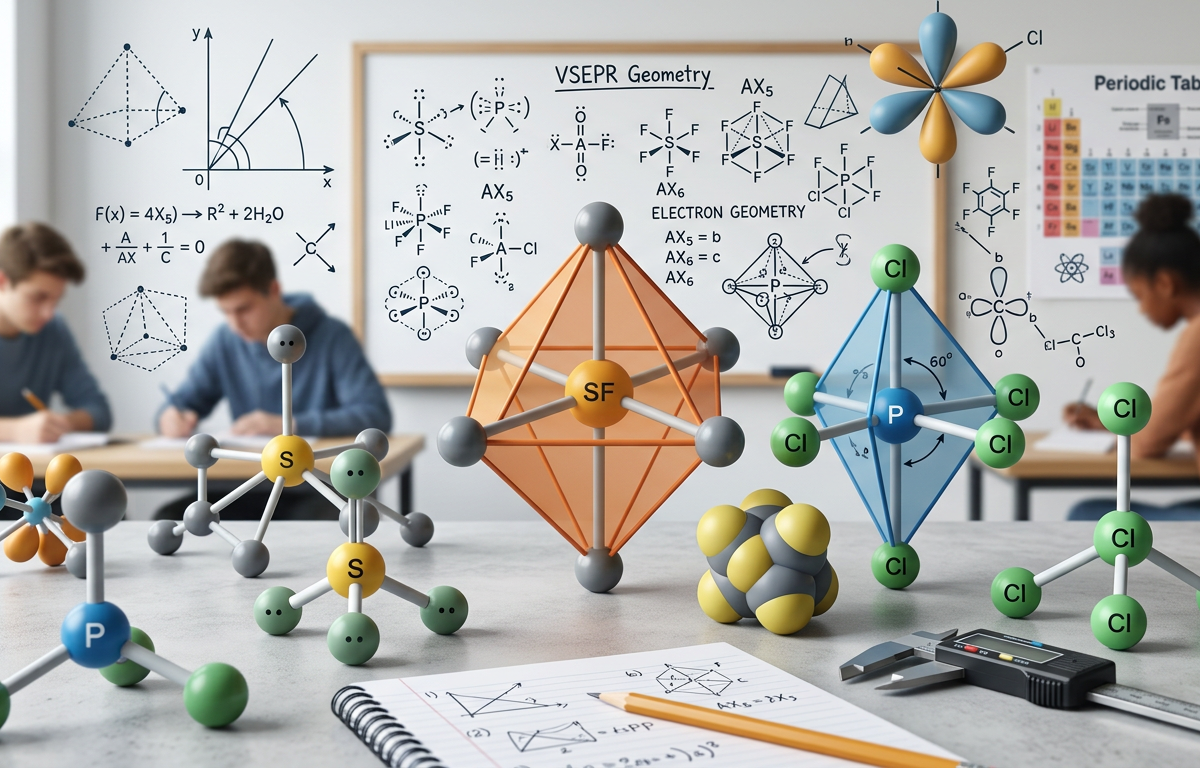
VSEPR (Valence Shell Electron Pair Repulsion) theory is a chemical model used to predict the three-dimensional geometry of individual molecules based on the repulsion between electron pairs surrounding a central atom. The fundamental premise of Hard VSEPR Geometry Practice Questions is that electron pairs, whether in bonds or as lone pairs, will arrange themselves in a way that minimizes electrostatic repulsion, thereby determining the molecular shape.
While basic VSEPR covers simple linear or tetrahedral shapes, advanced applications involve expanded octets, polyatomic ions with resonance, and the subtle distortion of bond angles caused by varying electron group strengths. To master these complex structures, one must first be proficient in drawing a Lewis Structure to accurately count the steric number (the sum of bonded atoms and lone pairs).
In advanced VSEPR, we distinguish between electron-group geometry and molecular geometry. Electron-group geometry describes the arrangement of all electron domains (linear, trigonal planar, tetrahedral, trigonal bipyramidal, or octahedral). Molecular geometry describes only the positions of the nuclei. According to Wikipedia's overview of VSEPR theory, the repulsion strength follows the order: Lone Pair-Lone Pair (LP-LP) > Lone Pair-Bonding Pair (LP-BP) > Bonding Pair-Bonding Pair (BP-BP). This hierarchy explains why lone pairs in a trigonal bipyramidal system always occupy equatorial positions and why they compress the angles of adjacent bonds in molecules like SF4 or BrF3.
When tackling difficult problems, you must also consider the effects of electronegativity and multiple bonds. For example, a double bond occupies more space than a single bond, leading to larger bond angles. Furthermore, the hybridization of the central atom is intrinsically linked to the VSEPR geometry, providing a quantum mechanical framework for these observed shapes. Understanding these nuances is critical for predicting molecular polarity, as symmetry can cancel out individual bond dipoles even in highly electronegative systems.
Solved Examples
Review these step-by-step solutions for complex molecules to understand the logic required for advanced VSEPR analysis.
Example 1: Xenon Tetrafluoride (XeF4)
Count total valence electrons: Xe (8) + 4F (4 × 7) = 36 electrons.
Draw the Lewis structure: Xe is the central atom with four single bonds to F and two lone pairs remaining (8 + 28 = 36).
Determine the steric number: 4 bonding pairs + 2 lone pairs = 6.
Identify electron geometry: Steric number 6 corresponds to Octahedral.
Determine molecular geometry: To minimize repulsion, the two lone pairs must be 180° apart (axial positions). This leaves the four F atoms in a plane. The shape is Square Planar.
Example 2: The Triiodide Ion (I3&supmin;)
Count valence electrons: (3 × 7) + 1 (extra charge) = 22 electrons.
Draw the Lewis structure: Central I atom bonded to two terminal I atoms. Central I has 3 lone pairs to satisfy the 22-electron count (2 bonds = 4e, 3 lone pairs on central I = 6e, 3 lone pairs on each terminal I = 12e; Total = 22).
Determine the steric number: 2 bonding pairs + 3 lone pairs = 5.
Identify electron geometry: Steric number 5 is Trigonal Bipyramidal.
Determine molecular geometry: Lone pairs occupy equatorial positions to maximize space. The two I-I bonds are axial (180°). The shape is Linear.
Example 3: Bromine Pentafluoride (BrF5)
Count valence electrons: 7 (Br) + 5 × 7 (F) = 42 electrons.
Draw the Lewis structure: Br is the central atom with 5 single bonds to F and 1 lone pair.
Determine the steric number: 5 bonding pairs + 1 lone pair = 6.
Identify electron geometry: Octahedral.
Determine molecular geometry: One lone pair reduces the bond angles from the ideal 90°. The shape is Square Pyramidal.
Practice Questions
Test your knowledge with these challenging VSEPR problems. Ensure you consider formal charges and expanded octets where necessary.
Predict the molecular geometry and the ideal bond angles for the IF4+ cation.
Determine the molecular shape of TeCl4 and explain why the bond angles are less than the ideal values.
The XeF5&supmin; ion is an unusual example of an expanded octet. Identify its electron-group geometry and molecular geometry.
Want unlimited practice questions like these?
Generate AI-powered questions with step-by-step solutions on any topic.
Try Question Generator Free →Compare SO2 and O3. Both have three atoms. Explain the difference in their bond angles based on VSEPR theory.
Predict the geometry of ICl2+ and ICl2&supmin;. How does the addition of two electrons change the shape?
Identify the molecular geometry of SF4. Which position (axial or equatorial) does the lone pair occupy, and why?
Analyze the POCl3 molecule. Predict the O-P-Cl bond angle relative to the Cl-P-Cl bond angle.
Determine the geometry of XeO2F2. Note: Xenon is the central atom and oxygen forms double bonds.
Predict the shape of ClF3. Discuss the resulting bond angles in terms of lone pair-bonding pair repulsion.
For the molecule SeF6, identify the electron geometry, molecular geometry, and all bond angles.
4. Answers & Explanations
IF4+: Steric number = 5 (4 bonds, 1 lone pair on Iodine). The electron geometry is trigonal bipyramidal. The lone pair occupies an equatorial position to minimize repulsion. Molecular geometry is Seesaw. Ideal angles: <90° (axial-equatorial) and <120° (equatorial-equatorial).
TeCl4: Steric number = 5 (4 bonds, 1 lone pair on Tellurium). The shape is Seesaw. The lone pair is equatorial. Repulsion from the lone pair pushes the bonding pairs closer together, making the angles less than 90° and 120°.
XeF5&supmin;: Steric number = 7 (5 bonds, 2 lone pairs on Xenon). This follows the pentagonal bipyramidal electron geometry. To minimize repulsion, the two lone pairs occupy the axial positions. The molecular geometry is Pentagonal Planar.
SO2 vs O3: Both have a steric number of 3 (2 bonds and 1 lone pair on the central atom) and are Bent. However, the double bonds in SO2 and the different electronegativities mean the bond angles will differ slightly from the ideal 120°, typically around 117-119°.
ICl2+ vs ICl2&supmin;: ICl2+ has 2 bonds and 2 lone pairs (Steric 4), making it Bent (~104.5°). ICl2&supmin; has 2 bonds and 3 lone pairs (Steric 5), making it Linear (180°) because the 3 lone pairs occupy the equatorial plane.
SF4: Steric number 5 (4 bonds, 1 lone pair). Shape is Seesaw. The lone pair MUST occupy the equatorial position because it only encounters two 90° repulsions (from axial bonds). In the axial position, it would encounter three 90° repulsions (from equatorial bonds), which is energetically unfavorable.
POCl3: Steric number 4 (4 bonds, 0 lone pairs). Electron geometry is tetrahedral. However, the P=O double bond contains more electron density than the P-Cl single bonds. Thus, the O-P-Cl angle is greater than 109.5°, and the Cl-P-Cl angle is less than 109.5°.
XeO2F2: Steric number 5 (4 bonds, 1 lone pair). Oxygen atoms form double bonds and prefer equatorial positions due to higher electron density. The lone pair also takes an equatorial position. This results in a Seesaw molecular geometry.
ClF3: Steric number 5 (3 bonds, 2 lone pairs). Electron geometry is trigonal bipyramidal. Two lone pairs occupy equatorial positions. The molecular geometry is T-shaped. The lone pairs compress the F(axial)-Cl-F(equatorial) angle to roughly 87.5°.
SeF6: Steric number 6 (6 bonds, 0 lone pairs). Both electron and molecular geometries are Octahedral. All bond angles are exactly 90° or 180° due to perfect symmetry.
1. Which molecule exhibits a square pyramidal molecular geometry?
6. Frequently Asked Questions
What is the difference between electron geometry and molecular geometry?
Electron geometry considers the spatial arrangement of all electron domains (bonds and lone pairs), while molecular geometry only describes the arrangement of the atoms. For example, ammonia has a tetrahedral electron geometry but a trigonal pyramidal molecular geometry.
Why do lone pairs occupy more space than bonding pairs?
Lone pairs are attracted to only one nucleus, allowing their electron cloud to spread out more broadly than bonding pairs, which are pulled between two nuclei. This increased spatial requirement leads to greater repulsion and the compression of nearby bond angles.
How does the steric number relate to VSEPR theory?
The steric number is the sum of the number of atoms bonded to a central atom and the number of lone pairs on that atom. It determines the basic electron-group geometry from which the specific molecular shape is derived.
Can VSEPR theory predict the geometry of transition metal complexes?
VSEPR is generally less effective for transition metal complexes because it does not account for the specific directions of d-orbital electrons. For these molecules, Crystal Field Theory or Ligand Field Theory is more accurate.
Why is the equatorial position preferred for lone pairs in trigonal bipyramidal shapes?
In the equatorial position, a lone pair only has two 90-degree repulsions from axial neighbors, whereas in the axial position, it would face three 90-degree repulsions from equatorial neighbors. Minimizing these high-energy 90-degree interactions is the primary driver for this preference.
Does VSEPR account for the size of terminal atoms?
While standard VSEPR focuses on electron pair repulsion, steric bulk (the physical size of large atoms like Iodine vs. Fluorine) can also influence bond angles and stability. Larger terminal atoms may increase bond angles to avoid physical crowding.
Want unlimited practice questions like these?
Generate AI-powered questions with step-by-step solutions on any topic.
Try Question Generator Free →
Want unlimited practice questions like these?
Generate AI-powered questions with step-by-step solutions on any topic.
Try Question Generator Free →Enjoyed this article?
Share it with others who might find it helpful.
Related Articles

Medium VSEPR Geometry Practice Questions
Master VSEPR geometry with our medium-level practice questions. Learn to predict molecular shapes, bond angles, and electron arrangements with detailed solutions.
Apr 4, 2026

Easy VSEPR Geometry Practice Questions
Master VSEPR theory with our easy practice questions. Learn to predict molecular shapes like linear, tetrahedral, and bent with step-by-step solved examples.
Apr 4, 2026
VSEPR Geometry Practice Questions with Answers
Master VSEPR Geometry with our comprehensive guide. Includes solved examples, practice questions on molecular shapes, and detailed explanations for chemistry students.
Apr 4, 2026

Decimal Conversion Practice Questions with Answers
Master decimal conversion with our comprehensive guide featuring solved examples, practice questions, and a quick quiz to sharpen your math skills.
Apr 6, 2026

Fraction Practice Questions with Answers
Fraction Practice Questions with Answers
Apr 6, 2026

Solving Time-Shift Algebra: How to Model Age Ratios and Sums
Master age problems with our comprehensive guide featuring solved examples, practice questions, and detailed algebraic explanations for all levels.
Apr 6, 2026

Logarithm Practice Questions with Answers
Master logarithms with our guide featuring core concepts, solved examples, and 10 practice questions with detailed answers to help you ace your math exams.
Apr 6, 2026

Linear Equations Practice Questions with Answers
Master linear equations with our comprehensive guide featuring step-by-step solved examples, practice questions, and detailed explanations for all levels.
Apr 6, 2026