Predicting Periodic Anomalies: Beyond Basic Trend Rules
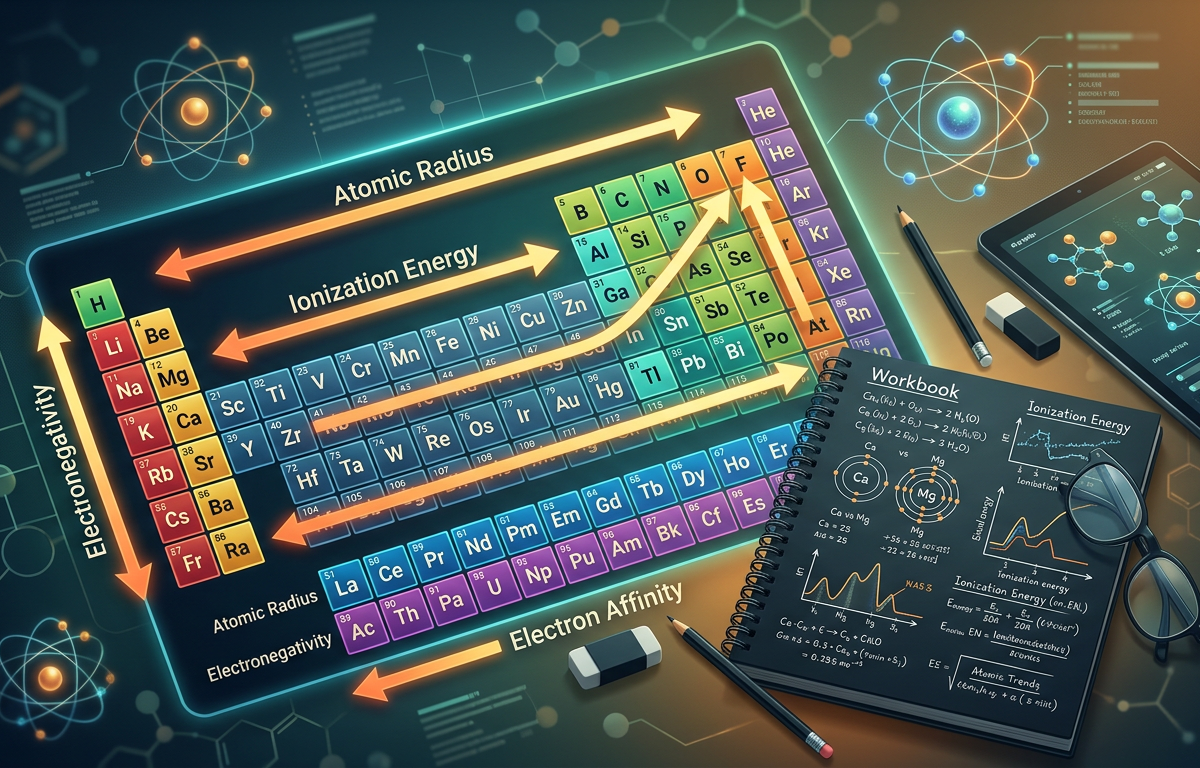
If you rely solely on the left-to-right or top-to-bottom arrows found in most textbooks, you will likely fail to explain why Gallium has a smaller atomic radius than Aluminum. Most students assume that adding an entire electron shell automatically increases atomic size, but this ignores the poor shielding properties of the 3d subshell. When transition metals or post-transition metals are involved, the simple rules of the periodic table break down because the effective nuclear charge does not increase linearly. You must account for how specific electron configurations, such as half-filled p-orbitals, create unexpected stability or repulsion.
This practice set moves past the basics to focus on the exceptions that define high-level inorganic chemistry. We will examine why the first ionization energy of Oxygen actually drops below that of Nitrogen and how the removal of a core electron from a Sodium cation creates a massive energy spike compared to Magnesium. Mastering these questions requires you to visualize the pull of the nucleus versus the specific geometry of subshell shielding. By working through these scenarios, you transition from memorizing patterns to calculating the actual physical forces that dictate chemical behavior.
Hard Periodic Trends Practice Questions
Mastering Hard Periodic Trends Practice Questions requires a deep understanding of effective nuclear charge, electron shielding, and the nuances of electronic configurations. This guide provides advanced learners with the tools to navigate complex chemical behaviors and predict properties across the periodic table of elements.
Shielding Effects and Subshell Stability
Periodic trends are the specific patterns in the properties of chemical elements that are revealed in the periodic table, primarily driven by the effective nuclear charge (Zeff) and the principal quantum number of the valence electrons. These trends include atomic radius, ionization energy, electron affinity, and electronegativity. To solve advanced problems, you must look beyond simple left-to-right or top-to-bottom rules. For instance, the ionization energy of an atom doesn't always increase linearly across a period; disruptions occur due to subshell symmetry and electron-electron repulsion. Similarly, the electron configuration of an element dictates its chemical reactivity and metallic character. Understanding how the nucleus exerts pull on electrons while inner-shell electrons provide shielding is the foundation for explaining why transition metals or post-transition metals often exhibit "anomalous" behaviors compared to main-group elements.
Solved Examples
Below are three worked examples that demonstrate how to apply theoretical concepts to complex scenarios.
Compare the second ionization energy (IE2) of Sodium (Na) and Magnesium (Mg). Which is higher and why?
Write the electron configurations for the neutral atoms: Na is [Ne]3s¹; Mg is [Ne]3s².
Determine the configuration after the first electron is removed: Na⁺ is [Ne] (a stable noble gas core); Mg⁺ is [Ne]3s¹.
Analyze the energy required for the second removal: For Na⁺, the second electron must be removed from a stable 2p subshell close to the nucleus. For Mg⁺, the electron is removed from the 3s subshell.
Conclusion: Na has a significantly higher IE2 because removing an electron from a full octet/noble gas core requires immense energy compared to removing a valence electron.
Explain why the atomic radius of Gallium (Ga, Z=31) is slightly smaller than the atomic radius of Aluminum (Al, Z=13), despite Ga being below Al in Group 13.
Identify the electronic structure: Al is [Ne]3s²3p¹; Ga is [Ar]3d¹⁰4s²4p¹.
Evaluate the role of d-electrons: Gallium follows the first row of transition metals. The 10 electrons in the 3d subshell are poor at shielding the nuclear charge.
Calculate the impact on Zeff: Because the 3d electrons shield poorly, the 31 protons in the Ga nucleus exert a much stronger pull on the 4p valence electrons than expected.
Conclusion: This "d-block contraction" increases the effective nuclear charge, pulling the electrons closer and making Ga smaller than Al.
Rank the following in order of increasing electron affinity: Nitrogen (N), Oxygen (O), and Fluorine (F).
Recall the general trend: Electron affinity usually becomes more negative (more exothermic) moving right across a period.
Check for anomalies: Nitrogen has a configuration of [He]2s²2p³. This is a half-filled p-subshell, which is relatively stable.
Assess the energy change: Adding an electron to N requires overcoming electron-electron repulsion in a stable half-filled shell, making its EA near zero or positive. Oxygen and Fluorine follow the trend.
Conclusion: N < O < F.
Practice Questions
Test your knowledge with these advanced challenges. Ensure you consider subshell stability and effective nuclear charge in your reasoning.
1. Which of the following ions has the largest ionic radius: S²⁻, Cl⁻, K⁺, or Ca²⁺?
2. Explain why the first ionization energy of Oxygen is lower than that of Nitrogen, despite Oxygen having a higher nuclear charge.
3. Arrange the following elements in order of increasing electronegativity: Si, P, S, and Ge.
Start Learning Smarter Today
Join thousands of students using AI-powered study tools to achieve better results.
Get Started Free
Start Learning Smarter Today
Join thousands of students using AI-powered study tools to achieve better results.
Get Started Free4. Predict which element has a more exothermic electron affinity: Silicon (Si) or Phosphorus (P).
5. Why does the metallic character of elements increase as you move down a group but decrease as you move across a period to the right?
6. Compare the third ionization energy (IE3) of Magnesium (Mg) and Aluminum (Al). Which is larger?
7. Account for the fact that the atomic radius of Gold (Au) is nearly identical to that of Silver (Ag), even though Gold has many more electrons and protons.
8. Identify the element in Period 3 that has the highest second ionization energy.
9. In terms of Zeff, explain why the 4s orbital is filled before the 3d orbital in transition metals, but electrons are removed from 4s first during ionization.
10. Arrange the following species in order of decreasing size: Te²⁻, I⁻, Cs⁺, Ba²⁺.
Answers & Explanations
S²⁻: These are all isoelectronic species (18 electrons). The size is determined by the number of protons. S²⁻ has the fewest protons (16), meaning the nucleus has the weakest pull on the electron cloud, resulting in the largest radius.
Electron Repulsion: Nitrogen has a half-filled 2p subshell (2p³). Oxygen has four electrons in the 2p subshell (2p⁴), meaning one orbital contains a pair of electrons. The repulsion between these two electrons makes it easier to remove one, lowering the IE compared to N.
Ge < Si < P < S: Electronegativity increases up a group and to the right across a period. Ge is below Si, so it is the least. S is furthest right in the same period as Si and P.
Silicon (Si): P has a half-filled 3p subshell (3p³), which is stable. Adding an electron to P causes more repulsion than adding one to Si (3p²). Thus, Si has a more exothermic EA.
Ionization Energy: Metallic character depends on the ease of losing electrons. Moving down a group, atomic radius increases and IE decreases, making it easier to lose electrons. Moving right, Zeff increases and IE increases, making it harder to lose electrons.
Magnesium (Mg): Mg²⁺ has a noble gas configuration ([Ne]). Removing a third electron requires breaking a stable octet. Al²⁺ has a [Ne]3s¹ configuration, so its third electron is a valence electron and much easier to remove.
Lanthanide Contraction: Gold follows the lanthanide series (4f block). The 4f electrons are very poor at shielding the nuclear charge. The resulting increase in Zeff pulls the 6s electrons in tightly, offsetting the expected increase in size from adding a new shell.
Sodium (Na): Na has one valence electron. Its first IE is low, but the second IE involves removing an electron from the stable 1s²2s²2p⁶ core, which requires more energy than any other Period 3 element's second IE.
Orbital Penetration: The 4s orbital penetrates closer to the nucleus than the 3d, so it is initially lower in energy. However, once the 3d subshell begins to fill, the relative energies shift due to electron-electron interactions, making 4s the "outermost" and first to be lost.
Te²⁻ > I⁻ > Cs⁺ > Ba²⁺: These are isoelectronic (54 electrons). Size decreases as atomic number (protons) increases: Te (52), I (53), Cs (55), Ba (56).
1. Which factor is primarily responsible for the decrease in atomic radius across a period?
Frequently Asked Questions
What is the Lanthanide Contraction?
The lanthanide contraction is the steady decrease in atomic and ionic radii of the lanthanide elements as the atomic number increases. It is caused by the poor shielding effect of the 4f electrons, which allows the nuclear charge to pull the outer electrons more strongly.
How does Zeff affect periodic trends?
Effective nuclear charge (Zeff) is the net positive charge experienced by valence electrons after accounting for shielding by inner electrons. An increase in Zeff across a period pulls electrons closer, increasing ionization energy and decreasing atomic radius.
Why is the electron affinity of Noble Gases positive?
Noble gases have completely filled valence shells, making them exceptionally stable. Adding an extra electron requires placing it into a higher energy principal shell, which is an endothermic process requiring energy input.
What is the difference between electronegativity and electron affinity?
Electronegativity is a measure of an atom's ability to attract shared electrons within a chemical bond. Electron affinity is the actual energy change that occurs when a neutral atom in the gas phase gains an electron.
Why do transition metals have similar atomic radii within a period?
As you move across a transition series, electrons are added to an inner d-subshell. These inner electrons shield the outer s-electrons quite effectively, meaning the increase in nuclear charge is largely offset, resulting in only minor changes in size.
Start Learning Smarter Today
Join thousands of students using AI-powered study tools to achieve better results.
Get Started FreeEnjoyed this article?
Share it with others who might find it helpful.
Related Articles
Predicting Radioactive Decay: Solving for Mass and Time Intervals
Master half-life calculations with our comprehensive guide featuring step-by-step solved examples, practice questions, and detailed answers for students.
Apr 2, 2026

Predicting Rate Law Exponents: Beyond Stoichiometric Coefficients
Master reaction order with our comprehensive guide featuring solved examples, practice questions, and clear explanations for zero, first, and second-order kinetics.
Apr 2, 2026

Predicting Reaction Direction: Q vs K Comparison Practice
Master the reaction quotient (Q) with these easy practice questions. Learn how to calculate Q and predict the direction of chemical shifts.
Mar 30, 2026

Solving Complex pH Problems: Beyond Simple Strong Acids
Master advanced pH calculations with our guide on weak acids, polyprotic systems, and salt hydrolysis. Includes step-by-step solved examples and practice questions.
Mar 29, 2026

Predicting Reaction Yields: Grams-to-Grams Stoichiometry Guide
Master mass-to-mass stoichiometry with our comprehensive guide. Includes step-by-step solved examples, practice questions, and a quick quiz to test your knowledge.
Mar 21, 2026

Calculating High-Stakes Meds: BSA Mosteller Formula Practice
Master hard body surface area-based dosage calculations with our comprehensive guide, solved examples, and practice questions for healthcare students.
May 17, 2026

Solving High-Stakes IV Titrations and Weight-Based Infusions
Master advanced IV flow rate calculations with these hard practice questions. Covers weight-based dosing, titrations, and dimensional analysis for nurses.
May 17, 2026

Solving Weight-Based Dosing: The 2.2 Conversion and Rounding Logic
Weight-Based Dosage Calculations Practice Questions with Answers
May 17, 2026