Hard NCLEX Pediatric Safety Practice Questions
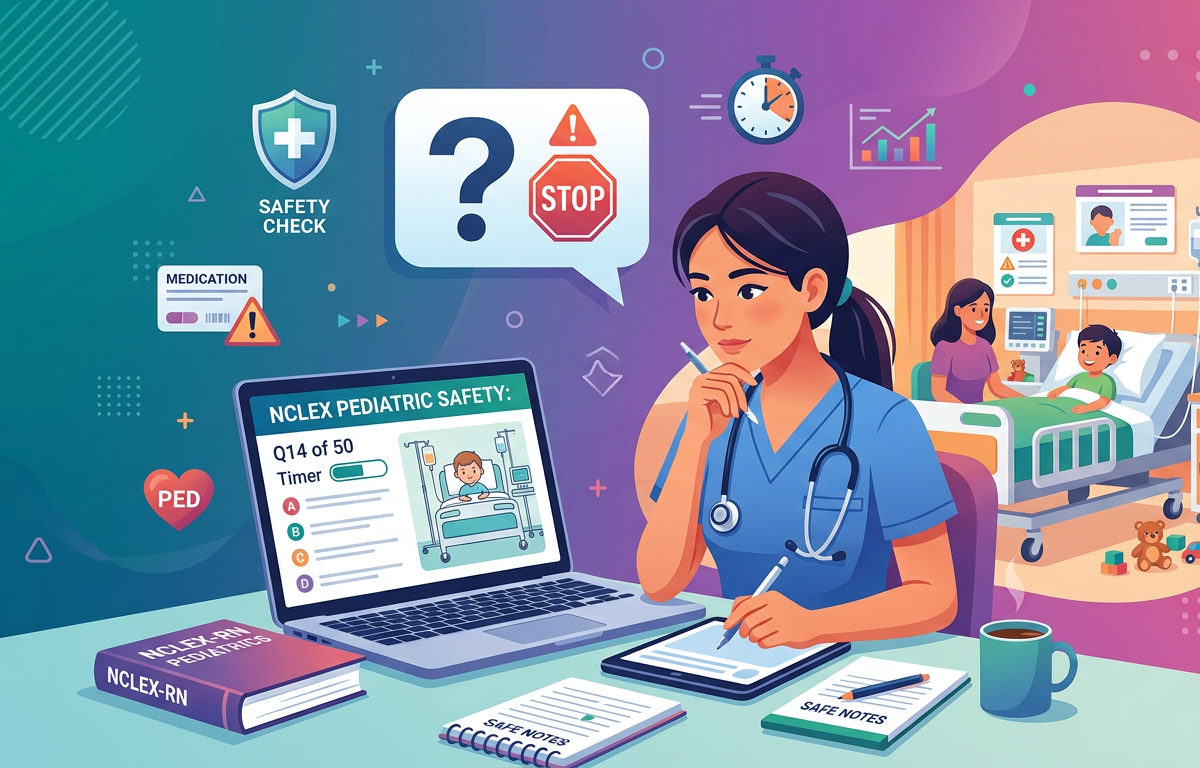
Hard NCLEX Pediatric Safety Practice Questions
Mastering Hard NCLEX Pediatric Safety Practice Questions requires a deep understanding of developmental milestones, physiological vulnerabilities, and clinical prioritization for the most vulnerable patient populations. Pediatric safety encompasses everything from environmental hazard prevention to the complex management of high-risk medical conditions in infants and children. According to the Centers for Disease Control and Prevention (CDC), unintentional injuries remain the leading cause of death for children in the United States, making safety a cornerstone of the NCLEX examination. Nursing candidates must demonstrate clinical judgment that accounts for growth and development to ensure the highest standards of care.
Concept Explanation
Pediatric safety is the clinical discipline of identifying, preventing, and managing risks to children’s physical and psychological well-being within a healthcare environment. It differs from adult safety because children have unique anatomical proportions, immature immune systems, and evolving cognitive abilities that change how they interact with their surroundings. For instance, the safety needs of a 6-month-old infant focus on aspiration and fall prevention, whereas the safety needs of a 4-year-old involve poisoning prevention and supervision during play.
When approaching Hard NCLEX Pediatric Safety Practice Questions, you must integrate knowledge from several domains:
- Developmental Stages: Recognizing what a child is capable of (e.g., a toddler can now reach a cabinet that was previously safe).
- Anatomical Vulnerabilities: Understanding that a child’s airway is smaller and more prone to obstruction than an adult’s.
- Medication Safety: Calculating dosages based on weight, often using the formula , and ensuring double-checks for high-alert medications.
- Infection Control: Implementing age-appropriate isolation precautions and standardizing hand hygiene to protect immunocompromised pediatric patients.
For more foundational knowledge, you may find it helpful to review NCLEX Pediatric Safety Practice Questions with Answers before tackling these advanced scenarios. Additionally, using a personalized study plan can help you allocate time effectively between complex pediatric topics and general safety principles.
Solved Examples
- Scenario: A nurse is caring for a 10-month-old infant who is beginning to crawl. Which safety intervention is the highest priority for the nurse to teach the parents?
- Step 1: Identify the developmental stage. A 10-month-old is mobile and explores by putting objects in their mouth.
- Step 2: Identify the greatest risk. Choking and aspiration are primary risks for this age group.
- Step 3: Select the intervention. Teaching parents to use a small-parts tester (choke tube) to evaluate toys and floor debris.
- Solution: The nurse must prioritize the removal of small objects from the floor and the installation of safety gates at stairs.
- Scenario: A 4-year-old child with a history of seizures is admitted. What is the most critical safety action the nurse should implement?
- Step 1: Assess the condition. Seizures present a risk of airway obstruction and physical injury.
- Step 2: Apply safety protocols. Seizure precautions include padding side rails and having suction equipment at the bedside.
- Step 3: Determine the "most critical" action. Airway is the priority.
- Solution: Ensuring oxygen and suction are functional and readily available at the bedside is the priority over padding rails.
- Scenario: A nurse is preparing to administer a medication to a child weighing 22 lbs. The safe dose is . How many milligrams should be delivered?
- Step 1: Convert pounds to kilograms.
- Step 2: Multiply the weight by the dosage.
- Solution: The nurse should administer exactly 50 mg. Mistakes in this calculation are a major source of pediatric safety errors.
Practice Questions
- A nurse is providing discharge instructions to the parents of a 2-year-old child who was treated for accidental salicylate ingestion. Which statement by the parents indicates a need for further teaching?
- A. "We will keep all medications in a locked cabinet high above the floor."
- B. "We will call the Poison Control Center immediately if we suspect he swallowed something."
- C. "We will keep a bottle of Syrup of Ipecac in our first aid kit just in case."
- D. "We will transition all our medications to containers with child-proof caps."
- Which action should the nurse prioritize when caring for a 6-year-old child in skeletal traction for a fractured femur?
- A. Assessing the pin sites for signs of infection every 8 hours.
- B. Ensuring the weights are hanging freely and not touching the floor.
- C. Encouraging the child to use the trapeze bar for repositioning.
- D. Performing neurovascular checks on the affected extremity every 4 hours.
- A 14-year-old patient with cystic fibrosis is admitted for a pulmonary exacerbation. The nurse notes the patient is refusing to wear their chest physiotherapy vest. What is the nurse's best initial response?
- A. Inform the patient that they cannot be discharged until they comply with treatment.
- B. Ask the patient to explain their reasons for refusing the treatment.
- C. Notify the healthcare provider of the patient's non-compliance.
- D. Explain the physiological importance of airway clearance in cystic fibrosis.
Feel more prepared for exam day.
Strengthen your clinical judgment and retention with AI-powered NCLEX preparation tools.
Start Preparing Free- A nurse is assigned to four pediatric patients. Which patient should the nurse assess first?
- A. A 3-year-old with croup who has a barking cough and a temperature of .
- B. A 5-year-old post-tonsillectomy who is swallowing frequently while asleep.
- C. A 10-year-old with asthma whose peak flow meter is in the "yellow zone."
- D. An 8-month-old with gastroenteritis who has had 4 wet diapers in the last 12 hours.
- A nurse is supervising a newly licensed nurse who is preparing to administer an intramuscular (IM) injection to a 15-month-old toddler. Which action by the new nurse requires immediate intervention?
- A. Selecting the vastus lateralis muscle as the injection site.
- B. Asking the parent to help hold the child's legs still.
- C. Preparing to use a 1.5-inch needle for the injection.
- D. Using a colorful bandage to cover the site after the procedure.
- The nurse is caring for a 3-year-old child who has just undergone a ventriculoperitoneal (VP) shunt revision. Which position is most appropriate for the child in the immediate postoperative period?
- A. High-Fowler's to promote drainage.
- B. Flat on the non-operative side.
- C. Semi-Fowler's with the head turned toward the operative side.
- D. Trendelenburg to increase cerebral perfusion.
- A nurse is implementing home safety teaching for the parents of a child with Hirschsprung disease who will be managed with daily saline enemas. What is the most important safety instruction?
- A. Use only tap water for the enemas to save on costs.
- B. Monitor the child for signs of water intoxication or electrolyte imbalance.
- C. Lubricate the tube with petroleum jelly before insertion.
- D. Ensure the enema bag is held at least 24 inches above the child's rectum.
- A 2-year-old is brought to the emergency department after ingesting an unknown quantity of a liquid household cleaner. The child is crying and has visible burns on the lips. Which action should the nurse take first?
- A. Administer activated charcoal per protocol.
- B. Assess the child's airway and respiratory status.
- C. Induce vomiting using Syrup of Ipecac.
- D. Insert a nasogastric tube for gastric lavage.
Answers & Explanations
- Answer: C. Syrup of Ipecac is no longer recommended for home use because it can cause more harm than good, especially with corrosive substances. The nurse should teach the parents to call Poison Control immediately. Options A, B, and D are correct safety measures for preventing or managing poisoning.
- Answer: D. While all options are part of traction care, neurovascular checks (the "5 Ps": pain, pallor, pulselessness, paresthesia, paralysis) are the priority to detect compartment syndrome, which is a limb-threatening emergency. This is a common focus in Hard NCLEX Patient Safety Practice Questions.
- Answer: B. For an adolescent, autonomy and identity are critical. The first step in addressing non-compliance is to understand the patient's perspective through therapeutic communication. This builds rapport and allows for collaborative problem-solving.
- Answer: B. Frequent swallowing in a post-tonsillectomy patient is a classic sign of active bleeding from the surgical site. This is a medical emergency that can lead to airway obstruction or hypovolemic shock. The other patients are stable or require less urgent interventions.
- Answer: C. For a 15-month-old, a 1.5-inch needle is too long for an IM injection and could strike the bone. A 5/8 to 1-inch needle is typically appropriate for a toddler's vastus lateralis.
- Answer: B. After a VP shunt revision, the child should be kept flat to prevent rapid drainage of cerebrospinal fluid (CSF), which could lead to a subdural hematoma. They should be positioned on the non-operative side to avoid pressure on the shunt valve.
- Answer: B. Using tap water enemas in children can lead to water intoxication and hyponatremia because the colon absorbs the hypotonic water. Isotonic saline must be used, and the nurse must monitor for fluid shifts.
- Answer: B. The ABCs (Airway, Breathing, Circulation) always come first. Visible burns on the lips suggest potential burns to the airway, which can cause rapid swelling and obstruction. Inducing vomiting (C) is contraindicated with corrosive cleaners as it causes a second burn to the esophagus.
1. Which developmental milestone in a 4-month-old infant presents the highest risk for falls?
Frequently Asked Questions
What makes pediatric safety questions "hard" on the NCLEX?
These questions are often difficult because they require the nurse to prioritize between several seemingly correct safety interventions based on the child's specific developmental age and physiological status. You must decide which risk is most immediate, such as airway patency versus long-term infection prevention.
How do I calculate pediatric dosages for safety?
Pediatric dosages are almost always weight-based, typically calculated as milligrams per kilogram (mg/kg). Always double-check your math, ensure the weight is converted to kilograms correctly by dividing pounds by 2.2, and verify that the final dose falls within the safe range listed in a drug formulary.
Why is frequent swallowing a safety concern after a tonsillectomy?
Frequent swallowing is a primary indicator of post-operative hemorrhage in children who have had a tonsillectomy. Because children often swallow blood rather than spitting it out, this sign may be the only early warning before the child develops signs of shock or airway compromise.
What are the standard seizure precautions for a pediatric patient?
Standard precautions include padding the side rails of the bed, ensuring oxygen and suction are functional at the bedside, and removing sharp objects from the immediate environment. During a seizure, the nurse's priority is maintaining a patent airway by positioning the child on their side.
How does developmental stage influence safety teaching?
Safety teaching must evolve as the child grows; for example, parents of a newborn focus on SIDS prevention and car seat safety, while parents of a toddler focus on poisoning and drowning prevention. Nurses must anticipate the next developmental milestone to provide proactive "anticipatory guidance."
What is the best way to practice these types of questions?
The best way to practice is by using specialized tools like an AI Exam Simulator or an AI Question Generator. These tools allow you to encounter a high volume of varied scenarios, helping you refine your ability to recognize subtle cues in pediatric patient data.
Feel more prepared for exam day.
Strengthen your clinical judgment and retention with AI-powered NCLEX preparation tools.
Start Preparing FreeEnjoyed this article?
Share it with others who might find it helpful.
Related Articles

Medium NCLEX Pediatric Safety Practice Questions
Medium NCLEX Pediatric Safety Practice Questions
May 21, 2026
Easy NCLEX Pediatric Safety Practice Questions
Easy NCLEX Pediatric Safety Practice Questions
May 21, 2026

NCLEX Pediatric Safety Practice Questions with Answers
NCLEX Pediatric Safety Practice Questions with Answers
May 21, 2026

Medium NCLEX Pediatric Practice Questions
Medium NCLEX Pediatric Practice Questions
May 21, 2026

Hard NCLEX Pediatric GI Practice Questions
Hard NCLEX Pediatric GI Practice Questions
May 21, 2026
Hard NCLEX Pediatric Respiratory Practice Questions
Hard NCLEX Pediatric Respiratory Practice Questions
May 21, 2026

Hard NCLEX Pediatric Medication Practice Questions
Hard NCLEX Pediatric Medication Practice Questions
May 21, 2026

Hard NCLEX Pediatric Practice Questions
Master Hard NCLEX Pediatric Practice Questions with our comprehensive guide featuring solved examples, practice questions, and detailed rationales for exam success.
May 21, 2026