Hard Functional Group Identification Practice Questions
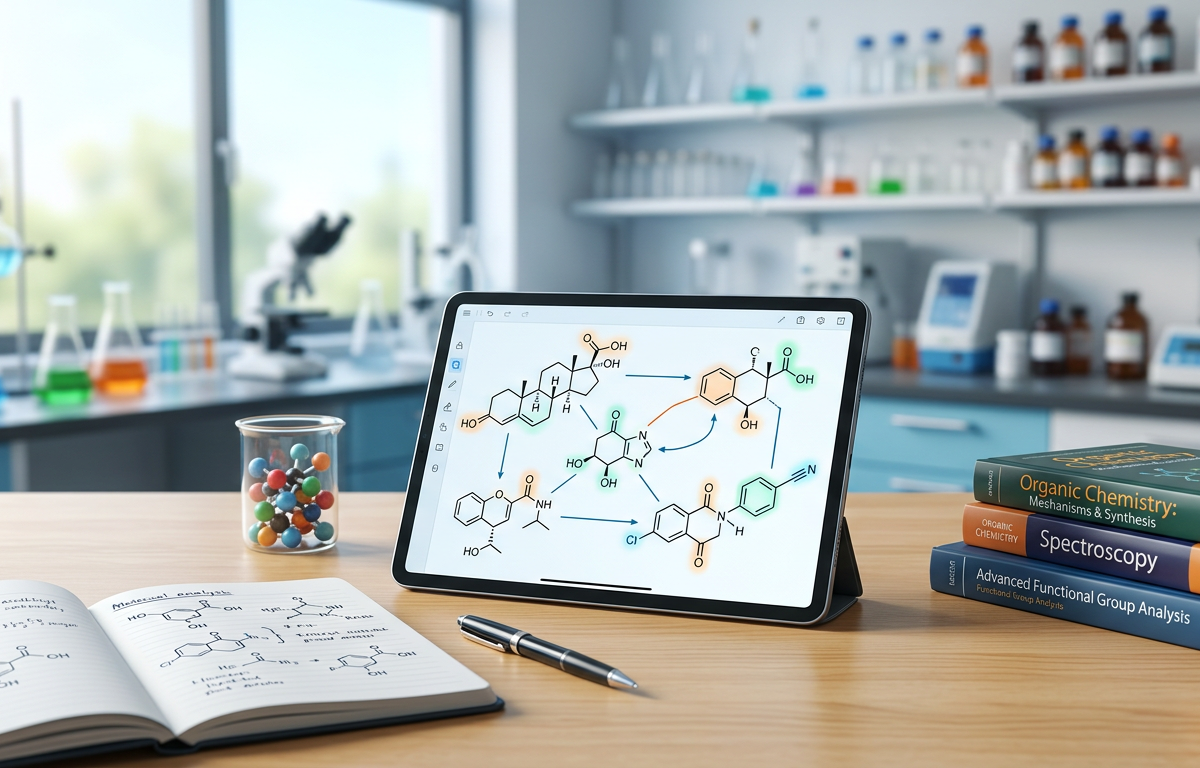
Concept Explanation
Functional group identification is the process of recognizing specific arrangements of atoms within a molecule that determine its chemical reactivity and physical properties, regardless of the size of the rest of the molecule.
In organic chemistry, these groups are the reactive centers of molecules. While basic identification involves spotting a simple hydroxyl (-OH) or carbonyl (C=O) group, advanced identification requires distinguishing between polyfunctional compounds, understanding the electronic effects of neighboring groups, and interpreting spectroscopic data. For instance, a carbonyl group is found in aldehydes, ketones, carboxylic acids, esters, and amides; the specific identity depends on what is attached to the carbon atom. Mastering this skill is a prerequisite for understanding reaction mechanisms and predicting molecular behavior in complex biological systems. According to the International Union of Pure and Applied Chemistry (IUPAC), functional groups are organized by priority to determine the systematic naming of compounds.
Solved Examples
The following examples demonstrate how to systematically analyze complex molecules for functional group identification.
Identify all functional groups in Aspirin (Acetylsalicylic acid).
Structure analysis: Aspirin contains a benzene ring, a carboxylic acid group, and an ester group.
Look at the substituent -COOH: This is the carboxylic acid.
Look at the substituent -OCOCH3: This is an ester group (specifically an acetoxy group).
The aromatic ring itself is an arene.
Final Answer: Arene, Carboxylic Acid, Ester.
Distinguish between a primary, secondary, and tertiary amide.
A primary amide has the form R-CONH2 (two hydrogens on nitrogen).
A secondary amide has the form R-CONHR' (one hydrogen on nitrogen).
A tertiary amide has the form R-CONR'R'' (no hydrogens on nitrogen).
Example: N,N-dimethylformamide (DMF) is a tertiary amide.
Identify the groups in Caffeine.
Caffeine is a xanthine alkaloid. It contains two fused rings (an imidazole and a pyrimidine-2,4-dione).
Look for nitrogen atoms: There are four nitrogens. Two are part of amide-like structures (specifically cyclic amides called lactams).
Look for double bonds: There is an alkene-like double bond within the imidazole ring.
Look for amines: There are tertiary amine sites within the ring system.
Final Answer: Amides (cyclic/lactams), Tertiary Amines, Alkene (aromatic-like).
Practice Questions
Test your skills with these hard functional group identification practice questions. Ensure you look for subtle differences between similar groups like ethers and esters.
1. Identify the five distinct functional groups present in the molecule of Penicillin G.
2. A molecule has the formula C4H6O3 and shows a strong IR absorption at 1820 cm⁻¹ and 1750 cm⁻¹. Which functional group is likely present?
3. Identify the functional groups in the neurotransmitter Dopamine.
Start Learning Smarter Today
Join thousands of students using AI-powered study tools to achieve better results.
Get Started Free
Start Learning Smarter Today
Join thousands of students using AI-powered study tools to achieve better results.
Get Started Free4. In a molecule containing both a ketone and an aldehyde, which group takes priority for IUPAC naming? (Hint: See naming organic compounds).
5. Identify the functional groups in the amino acid Arginine at physiological pH (7.4).
6. What functional groups are formed when a triglyceride undergoes saponification (hydrolysis with NaOH)?
7. Identify the functional groups in the molecule Acrylonitrile.
8. A compound contains a nitrogen atom single-bonded to two carbons and one hydrogen, where one of the carbons is part of a carbonyl group. Identify the specific functional group.
9. Identify the functional groups in the molecule Vanillin.
10. Distinguish between a phenol and an aliphatic alcohol based on their chemical environment.
Answers & Explanations
Penicillin G: Contains a carboxylic acid, a thioether (sulfide), a secondary amide, a beta-lactam (cyclic amide), and an aromatic (benzene) ring. The beta-lactam is the most chemically significant for its antibiotic activity.
Acid Anhydride: The formula C4H6O3 and the characteristic double carbonyl absorption in IR spectroscopy (around 1820 and 1750 cm⁻¹) are diagnostic of an acid anhydride (specifically acetic anhydride).
Dopamine: Contains a catechol (a benzene ring with two adjacent hydroxyl groups) and a primary amine. The catechol part makes it a phenol derivative.
Aldehyde: According to IUPAC priority rules, the aldehyde group (-CHO) has higher priority than the ketone group (>C=O). The suffix will be \"-al\" and the ketone will be treated as an \"oxo-\" substituent.
Arginine: At pH 7.4, it contains a carboxylate ion (-COO⁻), a protonated primary amine (-NH3⁺), and a protonated guanidino group. The guanidino group is a complex nitrogenous group unique to arginine.
Carboxylate salts and Alcohol: Saponification breaks the ester bonds in the triglyceride, yielding glycerol (a tri-alcohol) and salts of fatty acids (carboxylates).
Acrylonitrile: Contains an alkene (vinyl group) and a nitrile (cyano group). Structure: CH2=CH-CN.
Secondary Amide: Because the nitrogen is bonded to a carbonyl carbon and another carbon, and retains one hydrogen, it is classified as a secondary amide.
Vanillin: Contains an aldehyde, an ether (methoxy group), and a phenol (hydroxyl on a benzene ring).
Phenol vs. Aliphatic Alcohol: A phenol has the -OH group directly attached to an aromatic ring, making it significantly more acidic than an aliphatic alcohol where the -OH is attached to an sp³ hybridized carbon. You can further verify this through NMR interpretation where phenolic protons appear further downfield.
1. Which functional group is characterized by a carbon-nitrogen triple bond?
Frequently Asked Questions
What is the difference between an amine and an amide?
An amine consists of a nitrogen atom bonded to alkyl or aryl groups, whereas an amide features a nitrogen atom bonded directly to a carbonyl carbon. This structural difference significantly changes their basicity and reactivity.
How do you identify an ester in a complex molecule?
Look for a carbonyl group (C=O) where the carbon is also single-bonded to an oxygen atom that is further bonded to another carbon chain. This R-CO-OR' arrangement is the signature of an ester.
Why is phenol considered different from a regular alcohol?
Phenol has a hydroxyl group attached to an aromatic ring, which allows for resonance stabilization of the conjugate base. This makes phenols much more acidic than aliphatic alcohols like ethanol.
What is a "polyfunctional" molecule?
A polyfunctional molecule is an organic compound that contains two or more different functional groups. Examples include amino acids (amine and carboxylic acid) and keto-acids.
What is the highest priority functional group in IUPAC nomenclature?
The carboxylic acid group generally holds the highest priority in IUPAC naming conventions. When present, it dictates the numbering of the carbon chain and the suffix of the molecule's name.
Start Learning Smarter Today
Join thousands of students using AI-powered study tools to achieve better results.
Get Started FreeEnjoyed this article?
Share it with others who might find it helpful.
Related Articles
Hard Le Chatelier’s Principle Practice Questions
Master Hard Le Chatelier’s Principle Practice Questions with our comprehensive guide featuring solved examples, practice problems, and detailed explanations.
Mar 30, 2026
Hard Reaction Quotient (Q) Practice Questions
Hard Reaction Quotient (Q) Practice Questions
Mar 30, 2026
Grams to Moles Practice Questions with Answers
Master grams to moles conversions with our comprehensive guide. Includes step-by-step examples, practice questions, and detailed answers for chemistry students.
Mar 26, 2026
Avogadro’s Number Practice Questions with Answers
Master the mole concept with our Avogadro’s Number practice questions. Includes step-by-step solved examples, a quick quiz, and detailed explanations.
Mar 26, 2026

Empirical Formulas: Solving Ratios from Mass and Percent Data
Master empirical formula calculations with 10 practice questions, worked answers, and a free step-by-step calculator for mass, percentage, and combustion problems.
Mar 26, 2026