Hard Calorimetry Practice Questions
Concept Explanation
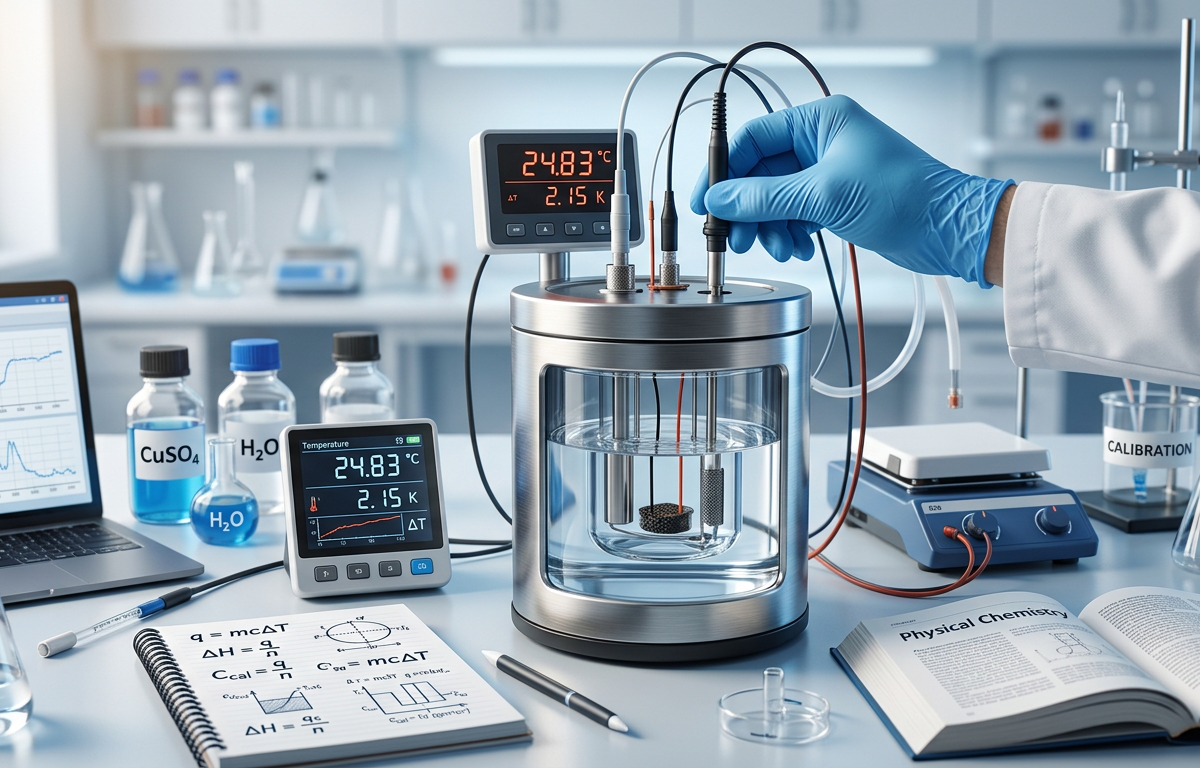
Calorimetry is the experimental science of measuring the heat flow associated with chemical reactions or physical transitions using a device called a calorimeter. At its core, calorimetry relies on the law of conservation of energy, which dictates that in an isolated system, the heat lost by one component must equal the heat gained by another (). While basic problems often focus on simple temperature changes in water, hard calorimetry practice questions typically involve phase changes, heat capacity of the calorimeter itself (calorimeter constant), and complex multi-step thermal equilibriums. Understanding the specific heat capacity ($c$), latent heat ($L$), and the difference between constant-pressure (coffee-cup) and constant-volume (bomb) calorimetry is essential for mastery. For more foundational concepts, you might want to review Calorimetry Practice Questions with Answers before tackling these advanced scenarios.
Solved Examples
The following examples demonstrate how to handle multi-step thermal energy transfers and the integration of phase changes into heat calculations.
Example 1: Ice to Steam Transition
Calculate the total energy required to convert 50.0 g of ice at -10.0°C to liquid water at 25.0°C. (Specific heat of ice = 2.09 J/g°C, water = 4.18 J/g°C; Heat of fusion = 334 J/g).Calculate heat to warm ice to 0°C: J.
Calculate heat for phase change (melting): J.
Calculate heat to warm water to 25°C: J.
Sum the values: J or 23.0 kJ.
Example 2: Bomb Calorimetry
A 1.50 g sample of benzoic acid is burned in a bomb calorimeter with a heat capacity of 10.15 kJ/°C. The temperature rises from 22.00°C to 25.87°C. Calculate the molar heat of combustion () in kJ/mol. (Molar mass = 122.12 g/mol).Calculate heat absorbed by the calorimeter: kJ.
Since the calorimeter absorbed heat, the reaction released it: kJ.
Determine moles of benzoic acid: mol.
Calculate molar heat: kJ/mol.
Example 3: Metal Identity via Thermal Equilibrium
A 100.0 g piece of metal at 150.0°C is dropped into 200.0 g of water at 20.0°C. The final temperature is 26.5°C. Calculate the specific heat of the metal.Set up the energy balance: .
Calculate J.
Set J.
Solve for : .
J/g°C.
Practice Questions
Test your skills with these advanced problems involving calorimetric principles and thermodynamic laws.
A 25.0 g sample of an unknown alloy at 98.0°C is placed in a calorimeter containing 50.0 g of water at 21.0°C. If the final temperature is 24.5°C, what is the specific heat of the alloy?
A coffee-cup calorimeter contains 150.0 g of water at 24.6°C. A 12.0 g sample of an ionic salt is dissolved, and the temperature drops to 21.1°C. Calculate the enthalpy of solution in J/g. (Assume the solution has the same specific heat as water).
How much energy is required to transform 10.0 g of ice at -20.0°C into steam at 110.0°C? (, , J/g°C; J/g, J/g).
Start Learning Smarter Today
Join thousands of students using AI-powered study tools to achieve better results.
Get Started Free
Start Learning Smarter Today
Join thousands of students using AI-powered study tools to achieve better results.
Get Started FreeA bomb calorimeter with is used to burn 2.00 g of glucose (). The temperature rises from 23.00°C to 26.65°C. Calculate the molar enthalpy of combustion for glucose.
50.0 mL of 1.0 M HCl and 50.0 mL of 1.0 M NaOH are mixed in a calorimeter. Both solutions start at 22.5°C. The final temperature is 29.2°C. Calculate the of neutralization in kJ/mol. (Assume density = 1.00 g/mL and J/g°C).
A 45.0 g piece of copper ( J/g°C) at 100.0°C is placed in a calorimeter with 100.0 g of water at 25.0°C. The calorimeter itself is made of 50.0 g of aluminum ( J/g°C). Find the final equilibrium temperature.
A reaction releases 45.2 kJ of heat. If this reaction is performed in a calorimeter containing 500.0 g of water (initially at 20.0°C) and the calorimeter has a heat capacity of 150 J/°C, what is the final temperature?
Ethylene glycol is used as a coolant. If 2.50 kg of ethylene glycol ( J/g°C) at 80.0°C is mixed with 5.00 kg of water at 20.0°C, what is the final temperature of the mixture?
Calculate the amount of ice at 0.0°C that must be added to 250.0 g of water at 85.0°C to cool the water to 15.0°C.
A 0.500 g sample of naphthalene () is burned in a bomb calorimeter. The temperature increases by 2.54°C. If the heat of combustion of naphthalene is -5150 kJ/mol, what is the heat capacity of the calorimeter?
Answers & Explanations
Answer: 0.398 J/g°C.
First, find heat gained by water: J. Heat lost by alloy is -731.5 J. J/g°C.Answer: -183 J/g.
Calculate heat change: J. Since the temperature dropped, the process is endothermic for the salt: J. Per gram: $2370 / 12.0 = 197.5$ J/g. (Note: is usually expressed relative to the system; here the solution process absorbed heat).Answer: 30.7 kJ.
Steps: Warm ice (418 J) + Melt ice (3340 J) + Warm water (4180 J) + Vaporize water (22600 J) + Warm steam (201 J). Total = 30,739 J.Answer: -2803 kJ/mol.
kJ. Moles glucose = $2.00 / 180.16 = 0.0111$ mol. kJ/mol (slight variance due to rounding).Answer: -56.1 kJ/mol.
Total mass = 100.0 g. J. Moles of reacted = $0.050$ L \u00d7 $1.0$ M = $0.050$ mol. kJ/mol.Answer: 27.8°C.
Set . $45.0 \u00d7 0.385 \u00d7 (T_f - 100) = -[100.0 \u00d7 4.18 \u00d7 (T_f - 25) + 50.0 \u00d7 0.897 \u00d7 (T_f - 25)]$. Solving for gives 27.8°C.Answer: 40.2°C.
. $45,200 = (500.0 \u00d7 4.184 \u00d7 \u0394T) + (150 \u00d7 \u0394T)$. $45,200 = 2242 \u00d7 \u0394T$. . °C.Answer: 33.5°C.
. $2500 \u00d7 2.42 \u00d7 (T_f - 80) = -5000 \u00d7 4.18 \u00d7 (T_f - 20)$. $6050T_f - 484000 = -20900T_f + 418000$. $26950T_f = 902000$. °C.Answer: 185 g.
Heat lost by water: J. Heat gained by ice: (melt) + (warm). $73,150 = m(334 + 62.7)$. g.Answer: 7.92 kJ/°C.
Moles naphthalene = $0.500 / 128.17 = 0.003901$ mol. Total heat released = $0.003901 \u00d7 5150 = 20.09$ kJ. kJ/°C.
1. Which condition is required for a bomb calorimeter to measure the internal energy change (ΔU) directly?
Frequently Asked Questions
What makes a calorimetry problem \"hard\"?
Hard calorimetry problems usually incorporate multiple phases of matter, require accounting for the calorimeter's own heat capacity, or involve chemical reactions where you must first determine the limiting reactant. They often require solving for an unknown final temperature using algebraic rearrangement of the equation.
How do I account for the calorimeter constant?
The calorimeter constant () represents the heat capacity of the entire apparatus. You add the term to the energy balance equation, ensuring that the heat absorbed by the container is not ignored in your final calculation.
What is the difference between specific heat and heat capacity?
Specific heat capacity is an intensive property representing the heat required to raise 1 gram of a substance by 1°C. Heat capacity is an extensive property representing the heat required to raise the entire object's temperature by 1°C, regardless of its mass.
Why is water commonly used in calorimetry?
Water has a very high specific heat capacity (4.184 J/g°C), which allows it to absorb or release large amounts of heat with relatively small changes in temperature. This makes it an ideal medium for measuring thermal energy transfers in a laboratory setting.
When should I use ΔH_fus versus ΔH_vap?
You use the heat of fusion () when a substance is transitioning between solid and liquid phases (melting or freezing). You use the heat of vaporization () when a substance is transitioning between liquid and gas phases (boiling or condensing).
Can calorimetry be used to find molar mass?
Yes, if the total heat released by a known mass of a substance is measured and the molar heat of combustion is known, you can calculate the moles used. Dividing the mass by the number of moles then provides the molar mass of the substance.
Start Learning Smarter Today
Join thousands of students using AI-powered study tools to achieve better results.
Get Started FreeEnjoyed this article?
Share it with others who might find it helpful.
Related Articles
Hard Le Chatelier’s Principle Practice Questions
Master Hard Le Chatelier’s Principle Practice Questions with our comprehensive guide featuring solved examples, practice problems, and detailed explanations.
Mar 30, 2026

Hard Reaction Quotient (Q) Practice Questions
Hard Reaction Quotient (Q) Practice Questions
Mar 30, 2026
Grams to Moles Practice Questions with Answers
Master grams to moles conversions with our comprehensive guide. Includes step-by-step examples, practice questions, and detailed answers for chemistry students.
Mar 26, 2026
Avogadro’s Number Practice Questions with Answers
Master the mole concept with our Avogadro’s Number practice questions. Includes step-by-step solved examples, a quick quiz, and detailed explanations.
Mar 26, 2026
Empirical Formulas: Solving Ratios from Mass and Percent Data
Master empirical formula calculations with 10 practice questions, worked answers, and a free step-by-step calculator for mass, percentage, and combustion problems.
Mar 26, 2026