Easy Weight-Based Dosage Calculations Practice Questions
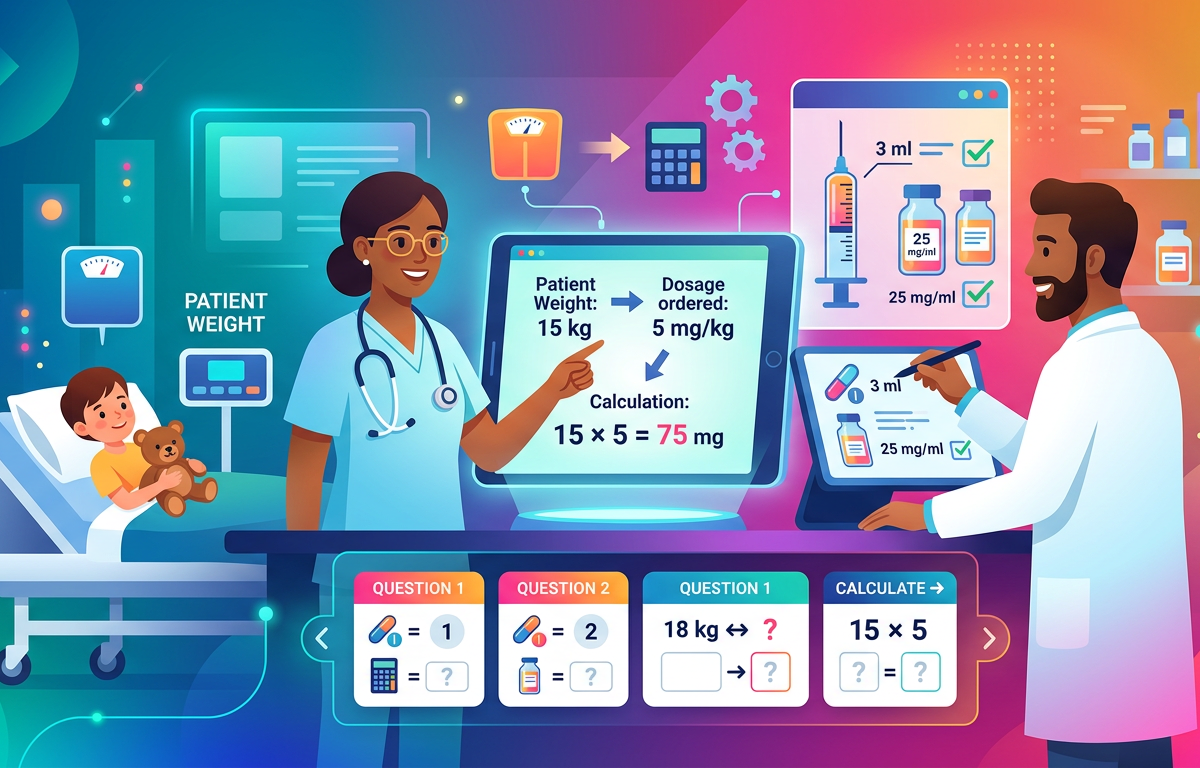
Easy Weight-Based Dosage Calculations Practice Questions
Mastering weight-based dosage calculations is a fundamental skill for nursing students and healthcare professionals to ensure patient safety and medication accuracy. These calculations require converting a patient's body weight into a specific dose of medication, typically expressed as milligrams per kilogram (mg/kg). By practicing these Easy Weight-Based Dosage Calculations Practice Questions, you will build the confidence needed to handle real-world clinical scenarios and excel in exams like the NCLEX.
Concept Explanation
Weight-based dosage calculations are mathematical processes used to determine the correct amount of medication for a patient based on their body weight, typically measured in kilograms (kg).
The standard formula for calculating a weight-based dose involves three primary steps. First, if the patient's weight is provided in pounds (lb), it must be converted to kilograms. According to the National Institute of Standards and Technology, the conversion factor is . Second, multiply the weight in kilograms by the prescribed dosage rate (e.g., ). Finally, if the medication is supplied in a specific concentration, use dimensional analysis to determine the final volume to be administered.
For more complex scenarios involving pediatric patients, you may want to review our guide on pediatric dosage practice questions. This method ensures that patients—especially children and those receiving high-potency drugs—receive a dose tailored to their physiological size, reducing the risk of toxicity or subtherapeutic treatment.
| Step | Action | Formula/Factor |
|---|---|---|
| 1 | Convert lb to kg | |
| 2 | Calculate Total Dose | |
| 3 | Convert to Volume |
Solved Examples
Review these solved examples to understand the logic behind the calculations before attempting the practice set.
- Example 1: Basic mg/kg Calculation
A physician orders Amoxicillin for a child weighing . How many milligrams should be administered?- Identify the weight: .
- Identify the dosage rate: .
- Multiply:
- Answer: 300 mg.
- Example 2: Weight Conversion (lb to kg)
A patient weighs . The order is for a medication at . Calculate the total dose.- Convert weight to kg:
- Calculate dose:
- Answer: 140 mg.
- Example 3: Calculating Volume (mL)
Order: Heparin SC. Patient weight: . Available: Heparin .- Calculate total units:
- Calculate volume:
- Answer: 0.8 mL.
Practice Questions
Test your knowledge with these weight-based dosage questions. Remember to round your final answers to the nearest tenth unless otherwise specified.
1. A provider orders Cefazolin for a patient weighing . What is the total dose in milligrams?
2. A patient weighs . The physician orders a medication at . How many milligrams will the patient receive?
3. Order: Methylprednisolone IV. Weight: . What is the total dose in mg?
Struggling with dosage calculations?
Practice IV flow rates, dimensional analysis, drip rates, and dosage calculations instantly with Bevinzey.
Practice Dosage Questions4. Order: Gentamicin IV. Weight: . Available: Gentamicin . How many mL will you administer?
5. A child weighs . The order is for Acetaminophen PO. Available: Liquid Acetaminophen . How many mL should be given?
6. An infant weighs . The order is for of a medication. How many micrograms (mcg) is this dose?
7. Order: Enoxaparin SC every 12 hours. Weight: . How many mg will the patient receive per dose?
8. Order: Vancomycin IV. Weight: . The drug is available in a vial labeled . How many mL are required?
9. A patient weighing is to receive a loading dose of Phenytoin at . What is the total loading dose in mg?
10. Order: Furosemide IV push. Weight: . Available: . How many mL will you draw up?
Answers & Explanations
- 1,500 mg
Calculation: . Since the weight was already in kg, no conversion was needed. - 50 mg
First, convert weight: . Then multiply by the dose: . - 100 mg
Convert weight: . Dose calculation: . - 5.6 mL
Total mg: . Volume: , rounded to 5.6 mL. - 9.4 mL
Convert weight: . Total mg: . Volume: , rounded to 9.4 mL. - 800 mcg
Total mg: . Convert to mcg: . For more on unit shifts, see our oral dosage practice questions. - 90 mg
Convert weight: . Dose: . - 13.5 mL
Total mg: . Convert available concentration: . Volume: . - 900 mg
Calculation: . - 8 mL
Convert weight: . Total mg: . Volume: .
1. What is the first step in a weight-based calculation if the patient's weight is given in pounds?
Frequently Asked Questions
How do I convert pounds to kilograms?
To convert pounds to kilograms, divide the weight in pounds by 2.2. For example, a 110-pound person weighs 50 kilograms after dividing 110 by 2.2.
What is the most common error in weight-based dosing?
The most common error is failing to convert pounds to kilograms before multiplying by the dosage rate. This often results in a dose that is more than double the intended amount, posing a significant safety risk.
Can I use a calculator for these dosage questions?
Yes, most nursing programs and the NCLEX provide an on-screen calculator for these problems. However, you should still understand the manual steps to verify your results for accuracy.
When should I round my answer in weight-based calculations?
You should generally wait until the final step to round your answer to avoid cumulative rounding errors. Standard practice is to round to the nearest tenth for adults and often the nearest hundredth for infants, depending on institutional policy.
What is the difference between mg/kg and mcg/kg/min?
Mg/kg is a flat dose based on weight, while mcg/kg/min is a titration rate typically used for continuous IV infusions. For help with time-based rates, explore our IV flow rate practice questions.
Where can I find more practice for the NCLEX?
You can use the AI Exam Simulator to practice standardized dosage questions in a timed environment. This tool helps simulate the real testing experience for better preparation.
Struggling with dosage calculations?
Practice IV flow rates, dimensional analysis, drip rates, and dosage calculations instantly with Bevinzey.
Practice Dosage QuestionsReviewed by
Michael Danquah, MS, PhD
Dr. Michael Danquah is a professor of pharmaceutical sciences and founder of several educational technology platforms focused on improving student learning and performance.
Enjoyed this article?
Share it with others who might find it helpful.
Related Articles

Hard Le Chatelier’s Principle Practice Questions
Master Hard Le Chatelier’s Principle Practice Questions with our comprehensive guide featuring solved examples, practice problems, and detailed explanations.
Mar 30, 2026

Hard Reaction Quotient (Q) Practice Questions
Hard Reaction Quotient (Q) Practice Questions
Mar 30, 2026

Grams to Moles Practice Questions with Answers
Master grams to moles conversions with our comprehensive guide. Includes step-by-step examples, practice questions, and detailed answers for chemistry students.
Mar 26, 2026

Avogadro’s Number Practice Questions with Answers
Master the mole concept with our Avogadro’s Number practice questions. Includes step-by-step solved examples, a quick quiz, and detailed explanations.
Mar 26, 2026

Empirical Formulas: Solving Ratios from Mass and Percent Data
Master empirical formula calculations with 10 practice questions, worked answers, and a free step-by-step calculator for mass, percentage, and combustion problems.
Mar 26, 2026