Easy Reaction Order Practice Questions

Concept Explanation
Reaction order is the power to which the concentration of a reactant is raised in the rate law equation, indicating how the rate of a chemical reaction changes in response to changes in that reactant's concentration. In chemical kinetics, the rate law is typically expressed as Rate = k[A]x[B]y, where the exponents 'x' and 'y' represent the individual reaction orders for each reactant. The overall reaction order is simply the sum of these individual exponents (x + y). Understanding these relationships is a fundamental step for students learning rate law practice questions and chemical dynamics.
Reaction orders are determined experimentally and cannot always be predicted by looking at the stoichiometric coefficients in a balanced chemical equation. The most common orders encountered in introductory chemistry are:
Zero-Order: The rate is independent of the reactant concentration. Doubling the concentration has no effect on the rate.
First-Order: The rate is directly proportional to the reactant concentration. Doubling the concentration doubles the rate.
Second-Order: The rate is proportional to the square of the reactant concentration. Doubling the concentration quadruples the rate (22 = 4).
According to LibreTexts Chemistry, these orders help scientists predict how long a reaction will take and what mechanism the molecules follow during the process. For those preparing for standardized tests, mastering these basics is as essential as knowing how to study for exams for the MCAT, where kinetics is a high-yield topic.
Solved Examples
The following examples demonstrate how to calculate individual and overall reaction orders using rate law expressions.
Example 1: Identifying Order from a Rate Law
Given the rate law: Rate = k[NO]2[O2], determine the order with respect to each reactant and the overall reaction order.
Look at the exponent for [NO]. The exponent is 2, so the reaction is second-order with respect to NO.
Look at the exponent for [O2]. Since no exponent is written, it is understood to be 1. The reaction is first-order with respect to O2.
Add the exponents together to find the overall order: 2 + 1 = 3. The overall reaction order is third-order.
Example 2: Deducing Order from Concentration Changes
In a reaction A → B, when the concentration of A is tripled, the rate of the reaction triples. What is the reaction order with respect to A?
Set up the proportional relationship: Rate ∝ [A]n.
Substitute the changes: (3) = (3)n.
Solve for n: Since 31 = 3, the value of n must be 1. The reaction is first-order.
Example 3: Zero-Order Relationships
A reaction has the rate law Rate = k[NH3]0. What happens to the rate if the concentration of NH3 is doubled?
Identify the exponent: The exponent is 0.
Apply the math: Any number raised to the power of 0 is 1.
Conclusion: The rate is equal to the rate constant (k) and does not change. The rate remains constant regardless of concentration.
Practice Questions
Test your knowledge with these easy reaction order practice questions. Ensure you have a calculator and a notebook ready.
1. A reaction has the rate law: Rate = k[A][B]2. What is the reaction order with respect to reactant A?
2. If a reaction is second-order overall and contains only one reactant (X), write the rate law expression.
3. Calculate the overall reaction order for the following rate law: Rate = k[H2][I2].
Start Learning Smarter Today
Join thousands of students using AI-powered study tools to achieve better results.
Get Started Free4. For the reaction 2NO + Cl2 → 2NOCl, the rate law is found to be Rate = k[NO]2[Cl2]. If the concentration of Cl2 is doubled while NO is held constant, by what factor does the rate increase?
5. A reaction is zero-order with respect to reactant B. If the initial concentration of B is 0.50 M and it is increased to 2.0 M, how will the rate be affected?
6. Identify the overall reaction order for a process with the rate law: Rate = k[PCl3][Cl2].
7. If doubling the concentration of a reactant causes the rate to increase by a factor of 4, what is the order of the reaction with respect to that reactant?
8. What is the unit of the rate constant (k) for a first-order reaction? (Hint: Rate is in M/s).
9. A reaction is third-order overall. If the rate law is Rate = k[A]x[B]1, what is the value of x?
10. In the decomposition of hydrogen peroxide, the reaction is first-order. If the rate is 0.020 M/s at a concentration of 1.0 M, what is the rate if the concentration is reduced to 0.50 M?
Answers & Explanations
Answer: 1 (First-order). In the expression Rate = k[A][B]2, the reactant A has no visible exponent, which mathematically implies an exponent of 1.
Answer: Rate = k[X]2. Since there is only one reactant and the overall order is 2, that reactant must be raised to the second power.
Answer: 2 (Second-order overall). Both H2 and I2 have an implied exponent of 1. Adding them (1 + 1) gives an overall order of 2.
Answer: 2 (Doubles). The reaction is first-order with respect to Cl2. Therefore, the rate change is proportional to the concentration change: 21 = 2.
Answer: No change. In a zero-order reaction, the rate is independent of the concentration of the reactant. Increasing the concentration of B does not affect the speed of the reaction.
Answer: 2. The individual orders are 1 for PCl3 and 1 for Cl2. Summing them gives 1 + 1 = 2.
Answer: 2 (Second-order). We use the formula (Change in Concentration)order = Change in Rate. Here, 2n = 4. Since 22 = 4, the order is 2.
Answer: s-1 (or 1/s). For a first-order reaction, Rate (M/s) = k [M]. To solve for k, we divide (M/s) by M, which leaves 1/s. This is a common topic in reaction order practice questions regarding units.
Answer: 2. The overall order is the sum of exponents: x + 1 = 3. Solving for x gives x = 2.
Answer: 0.010 M/s. Because the reaction is first-order, the rate is directly proportional to concentration. If the concentration is halved (from 1.0 M to 0.50 M), the rate is also halved (0.020 / 2 = 0.010).
1. If a reaction rate quadruples when the reactant concentration is doubled, what is the reaction order?
Frequently Asked Questions
How do you find the overall reaction order?
The overall reaction order is found by summing the individual exponents of all reactants appearing in the rate law equation. For example, if the rate law is Rate = k[A]1[B]2, the overall order is 1 + 2 = 3.
Can a reaction order be a fraction?
Yes, reaction orders can be fractions, although they are most commonly integers like 0, 1, or 2 in introductory chemistry. Fractional orders often indicate a complex reaction mechanism involving multiple steps.
What does a zero-order reaction mean in practical terms?
A zero-order reaction means that the rate of the reaction is constant and does not speed up or slow down as reactants are consumed. This often occurs in reactions catalyzed by a surface or enzyme that is completely saturated by the reactant.
Why is reaction order important?
Reaction order is critical because it allows chemists to understand the reaction mechanism and predict how the reaction will behave under different conditions. It is essential for industrial processes where controlling the speed of a reaction is necessary for safety and efficiency.
Is the reaction order always the same as the stoichiometric coefficient?
No, the reaction order is not necessarily the same as the coefficients in the balanced equation. While they may match in simple one-step elementary reactions, they must always be verified through experimental measurements.
How do units of the rate constant change with reaction order?
The units of the rate constant (k) change to ensure the rate is always expressed in M/s. For zero-order, units are M/s; for first-order, units are s⁻¹; and for second-order, units are M⁻¹s⁻¹.
Start Learning Smarter Today
Join thousands of students using AI-powered study tools to achieve better results.
Get Started FreeEnjoyed this article?
Share it with others who might find it helpful.
Related Articles
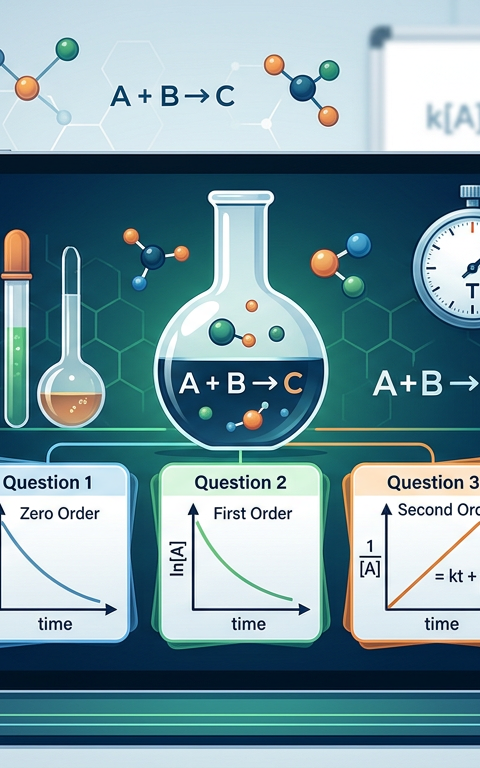
Medium Reaction Order Practice Questions
Master chemical kinetics with these medium reaction order practice questions, including step-by-step solutions, rate law calculations, and a quick quiz.
Apr 2, 2026
Hard Redox Reaction Practice Questions
Master complex chemistry with our Hard Redox Reaction Practice Questions. Learn to balance equations in acidic/basic media and calculate cell potentials.
Apr 4, 2026
Medium Redox Reaction Practice Questions
Master medium-level redox reaction problems with our comprehensive guide featuring solved examples, balancing tips, and practice questions for students.
Apr 4, 2026
Easy Redox Reaction Practice Questions
Master the basics of electron transfer with these easy redox reaction practice questions, featuring step-by-step solutions and clear explanations.
Apr 4, 2026
Redox Reaction Practice Questions with Answers
Master redox reactions with these practice questions and answers. Learn to identify oxidation, reduction, and balancing techniques for your chemistry exams.
Apr 3, 2026
Predicting Reaction Direction: Q vs K Comparison Practice
Master the reaction quotient (Q) with these easy practice questions. Learn how to calculate Q and predict the direction of chemical shifts.
Mar 30, 2026
Predicting Reaction Yields: Grams-to-Grams Stoichiometry Guide
Master mass-to-mass stoichiometry with our comprehensive guide. Includes step-by-step solved examples, practice questions, and a quick quiz to test your knowledge.
Mar 21, 2026

Calculating High-Stakes Meds: BSA Mosteller Formula Practice
Master hard body surface area-based dosage calculations with our comprehensive guide, solved examples, and practice questions for healthcare students.
May 17, 2026