Easy Reaction Mechanism Practice Questions
Concept Explanation
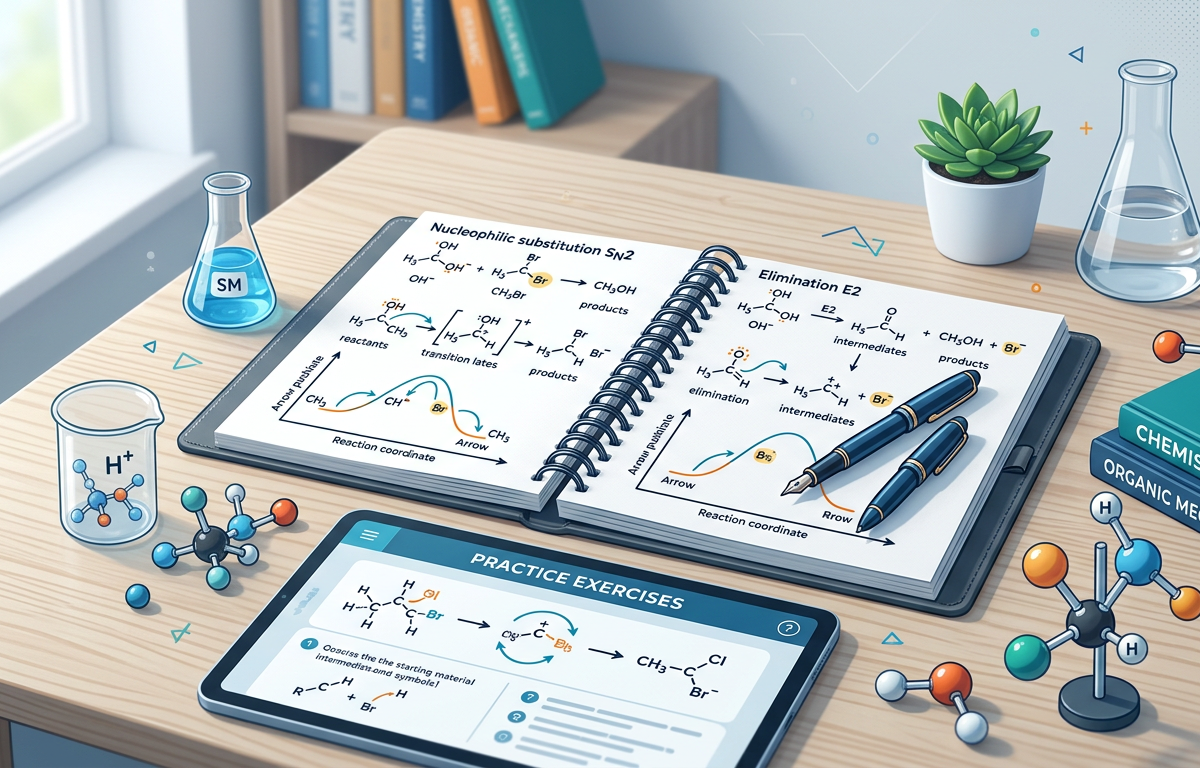
A reaction mechanism is a step-by-step description of the path that reactants take to become products, detailing the movement of electrons and the formation or breaking of chemical bonds. While a balanced chemical equation tells us what starts and ends a reaction, the mechanism provides the \"behind-the-scenes\" look at individual elementary steps. Understanding these pathways is essential for predicting the outcome of chemical processes and is a fundamental skill in organic chemistry. For students just starting out, mastering these basics is as critical as learning Naming Organic Compounds (IUPAC).
Key components of a reaction mechanism include:
Curved Arrows: These represent the movement of electron pairs. An arrow starts at an electron source (like a lone pair or a bond) and points to an electron sink (an atom or a new bond location).
Nucleophiles and Electrophiles: Nucleophiles are electron-rich species that donate electrons, while electrophiles are electron-poor species that accept them.
Reaction Intermediates: These are short-lived species, such as carbocations, carbanions, or free radicals, that form during one step and are consumed in the next.
Transition States: High-energy, unstable arrangements of atoms that represent the peak of the energy barrier between steps.
According to the IUPAC Gold Book, a mechanism must account for all observed experimental data, including the rate law and stereochemistry. For those advancing to more complex topics, comparing SN1 vs SN2 Reaction Practice Questions can help clarify how different pathways compete under various conditions.
Solved Examples
Reviewing worked problems helps visualize how electrons move during a chemical transformation. Here are three examples of common, entry-level mechanisms.
Example 1: Nucleophilic Attack on a Carbocation
Show the mechanism for the reaction between a methyl carbocation (CH₃⁺) and a bromide ion (Br⁻).
Identify the nucleophile (Br⁻) and the electrophile (CH₃⁺).
Draw a curved arrow starting from one of the lone pairs on the bromide ion.
Point the arrow directly at the positively charged carbon atom.
The result is the formation of a C-Br sigma bond, creating methyl bromide.
Example 2: Protonation of Water
Show how a water molecule (H₂O) reacts with a hydronium ion (H₃O⁺) to exchange a proton.
Identify water as the nucleophile (using its lone pair) and the hydronium ion as the acid/electrophile.
Draw an arrow from the oxygen lone pair of H₂O to one of the hydrogen atoms on H₃O⁺.
Simultaneously draw an arrow from the O-H bond in H₃O⁺ back to its oxygen atom to break the bond.
The products are a new hydronium ion and a neutral water molecule.
Example 3: Simple Alkene Electrophilic Addition (First Step)
Show the first step of the reaction between ethylene (CH₂=CH₂) and H⁺.
The pi bond in the alkene acts as the nucleophile.
Draw a curved arrow from the center of the C=C double bond to the H⁺ ion.
One carbon forms a new C-H bond, while the other carbon loses its share of the pi electrons, becoming a carbocation.
The intermediate is an ethyl carbocation (CH₃CH₂⁺).
Practice Questions
Test your understanding of electron flow and basic reactivity with these easy reaction mechanism practice questions.
1. Identify the nucleophile in the reaction between ammonia (:NH₃) and boron trifluoride (BF₃).
2. Draw the curved arrow for the dissociation of a C-Cl bond in tert-butyl chloride to form a carbocation and a chloride ion.
3. In a reaction where a hydroxide ion (OH⁻) attacks a methyl cation (CH₃⁺), which atom is the electron sink?
Start Learning Smarter Today
Join thousands of students using AI-powered study tools to achieve better results.
Get Started Free
Start Learning Smarter Today
Join thousands of students using AI-powered study tools to achieve better results.
Get Started Free4. Define the term \"reaction intermediate\" and provide one example.
5. What does a double-headed curved arrow signify in a mechanism diagram?
6. If an arrow starts at a pi bond and points to an atom, what type of new bond is being formed?
7. True or False: A transition state can be isolated and stored in a laboratory bottle.
8. Draw the mechanism for the reaction of a methoxide ion (CH₃O⁻) with a proton (H⁺) to form methanol.
Answers & Explanations
1. Ammonia (:NH₃). The nucleophile is the species that donates an electron pair. Ammonia has a lone pair on the nitrogen atom, whereas BF₃ is electron-deficient and acts as the electrophile.
2. Arrow from bond to atom. The curved arrow should start at the center of the C-Cl sigma bond and point directly to the Chlorine atom. This indicates that both electrons in the bond are moving to the Chlorine to form a chloride ion (Cl⁻).
3. The Carbon atom. The electron sink is the destination of the electrons. Since the hydroxide ion (source) is attacking the methyl cation, the carbon atom with the positive charge receives the electrons.
4. A species formed in one step and consumed in another. An example is a carbocation formed during the dehydration of an alcohol. Unlike products, intermediates do not appear in the final balanced equation.
5. The movement of a pair of electrons. In contrast, a single-headed (fishhook) arrow represents the movement of a single electron, often seen in radical mechanisms described by resources like Khan Academy.
6. A sigma (σ) bond. When pi electrons are used to attack an electrophile, the pi bond breaks and a new single (sigma) bond is created between one of the original alkene carbons and the electrophile.
7. False. Transition states are fleeting arrangements at the energy maximum of a reaction step. They have a lifetime of nearly zero and cannot be isolated, unlike intermediates.
8. Lone pair to H⁺. Draw a curved arrow starting from one of the lone pairs on the oxygen atom of the methoxide ion (CH₃O⁻) and point it to the H⁺ ion. This represents the formation of the O-H bond in methanol (CH₃OH).
1. Which of the following best describes an electrophile?
Frequently Asked Questions
What is the rate-determining step in a mechanism?
The rate-determining step is the slowest elementary step in a reaction mechanism. It acts as a bottleneck, determining the overall speed at which reactants are converted into products.
Can a neutral molecule be a nucleophile?
Yes, neutral molecules can be nucleophiles if they possess a lone pair of electrons or a pi bond. Common examples include water (H₂O), ammonia (NH₃), and ethylene (C₂H₄), which can donate electrons to electrophiles.
What is the difference between a mechanism and a net equation?
A net equation shows only the starting materials and final products, while a mechanism shows every individual step, including intermediates and electron movement. For more on identifying products, see our guide on Reaction Mechanism Practice Questions with Answers.
How do I know where to start a curved arrow?
Always start a curved arrow at a source of high electron density, such as a lone pair on an atom or the electrons within a chemical bond. Never start an arrow at a positive charge or an electron-poor atom.
Why are reaction mechanisms important in medicine?
Understanding mechanisms allows scientists to design drugs that can inhibit specific enzymes by mimicking transition states or blocking active sites. This is a core principle in pharmacology and biochemistry research published in journals like Nature.
Is a carbocation a transition state?
No, a carbocation is a reaction intermediate because it occupies a local energy minimum on a reaction coordinate diagram. It has a finite lifetime and can sometimes be detected experimentally, unlike a transition state.
Start Learning Smarter Today
Join thousands of students using AI-powered study tools to achieve better results.
Get Started FreeEnjoyed this article?
Share it with others who might find it helpful.
Related Articles
Hard Le Chatelier’s Principle Practice Questions
Master Hard Le Chatelier’s Principle Practice Questions with our comprehensive guide featuring solved examples, practice problems, and detailed explanations.
Mar 30, 2026

Hard Reaction Quotient (Q) Practice Questions
Hard Reaction Quotient (Q) Practice Questions
Mar 30, 2026
Grams to Moles Practice Questions with Answers
Master grams to moles conversions with our comprehensive guide. Includes step-by-step examples, practice questions, and detailed answers for chemistry students.
Mar 26, 2026
Avogadro’s Number Practice Questions with Answers
Master the mole concept with our Avogadro’s Number practice questions. Includes step-by-step solved examples, a quick quiz, and detailed explanations.
Mar 26, 2026
Empirical Formulas: Solving Ratios from Mass and Percent Data
Master empirical formula calculations with 10 practice questions, worked answers, and a free step-by-step calculator for mass, percentage, and combustion problems.
Mar 26, 2026