Easy LSAT Sufficient Assumption Questions With Answers Practice Questions
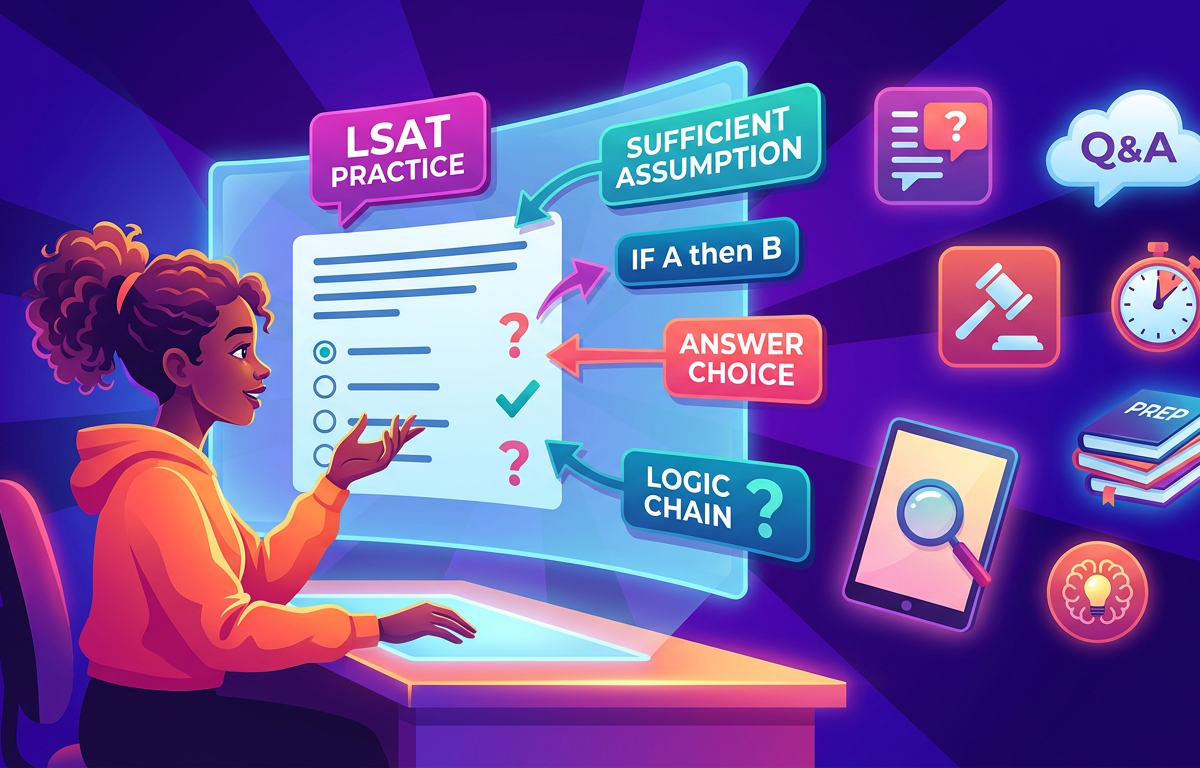
Concept Explanation
Sufficient assumption questions require you to identify a new piece of information that, when added to the existing premises, guarantees the truth of the conclusion. In the context of Easy LSAT Sufficient Assumption Questions With Answers, these logical gaps are often straightforward, involving a missing link between a specific premise and the final claim. Think of the sufficient assumption as the "missing piece" of a puzzle that makes the argument 100% logically valid. If the argument says "A implies B" and concludes "A implies C," the sufficient assumption is simply "B implies C."
To solve these efficiently, you should first isolate the conclusion and the premises. On the LSAT Prep journey, many students find it helpful to use formal logic notation to map out the conditional relationships. A sufficient assumption does not just help the argument; it forces the conclusion to follow. This differs from "Necessary Assumption" questions, which ask for something the argument simply needs to survive. For a sufficient assumption, you are looking for a powerful statement that closes the gap entirely. You can often find these by looking for a "new" term in the conclusion that was never mentioned in the premises and connecting it to the premise terms.
Solved Examples
- Example 1: The New Term Bridge
Argument: All mammals are warm-blooded. Therefore, all dogs are warm-blooded.
Step-by-step Solution:- Identify the Premise: Mammal Warm-blooded.
- Identify the Conclusion: Dog Warm-blooded.
- Find the Gap: We know warm-bloodedness applies to mammals, but we don't know if dogs are mammals.
- Sufficient Assumption: All dogs are mammals. (Dog Mammal). Adding this makes the chain: Dog Mammal Warm-blooded.
- Example 2: Negative Logic
Argument: Anyone who is tired cannot concentrate. Thus, Sarah cannot concentrate.
Step-by-step Solution:- Premise: Tired NOT Concentrate.
- Conclusion: Sarah NOT Concentrate.
- Find the Gap: We need to connect Sarah to the condition of being tired.
- Sufficient Assumption: Sarah is tired. This completes the logical requirement.
- Example 3: Formal Logic Chains
Argument: If the store is open, the lights are on. If the lights are on, the owner is present. Therefore, if the store is open, the alarm is off.
Step-by-step Solution:- Premise 1: Open Lights On.
- Premise 2: Lights On Owner Present.
- Conclusion: Open Alarm Off.
- Find the Gap: We have a chain (Open Lights Owner). We need to reach "Alarm Off."
- Sufficient Assumption: If the owner is present, the alarm is off. (Owner Alarm Off).
Practice Questions
- Every professional athlete follows a strict diet. Therefore, James follows a strict diet. Which of the following is a sufficient assumption?
- If a city has a subway system, it is a major metropolis. City X is a major metropolis. Which of the following, if assumed, makes the conclusion that City X has a subway system follow logically?
- Only students with a high GPA are eligible for the scholarship. Mark is eligible for the scholarship. Thus, Mark must be a senior. Which of the following is a sufficient assumption?
Build the reasoning skills behind a higher LSAT score.
Strengthen argument analysis, reading precision, and test-day performance through deliberate practice.
Start Improving Today- No one who enjoys hiking is afraid of heights. Since Maria is not afraid of heights, she must enjoy hiking. What is the sufficient assumption?
- All renewable energy sources are sustainable. Since wind power is a renewable energy source, it will reduce global carbon emissions. What is the sufficient assumption?
- If the temperature drops below freezing, the pipes will burst. The pipes in the basement did not burst. Therefore, the temperature did not drop below freezing. (Note: Is an assumption needed here? If so, identify the gap).
- Every employee who receives a bonus must have met their sales quota. Sarah met her sales quota. Therefore, Sarah will receive a bonus. What is the sufficient assumption?
- Most successful businesses prioritize customer service. Company Y prioritizes customer service. Therefore, Company Y is a successful business. What is the sufficient assumption?
Answers & Explanations
- Answer: James is a professional athlete.
The premise establishes a rule for all athletes. To conclude James follows the diet, we must assume he belongs to the group of professional athletes. - Answer: Any city that is a major metropolis has a subway system.
The original premise was Subway Metropolis. The conclusion reverses this (Metropolis Subway). To make this valid, we need the sufficient assumption to be the converse of the original premise. - Answer: Everyone eligible for the scholarship is a senior.
The premise links GPA to eligibility. The conclusion introduces a new term: "senior." We must bridge "eligible" to "senior" to guarantee the conclusion. - Answer: Everyone who is not afraid of heights enjoys hiking.
The premise says Hiking NOT Afraid. The conclusion says NOT Afraid Hiking. This is a common logical fallacy unless we assume the reverse is also true. - Answer: Anything that is sustainable reduces global carbon emissions.
The premises establish: Wind Renewable Sustainable. The conclusion introduces "reduces carbon." We must link "sustainable" to "reduces carbon." - Answer: No assumption needed (or: the logic is already valid).
This uses the modus tollens form: , , therefore . If the pipes didn't burst, it must not have been below freezing. - Answer: Anyone who meets their sales quota receives a bonus.
The premise says Bonus Quota. To conclude that meeting the quota guarantees a bonus, we need Quota Bonus. - Answer: Every business that prioritizes customer service is a successful business.
The word "most" in the premise is too weak to guarantee a conclusion about a specific company. We need a universal rule (Every) to make the conclusion 100% certain.
1. If an argument states "All A are B" and concludes "All A are C," what is the sufficient assumption?
Frequently Asked Questions
What is the "Bridge" method in LSAT Sufficient Assumption questions?
The bridge method involves identifying a term in the premise and a new term in the conclusion, then creating a conditional statement that links them. This ensures the logic flows from the evidence directly to the final claim without any gaps.
Can a sufficient assumption be "too strong"?
No, a sufficient assumption cannot be too strong for this specific question type. Since the goal is to guarantee the conclusion, a statement that provides more information than needed is still correct as long as it gets the job done.
How do I distinguish between sufficient and necessary assumptions?
Look at the question stem: "if assumed" or "allows the conclusion to follow" indicates sufficient, while "depends on" or "required" indicates necessary. You can also use tools like the AI Question Generator to practice differentiating these stems.
Should I diagram every sufficient assumption question?
Diagramming is highly effective for questions containing conditional language like "if," "only if," or "all." For simpler arguments, you might be able to visualize the gap, but formal notation prevents errors on more complex logical reasoning tasks.
What if multiple answer choices seem to help the argument?
Only one choice will be "sufficient" to make the conclusion 100% certain. Other choices might strengthen the argument or be necessary for it, but they won't provide the absolute logical guarantee required for this question type.
Build the reasoning skills behind a higher LSAT score.
Strengthen argument analysis, reading precision, and test-day performance through deliberate practice.
Start Improving TodayTags
Enjoyed this article?
Share it with others who might find it helpful.
Related Articles

Hard LSAT Sufficient Assumption Questions With Answers Practice Questions
Hard LSAT Sufficient Assumption Questions With Answers Practice Questions
Aug 7, 2026

Medium LSAT Sufficient Assumption Questions With Answers Practice Questions
Medium LSAT Sufficient Assumption Questions With Answers Practice Questions
Aug 7, 2026

Hard LSAT Point at Issue Questions Practice Questions
Hard LSAT Point at Issue Questions Practice Questions
Aug 9, 2026

Medium LSAT Assumption Practice Test Practice Questions
Medium LSAT Assumption Practice Test Practice Questions
Aug 9, 2026

LSAT Practice Questions for Beginners Practice Questions with Answers
LSAT Practice Questions for Beginners Practice Questions with Answers
Aug 9, 2026

Hard LSAT Mixed Practice Questions Set Practice Questions
Hard LSAT Mixed Practice Questions Set Practice Questions
Aug 7, 2026

Hard Hard LSAT Comparative Reading Questions Practice Questions
Master high-difficulty LSAT Comparative Reading with expert strategies, solved examples, and practice questions focused on synthesis and authorial perspective.
Aug 7, 2026

Hard LSAT Comparative Reading Questions With Answers Practice Questions
Hard LSAT Comparative Reading Questions With Answers Practice Questions
Aug 7, 2026