Easy LSAT Strengthen vs Weaken Questions Practice Questions

Concept Explanation
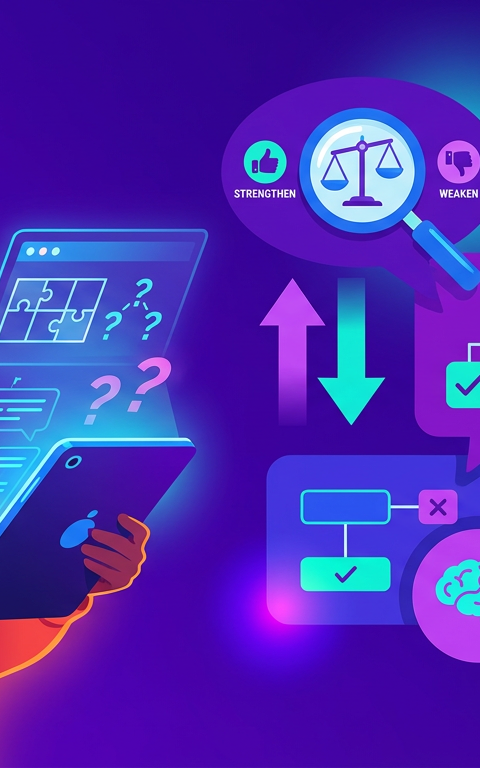
Strengthen and Weaken questions on the LSAT require you to identify information that either bolsters or undermines the relationship between a set of premises and a conclusion. These question types are fundamental components of the Logical Reasoning section, accounting for approximately 15-20% of the total scored items. In a Strengthen question, your goal is to find an answer choice that makes the conclusion more likely to be true based on the provided evidence. Conversely, in a Weaken question, you must select an option that exposes a flaw or provides a counter-premise that makes the conclusion less certain. According to LSAC, these questions test your ability to evaluate the support structures within an argument.
To succeed at Easy LSAT Strengthen vs Weaken Questions, you must first isolate the conclusion and the supporting premises. Most arguments on the LSAT rely on an unstated assumption—a "missing link" that connects the evidence to the final claim. A strengthener often validates this assumption or rules out an alternative explanation. A weakener often points out a reason why the premises might be true while the conclusion remains false. For beginners, it is helpful to explore our LSAT Prep hub to understand how these questions fit into the broader exam structure.
When evaluating answer choices, remember these three rules:
- Accept the choices as true: The question usually asks "Which of the following, if true...". Do not argue with the facts in the answer choices.
- Focus on the gap: Look for the disconnect between the evidence and the conclusion.
- Directionality: Ensure you are moving the argument in the correct direction (up for strengthen, down for weaken).
Solved Examples
The following examples demonstrate how to break down an argument and apply the necessary logic to find the correct answer.
- Strengthen Example:
Argument: Recent studies show that people who eat breakfast every morning have higher energy levels throughout the day than those who skip it. Therefore, eating breakfast causes an increase in daily energy levels.
Step-by-Step Solution:
- Identify the Conclusion: Eating breakfast causes higher energy.
- Identify the Evidence: There is a correlation between breakfast and energy.
- Find the Gap: Correlation does not equal causation. Perhaps high-energy people are just more likely to wake up early enough to eat.
- Strengthen: Find a choice that supports the causal link. An answer like "A clinical trial showed that skipping breakfast led to a 20% drop in energy in previously energetic people" would strengthen the argument by showing the effect disappears when the cause is removed.
- Weaken Example:
Argument: The city of Springfield saw a 10% decrease in crime after installing new streetlights. Thus, the streetlights were responsible for the drop in crime.
Step-by-Step Solution:
- Identify the Conclusion: The streetlights caused the crime drop.
- Identify the Evidence: Crime dropped after the lights were installed.
- Find the Gap: Other factors could have caused the drop.
- Weaken: Find a choice that provides an alternative cause. An answer like "The city also hired 50 new police officers at the same time the lights were installed" weakens the argument by suggesting the police, not the lights, might be the cause.
- Strengthen Example:
Argument: Every time the local professional team wins a game, the city's economy sees a boost. To improve our local economy, we should invest public funds into the team's training facilities.
Step-by-Step Solution:
- Identify the Conclusion: Investing in facilities will improve the economy.
- Identify the Evidence: Winning games correlates with economic boosts.
- Find the Gap: It assumes better facilities lead to more wins.
- Strengthen: An answer like "Teams with modern training facilities win 30% more games than teams with outdated facilities" connects the investment to the wins, supporting the conclusion.
Practice Questions
Test your skills with these Easy LSAT Strengthen vs Weaken Questions. Read each stimulus carefully before selecting your answer.
1. (Strengthen) Scientists found that children who play musical instruments perform better on math tests. They concluded that musical training improves mathematical reasoning skills. Which of the following, if true, most strengthens the conclusion?
2. (Weaken) A bookstore owner noticed that sales of physical books increased by 15% last year. The owner concluded that people are becoming tired of digital e-readers and are returning to paper books. Which of the following, if true, most weakens the conclusion?
3. (Strengthen) A new law requires all cyclists to wear helmets. Proponents argue this will significantly reduce the number of serious head injuries in the city. Which of the following, if true, most supports the proponents' claim?
Strengthen argument analysis, reading precision, and test-day performance through deliberate practice. Start Improving Today
4. (Weaken) After the university implemented a mandatory "Introduction to Ethics" course, incidents of cheating dropped by half. The administration concluded that the course successfully taught students the value of honesty. Which of the following most weakens this conclusion?
5. (Strengthen) Farmers who use organic compost instead of synthetic fertilizer report higher crop yields over a five-year period. Therefore, organic compost is more effective for long-term soil health. Which of the following most strengthens the argument?
6. (Weaken) A study found that people who drink green tea daily live longer than those who do not. The researchers concluded that green tea contains compounds that extend the human lifespan. Which of the following most weakens the conclusion?
7. (Strengthen) The company's new marketing campaign led to a record number of website visits. The CEO claims the campaign was the primary driver of the company's increased revenue this quarter. Which of the following most strengthens the CEO's claim?
8. (Weaken) A nutritionist argues that because apples contain high amounts of Vitamin C, eating an apple every day is the best way to prevent the common cold. Which of the following most undermines this argument?
Answers & Explanations
- Answer: A study of twins showed that the twin who received music lessons scored higher in math than the twin who did not. Explanation: This strengthens the causal link by controlling for genetic and environmental factors, suggesting the music itself is the variable.
- Answer: The bookstore closed its three largest competitors in the neighborhood last year. Explanation: This provides an alternative explanation for the sales increase; it wasn't a change in preference, but a lack of other places to buy books.
- Answer: Hospital records show that helmet-wearing cyclists involved in accidents suffer 70% fewer traumatic brain injuries than those without helmets. Explanation: This directly supports the claim that helmets reduce head injuries.
- Answer: The university also installed high-tech proctoring software in all exam halls at the same time the course was introduced. Explanation: This introduces an alternative cause for the drop in cheating, weakening the link to the ethics course.
- Answer: Synthetic fertilizers were found to deplete essential soil minerals after three years of continuous use. Explanation: This supports the conclusion by showing a specific mechanism by which the alternative (synthetic) is less effective for long-term health.
- Answer: People who drink green tea daily are significantly more likely to engage in regular exercise and maintain a balanced diet. Explanation: This suggests that lifestyle factors, rather than the tea itself, may be responsible for the increased lifespan.
- Answer: Data shows that 80% of the customers who made purchases this quarter were first-time visitors who arrived via the new campaign's links. Explanation: This provides direct evidence connecting the campaign to the revenue increase.
- Answer: Oranges and bell peppers contain significantly higher concentrations of Vitamin C than apples do. Explanation: This weakens the claim that an apple is the "best" way to prevent a cold by highlighting superior alternatives.
1. In a Weaken question, what is the primary goal?
Frequently Asked Questions
What is the difference between a Strengthen question and an Assumption question?
A Strengthen question asks for any information that makes the conclusion more likely, whereas an Assumption question asks for a specific piece of information that is absolutely necessary for the argument to function. Think of strengthening as "helping" the argument and assumptions as "required" for the argument.
Can I use outside knowledge to answer these questions?
No, you should only use the information provided in the stimulus and the answer choices. However, you must use common sense and general logic to understand how a new fact in an answer choice would impact the specific logic of the argument.
Do all LSAT arguments have a conclusion?
While most Logical Reasoning stimuli contain an argument with a conclusion, some question types, like "Must Be True," may only provide a set of facts without a final claim. For Strengthen and Weaken questions, identifying the conclusion is a mandatory first step.
How do I identify the conclusion quickly?
Look for indicator words like "therefore," "thus," "hence," "so," or "consequently." If those are missing, ask yourself, "What is the author trying to convince me of?" The answer to that question is the conclusion. For more strategies, check out our reading analysis guides which share similar logic principles.
Should I look for the "perfect" answer?
On the LSAT, you are looking for the "most" strengthen or "most" weaken answer. Sometimes multiple choices might have a slight effect, but one will be much more impactful than the others. Always compare the choices against each other. You can practice this comparison using the AI Question Generator to see how different distractors are constructed.
Build the reasoning skills behind a higher LSAT score.
Strengthen argument analysis, reading precision, and test-day performance through deliberate practice.
Start Improving TodayTags
Enjoyed this article?
Share it with others who might find it helpful.
Related Articles
Hard LSAT Strengthen vs Weaken Questions Practice Questions
Hard LSAT Strengthen vs Weaken Questions Practice Questions
Aug 7, 2026

Medium LSAT Strengthen vs Weaken Questions Practice Questions
Practice medium-level LSAT Strengthen vs Weaken questions with detailed explanations and expert tips to master logical reasoning and improve your score.
Aug 7, 2026

Hard LSAT Point at Issue Questions Practice Questions
Hard LSAT Point at Issue Questions Practice Questions
Aug 9, 2026

LSAT Practice Questions for Beginners Practice Questions with Answers
LSAT Practice Questions for Beginners Practice Questions with Answers
Aug 9, 2026

Hard LSAT Mixed Practice Questions Set Practice Questions
Hard LSAT Mixed Practice Questions Set Practice Questions
Aug 7, 2026

Hard Hard LSAT Comparative Reading Questions Practice Questions
Master high-difficulty LSAT Comparative Reading with expert strategies, solved examples, and practice questions focused on synthesis and authorial perspective.
Aug 7, 2026

Hard LSAT Comparative Reading Questions With Answers Practice Questions
Hard LSAT Comparative Reading Questions With Answers Practice Questions
Aug 7, 2026

Hard LSAT Comparative Reading Practice Questions Practice Questions
Master high-difficulty LSAT Comparative Reading with these practice questions, solved examples, and expert strategies for cross-textual analysis.
Aug 7, 2026