Easy Half-Life Calculations Practice Questions
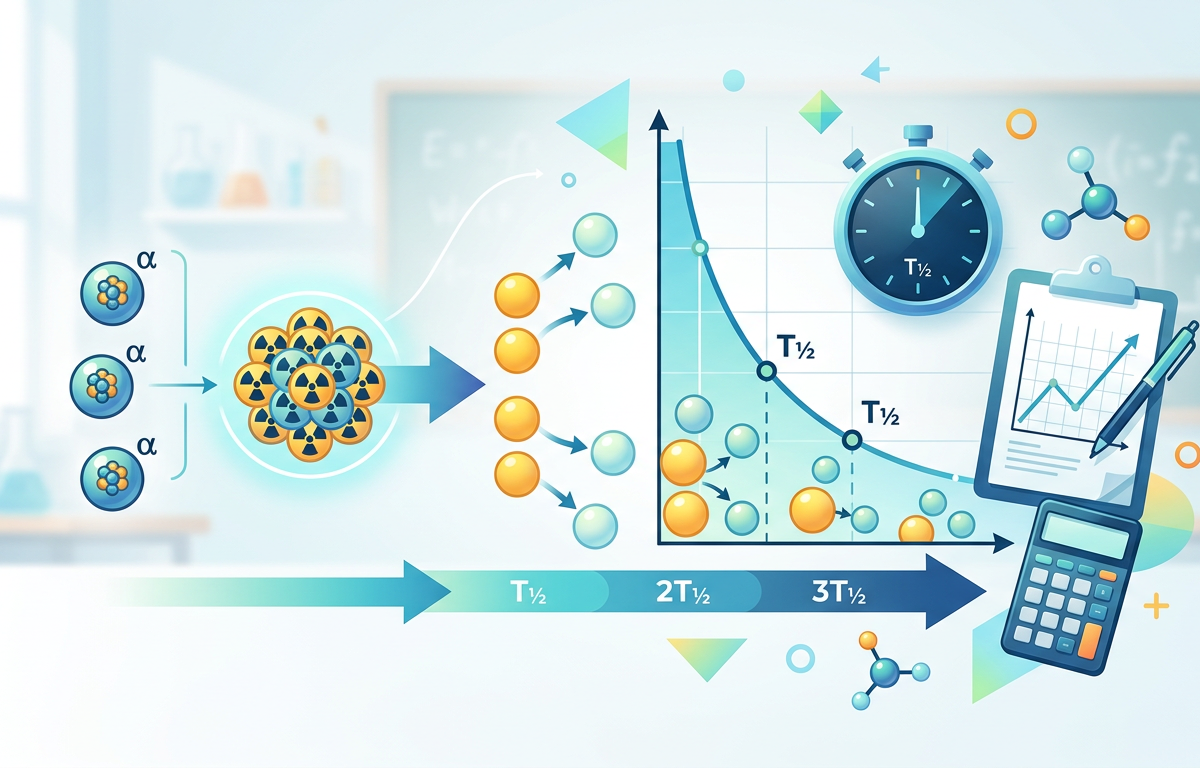
Easy half-life calculations practice questions are essential tools for understanding how radioactive substances decay over time, specifically measuring the period required for half of a sample's atoms to undergo radioactive decay. Whether you are studying chemistry, physics, or environmental science, mastering these calculations allows you to predict the remaining amount of a substance or determine the age of a specimen. Understanding this concept is a foundational step before moving on to more complex topics like reaction order practice questions or nuclear kinetics. By breaking down the process into simple steps, you can quickly learn to solve problems involving time, initial mass, and final mass without needing a complex calculus background.
Concept Explanation
Half-life is the specific amount of time required for the quantity of a radioactive isotope to fall to half of its initial value. This concept describes the exponential decay of substances, which occurs at a constant rate regardless of the total amount of material present. In basic chemistry and physics, we often use a simple iterative approach or a formula to find the remaining amount of a substance after a certain number of half-lives have passed. This is particularly useful for students who are also learning how to study for exams in college more effectively by breaking down complex formulas into manageable parts.
The primary variables involved in half-life calculations are:
- Initial Amount (N₀): The starting quantity of the substance.
- Remaining Amount (Nₜ): The quantity left after time (t) has passed.
- Half-life (t₁/₂): The time it takes for half the sample to decay.
- Number of Half-lives (n): Calculated by dividing total time by the half-life duration (n = t / t₁/₂).
For introductory levels, the relationship is expressed as: Nₜ = N₀ × (0.5)ⁿ. This means that after one half-life, 50% remains; after two, 25% remains; after three, 12.5% remains, and so on. Organizations like the U.S. Environmental Protection Agency (EPA) use these calculations to monitor environmental safety and isotope decay in nature.
Solved Examples
These solved examples demonstrate how to approach easy half-life calculations practice questions using step-by-step logic.
Example 1: Finding the Remaining Mass
A sample of Iodine-131 has a mass of 80 grams. If the half-life of Iodine-131 is 8 days, how much will remain after 24 days?
- Identify the knowns: Initial mass = 80g, Half-life = 8 days, Total time = 24 days.
- Calculate the number of half-lives: 24 days ÷ 8 days = 3 half-lives.
- Apply the decay:
- 80g → (1st half-life) → 40g
- 40g → (2nd half-life) → 20g
- 20g → (3rd half-life) → 10g
- The final answer is 10 grams.
Example 2: Determining the Half-life
A 200g sample of an unknown isotope decays to 25g over a period of 60 minutes. What is the half-life of the isotope?
- Determine how many times the sample was halved:
- 200g → 100g (1 half-life)
- 100g → 50g (2 half-lives)
- 50g → 25g (3 half-lives)
- Set up the equation: Total time / number of half-lives = Half-life duration.
- Calculate: 60 minutes ÷ 3 = 20 minutes.
- The half-life is 20 minutes.
Example 3: Calculating Total Elapsed Time
Sodium-24 has a half-life of 15 hours. How long will it take for a 100mg sample to decay until only 6.25mg remains?
- Find the number of half-lives:
- 100 → 50 (1) → 25 (2) → 12.5 (3) → 6.25 (4)
- Identify that 4 half-lives have occurred.
- Multiply half-lives by the duration: 4 × 15 hours = 60 hours.
- The total time is 60 hours.
Practice Questions
Try these easy half-life calculations practice questions to test your understanding. If you find these concepts challenging, you might also want to review how to study for exams with poor memory to help retain these mathematical steps.
- A radioactive isotope has a half-life of 10 years. If you start with 400g, how much will be left after 30 years?
- The half-life of Carbon-14 is approximately 5,730 years. If a fossil originally had 16mg of Carbon-14 and now has 2mg, how old is the fossil?
- A 500g sample decays to 62.5g in 15 days. What is the half-life of this substance?
Want unlimited practice questions like these?
Generate AI-powered questions with step-by-step solutions on any topic.
Try Question Generator Free →- Phosphorus-32 is used in biological research and has a half-life of 14 days. If a lab starts with 20g, how much remains after 42 days?
- An isotope with a half-life of 2 hours decays for 8 hours. What percentage of the original sample remains?
- If 12.5% of a radioactive sample remains after 90 minutes, what is the half-life of the sample?
- A doctor injects a patient with 100mg of a tracer that has a half-life of 6 hours. How much tracer is left in the patient after 24 hours?
- Barium-131 has a half-life of 12 days. How many days must pass for a sample to decay to 1/16th of its original amount?
- A sample of Radon-222 has a half-life of 3.8 days. If you have 64g initially, how much is left after 11.4 days?
- A substance has a half-life of 50 years. How many half-lives have passed after 250 years?
Answers & Explanations
- 50g. Explanation: 30 years / 10 years = 3 half-lives. 400 → 200 → 100 → 50.
- 17,190 years. Explanation: 16mg → 8 → 4 → 2 is 3 half-lives. 3 × 5,730 = 17,190.
- 5 days. Explanation: 500 → 250 → 125 → 62.5 is 3 half-lives. 15 days / 3 = 5 days.
- 2.5g. Explanation: 42 / 14 = 3 half-lives. 20 → 10 → 5 → 2.5.
- 6.25%. Explanation: 8 hours / 2 hours = 4 half-lives. 100% → 50% → 25% → 12.5% → 6.25%.
- 30 minutes. Explanation: 100% → 50% → 25% → 12.5% is 3 half-lives. 90 min / 3 = 30 min.
- 6.25mg. Explanation: 24 / 6 = 4 half-lives. 100 → 50 → 25 → 12.5 → 6.25.
- 48 days. Explanation: 1/16 is (1/2)&sup4;, so 4 half-lives. 4 × 12 days = 48 days.
- 8g. Explanation: 11.4 / 3.8 = 3 half-lives. 64 → 32 → 16 → 8.
- 5 half-lives. Explanation: 250 years / 50 years per half-life = 5.
1. If a substance has a half-life of 5 minutes, what fraction of the original sample remains after 15 minutes?
Frequently Asked Questions
What is the definition of half-life?
Half-life is the time required for one-half of the atomic nuclei of a radioactive sample to decay spontaneously into other nuclear species. This is a constant value for any specific isotope, as noted by sources like Wikipedia.
Does the half-life change as the sample gets smaller?
No, the half-life of a specific radioactive isotope remains constant regardless of the initial amount of the substance or how much has already decayed. It is an intrinsic property of the isotope's nuclear stability.
What formula is used for easy half-life calculations?
The most common formula for introductory levels is Nₜ = N₀(1/2)ⁿ, where Nₜ is the final amount, N₀ is the initial amount, and n is the number of half-lives that have elapsed. This formula assumes the decay follows first-order kinetics.
How do you calculate the number of half-lives?
To find the number of half-lives (n), divide the total time elapsed by the length of one half-life. For example, if 20 minutes have passed and the half-life is 5 minutes, 4 half-lives have occurred.
Why is half-life important in medicine?
In medicine, half-life is crucial for determining how long a radioactive tracer or a drug will remain active in a patient's body. This information helps doctors calculate safe dosages and ensure that diagnostic materials like those discussed by the International Atomic Energy Agency (IAEA) clear the system appropriately.
Can half-life be used to date old objects?
Yes, techniques like radiocarbon dating use the known half-life of Carbon-14 to estimate the age of organic materials. By measuring the ratio of remaining Carbon-14 to the original amount, scientists can determine how many thousands of years have passed since the organism died.
Enjoyed this article?
Share it with others who might find it helpful.
Related Articles
Hard Le Chatelier’s Principle Practice Questions
Master Hard Le Chatelier’s Principle Practice Questions with our comprehensive guide featuring solved examples, practice problems, and detailed explanations.
Mar 30, 2026

Hard Reaction Quotient (Q) Practice Questions
Hard Reaction Quotient (Q) Practice Questions
Mar 30, 2026
Grams to Moles Practice Questions with Answers
Master grams to moles conversions with our comprehensive guide. Includes step-by-step examples, practice questions, and detailed answers for chemistry students.
Mar 26, 2026
Avogadro’s Number Practice Questions with Answers
Master the mole concept with our Avogadro’s Number practice questions. Includes step-by-step solved examples, a quick quiz, and detailed explanations.
Mar 26, 2026
Empirical Formulas: Solving Ratios from Mass and Percent Data
Master empirical formula calculations with 10 practice questions, worked answers, and a free step-by-step calculator for mass, percentage, and combustion problems.
Mar 26, 2026