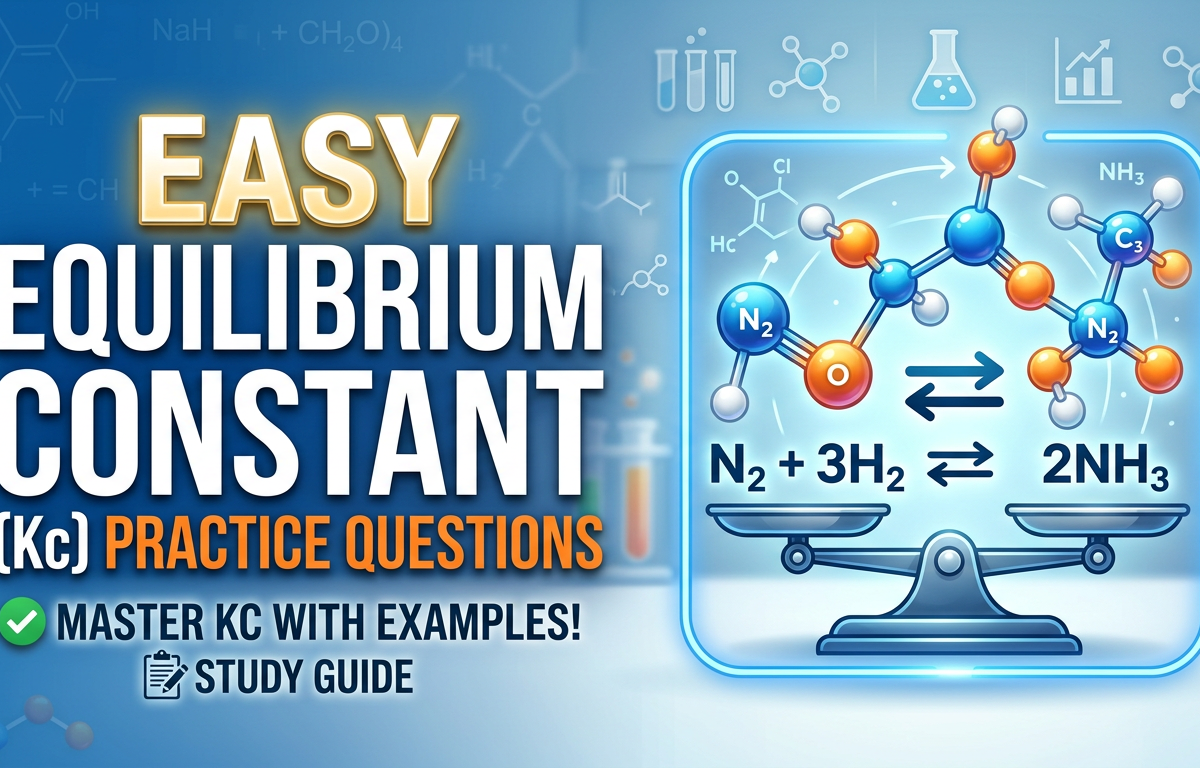
Easy Equilibrium Constant (Kc) Practice Questions
Concept Explanation
The equilibrium constant () is a numerical value that describes the relative concentrations of reactants and products in a chemical system at dynamic equilibrium at a specific temperature. When a reversible reaction reaches equilibrium, the rate of the forward reaction equals the rate of the reverse reaction, and the concentrations of all species remain constant over time. According to the Law of Mass Action, the expression is written as the product of the molar concentrations of the products divided by the product of the molar concentrations of the reactants, each raised to the power of their stoichiometric coefficients.
For a general reaction: , the expression is:
Key rules for writing expressions include:
Only species in the aqueous (aq) or gaseous (g) states are included in the expression.
Pure solids (s) and liquids (l) have constant concentrations and are omitted from the formula.
The value of is temperature-dependent; changing the temperature will change the value of the constant.
A large ($> 1$) indicates that products are favored at equilibrium, while a small ($< 1$) indicates that reactants are favored.
Understanding these basics is essential before moving on to more complex topics like Ka and Kb calculations or investigating strong vs weak acids, where equilibrium principles are applied to ionic dissociation.
Solved Examples
Below are three fully worked examples to demonstrate how to write expressions and calculate values for the equilibrium constant (Kc).
Writing an Expression: Write the expression for the reaction: .
Identify the products: with a coefficient of 2.
Identify the reactants: (coefficient 1) and (coefficient 3).
Place products in the numerator and reactants in the denominator, raising each to the power of their coefficient.
Solution:
Calculating from Concentrations: For the reaction , the equilibrium concentrations are , , and . Calculate .
Write the expression: .
Substitute the values: .
Calculate the numerator: $0.16$.
Calculate the denominator: $0.02$.
Final Answer: .
Handling Heterogeneous Equilibria: Write the expression for .
List all species: , , and .
Apply the rule: Omit solids and liquids.
and $CaO$ are both solid (s), so they are excluded.
Solution: .
Practice Questions
Test your knowledge with these easy equilibrium constant (Kc) practice questions. Ensure you pay attention to the physical states of each substance.
1. Write the equilibrium constant expression for the following reaction: $2SO_2(g) + O_2(g) \rightleftharpoons 2SO_3(g)$.
2. In a 1.0 L flask, the equilibrium concentrations for the reaction are , , and . Calculate the value of .
3. Identify which species should be excluded from the expression for this reaction: .
Want unlimited practice questions like these?
Generate AI-powered questions with step-by-step solutions on any topic.
Try Question Generator Free →4. Write the expression for the decomposition of liquid water into its gaseous elements: $2H_2O(l) \rightleftharpoons 2H_2(g) + O_2(g)$.
5. At a certain temperature, for the reaction . If the equilibrium concentrations of and are both $0.02 ext{ M}$, what is the equilibrium concentration of $HI$?
6. For the reaction , the equilibrium concentrations are , , and . Calculate .
7. True or False: If you double the coefficients of a balanced chemical equation, the value of remains the same.
8. Write the expression for the reaction: .
9. A reaction has a value of $1.5 \times 10^{-10}$. At equilibrium, does the mixture contain mostly reactants or mostly products?
10. Calculate for the reaction if the equilibrium concentrations are , , and .
Answers & Explanations
Answer: . All species are gases, so they are all included. The coefficients become exponents.
Answer: $0.08$. .
Answer: . Pure solids are always excluded from the equilibrium constant expression because their density (and thus concentration) does not change significantly during the reaction.
Answer: . Since is in the liquid state (l), it is excluded from the denominator.
Answer: $0.141 ext{ M}$. . Thus, . Taking the square root gives .
Answer: $2.5$. .
Answer: False. If you double the coefficients, the new equilibrium constant () will be the square of the original constant ().
Answer: . The reactant is a solid and is therefore omitted from the expression.
Answer: Mostly reactants. A very small (much less than 1) indicates that the equilibrium position lies far to the left, favoring the reactants.
Answer: $4.0$. .
1. Which of the following states of matter is NEVER included in a Kc expression?
Frequently Asked Questions
What is the difference between Kc and Kp?
is the equilibrium constant defined by molar concentrations (mol/L), whereas is defined by the partial pressures of gaseous reactants and products. They are related by the equation , where is the change in moles of gas.
Why are solids and liquids excluded from Kc?
The concentrations of pure solids and pure liquids are considered constant because their density does not change significantly regardless of how much of the substance is present. Since equilibrium constants only track changes in concentration, these constant values are mathematically incorporated into the value itself.
Can Kc be a negative number?
No, cannot be negative because it is calculated using concentrations and coefficients as exponents, all of which result in positive values. A value can be very close to zero, but never less than zero.
Does Kc have units?
In many introductory chemistry courses, is treated as unitless by using "activities" relative to a standard state of 1 M. However, if units are required, they are derived by substituting into the expression, which varies depending on the stoichiometry of the reaction.
How is Kc related to reaction rate?
describes the extent of a reaction at equilibrium, but it provides no information about how fast the reaction reaches that state. A reaction can have a very large but proceed so slowly that it appears not to happen at all without a catalyst.
For more practice with related thermodynamic concepts, check out our guide on easy enthalpy change practice questions.
Want unlimited practice questions like these?
Generate AI-powered questions with step-by-step solutions on any topic.
Try Question Generator Free →
Want unlimited practice questions like these?
Generate AI-powered questions with step-by-step solutions on any topic.
Try Question Generator Free →Enjoyed this article?
Share it with others who might find it helpful.
Related Articles
Medium Equilibrium Constant (Kc) Practice Questions
Medium Equilibrium Constant (Kc) Practice Questions
Mar 30, 2026
Solving Equilibrium Problems Without Losing Your Stoichiometry
Master chemical equilibrium with these easy ICE table practice questions. Learn to calculate concentrations and K values with step-by-step solved examples.
Mar 30, 2026
Calculating Kc: Mastering the Ratio of Equilibrium Concentrations
Master the Equilibrium Constant (Kc) with our comprehensive guide featuring solved examples, practice questions, and detailed explanations for chemistry students.
Mar 30, 2026

Calculating High-Stakes Meds: BSA Mosteller Formula Practice
Master hard body surface area-based dosage calculations with our comprehensive guide, solved examples, and practice questions for healthcare students.
May 17, 2026

Solving High-Stakes IV Titrations and Weight-Based Infusions
Master advanced IV flow rate calculations with these hard practice questions. Covers weight-based dosing, titrations, and dimensional analysis for nurses.
May 17, 2026

Solving Weight-Based Dosing: The 2.2 Conversion and Rounding Logic
Weight-Based Dosage Calculations Practice Questions with Answers
May 17, 2026
Predicting Periodic Anomalies: Beyond Basic Trend Rules
Hard Periodic Trends Practice Questions
Apr 4, 2026

Hard Electron Configuration Practice Questions
Hard Electron Configuration Practice Questions
Apr 4, 2026