Easy Electron Configuration Practice Questions
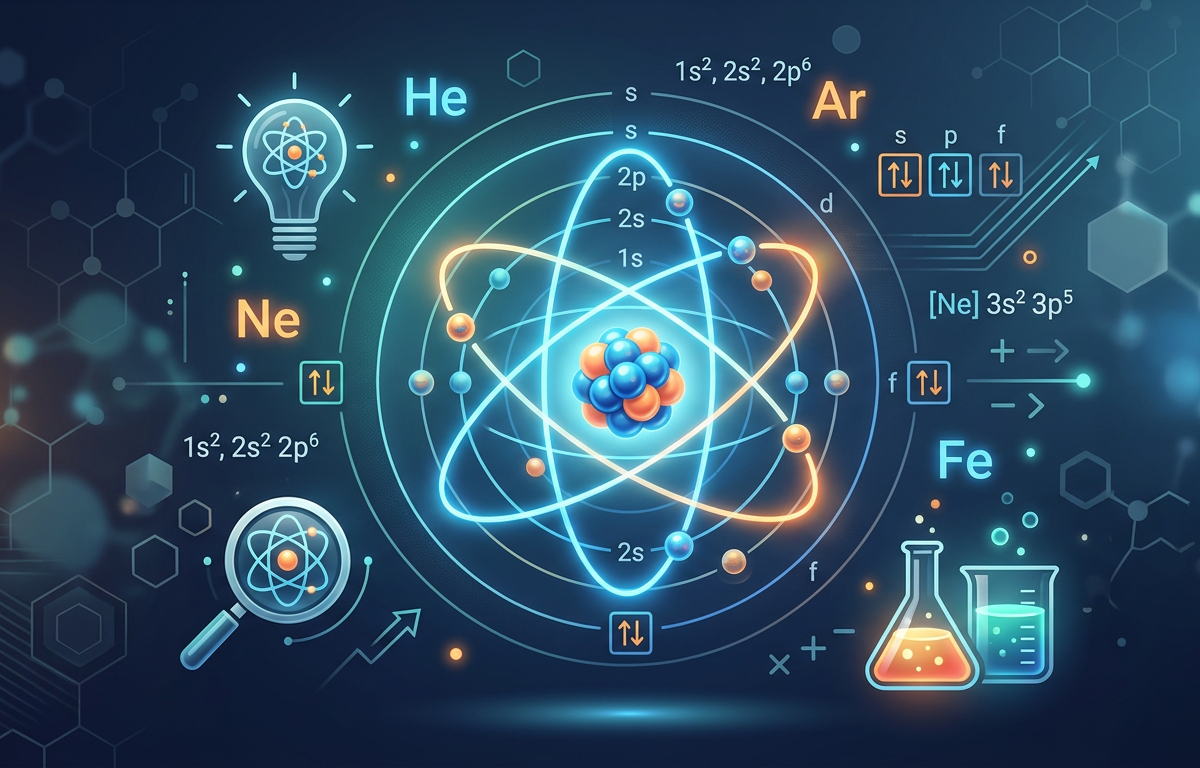
Concept Explanation
Electron configuration is the systematic distribution of an atom's electrons among various atomic orbitals according to specific energy levels and subshells. This arrangement follows the fundamental laws of quantum mechanics, ensuring that electrons occupy the lowest available energy states first to maintain stability. To master this topic, students must understand the Aufbau Principle, which dictates that electrons fill subshells in order of increasing energy (1s, 2s, 2p, 3s, and so on).
When working through Easy Electron Configuration Practice Questions, you need to be familiar with three primary rules:
The Aufbau Principle: Electrons enter orbitals of lowest energy first.
Pauli Exclusion Principle: An atomic orbital may describe at most two electrons, each with opposite spins.
Hund's Rule: Electrons occupy orbitals of the same energy in a way that makes the number of electrons with the same spin direction as large as possible.
The notation used involves a number representing the principal energy level, a letter representing the subshell (s, p, d, or f), and a superscript indicating the number of electrons in that subshell. For example, in the configuration 1s², '1' is the energy level, 's' is the orbital type, and '²' means there are two electrons. This topic is closely related to Quantum Number Practice Questions, as these numbers define the "address" of each electron.
Solved Examples
Below are step-by-step solutions for determining the electron configuration of common elements.
Determine the electron configuration for Carbon (Atomic Number 6).
Identify the total number of electrons: Carbon has 6 electrons.
Fill the 1s subshell: 1s² (2 electrons used, 4 remaining).
Fill the 2s subshell: 2s² (2 more electrons used, 2 remaining).
Fill the 2p subshell: 2p² (Remaining 2 electrons).
Final Configuration: 1s² 2s² 2p².
Determine the electron configuration for Sodium (Atomic Number 11).
Identify the total number of electrons: Sodium has 11 electrons.
Fill in order: 1s² (2), 2s² (4), 2p⁶ (10).
The next lowest energy orbital is 3s. Place the final electron there: 3s¹.
Final Configuration: 1s² 2s² 2p⁶ 3s¹.
Determine the electron configuration for Oxygen (Atomic Number 8).
Identify the total number of electrons: Oxygen has 8 electrons.
Fill the 1s subshell: 1s² (2 used).
Fill the 2s subshell: 2s² (4 used).
Fill the 2p subshell: 2p⁴ (8 total).
Final Configuration: 1s² 2s² 2p⁴.
Practice Questions
Test your knowledge with these Easy Electron Configuration Practice Questions. Use a periodic table for reference if needed.
1. Write the full electron configuration for Helium (Z=2).
2. What is the electron configuration for Lithium (Z=3)?
3. Identify the element with the electron configuration 1s² 2s² 2p⁶.
Want unlimited practice questions like these?
Generate AI-powered questions with step-by-step solutions on any topic.
Try Question Generator Free →4. Write the full electron configuration for Boron (Z=5).
5. Which orbital is filled immediately after the 2p subshell?
6. How many electrons are in the outer shell (valence shell) of Nitrogen (1s² 2s² 2p³)?
7. Write the full electron configuration for Magnesium (Z=12).
8. Identify the element that ends its configuration with 3p⁵.
9. What is the maximum number of electrons that can occupy any single 's' orbital?
10. Write the full electron configuration for Neon (Z=10).
Answers & Explanations
1s²: Helium has 2 electrons, which completely fill the first energy level's s-orbital.
1s² 2s¹: Lithium has 3 electrons. The first two fill 1s, and the third enters the 2s orbital.
Neon: Adding the superscripts (2+2+6) gives 10. The element with atomic number 10 is Neon. This is a stable noble gas configuration.
1s² 2s² 2p¹: Boron has 5 electrons. We fill 1s and 2s first, leaving one electron for the 2p orbital.
3s: According to the diagonal rule and the Aufbau principle, after 2p is filled with 6 electrons, the next lowest energy level is 3s.
5 electrons: The valence shell is the highest principal energy level (n=2). In 2s² 2p³, there are 2 + 3 = 5 valence electrons. Understanding this is key to solving Lewis Structure Practice Questions later.
1s² 2s² 2p⁶ 3s²: Magnesium has 12 electrons. We fill up to Neon's configuration (10) and then add two electrons to the 3s orbital.
Chlorine: To find this, count through the subshells: 1s² 2s² 2p⁶ 3s² 3p⁵. Summing the electrons (2+2+6+2+5) equals 17, which is Chlorine.
2 electrons: According to the Pauli Exclusion Principle, any single orbital can hold a maximum of two electrons with opposite spins.
1s² 2s² 2p⁶: Neon has 10 electrons, which perfectly fills the n=1 and n=2 shells.
Mastering these basics allows you to progress to more complex topics like Periodic Trends Practice Questions, where configuration directly influences atomic radius and reactivity.
1. Which rule states that electrons must occupy the lowest energy orbital available?
Frequently Asked Questions
What is the shorthand or noble gas notation?
Noble gas notation is a method of simplifying electron configurations by using the previous noble gas in brackets to represent the core electrons. For example, Sodium is written as [Ne] 3s¹ instead of 1s² 2s² 2p⁶ 3s¹.
How many electrons can an 's' subshell hold?
An 's' subshell contains only one orbital and can hold a maximum of 2 electrons. This rule applies regardless of the principal energy level (1s, 2s, 3s, etc.).
What is the difference between a shell and a subshell?
A shell refers to the principal energy level (n), while a subshell refers to the specific shape of the orbital (s, p, d, f) within that shell. Each shell can contain one or more subshells.
Why does the 4s orbital fill before the 3d orbital?
The 4s orbital has a slightly lower energy level than the 3d orbital in neutral atoms. Following the Aufbau principle, electrons always occupy the lowest energy state first to minimize the atom's total energy.
What are valence electrons?
Valence electrons are the electrons located in the outermost shell of an atom. They are the most important electrons for determining an element's chemical reactivity and bonding behavior.
Want unlimited practice questions like these?
Generate AI-powered questions with step-by-step solutions on any topic.
Try Question Generator Free →
Want unlimited practice questions like these?
Generate AI-powered questions with step-by-step solutions on any topic.
Try Question Generator Free →Enjoyed this article?
Share it with others who might find it helpful.
Related Articles
Hard Electron Configuration Practice Questions
Hard Electron Configuration Practice Questions
Apr 4, 2026
Medium Electron Configuration Practice Questions
Master medium-level electron configuration with our comprehensive guide, including solved examples, stability exceptions, and practice questions with answers.
Apr 4, 2026
Electron Configuration Practice Questions with Answers
Master electron configuration with our comprehensive guide featuring solved examples, practice questions, and detailed explanations for chemistry students.
Apr 4, 2026

Calculating High-Stakes Meds: BSA Mosteller Formula Practice
Master hard body surface area-based dosage calculations with our comprehensive guide, solved examples, and practice questions for healthcare students.
May 17, 2026

Solving High-Stakes IV Titrations and Weight-Based Infusions
Master advanced IV flow rate calculations with these hard practice questions. Covers weight-based dosing, titrations, and dimensional analysis for nurses.
May 17, 2026

Solving Weight-Based Dosing: The 2.2 Conversion and Rounding Logic
Weight-Based Dosage Calculations Practice Questions with Answers
May 17, 2026
Predicting Periodic Anomalies: Beyond Basic Trend Rules
Hard Periodic Trends Practice Questions
Apr 4, 2026
Hard Balancing Redox Practice Questions
Master complex chemical equations with our hard balancing redox practice questions. Includes step-by-step solutions for acidic and basic media.
Apr 4, 2026