Easy Cardiovascular System Questions Practice Questions
Concept Explanation
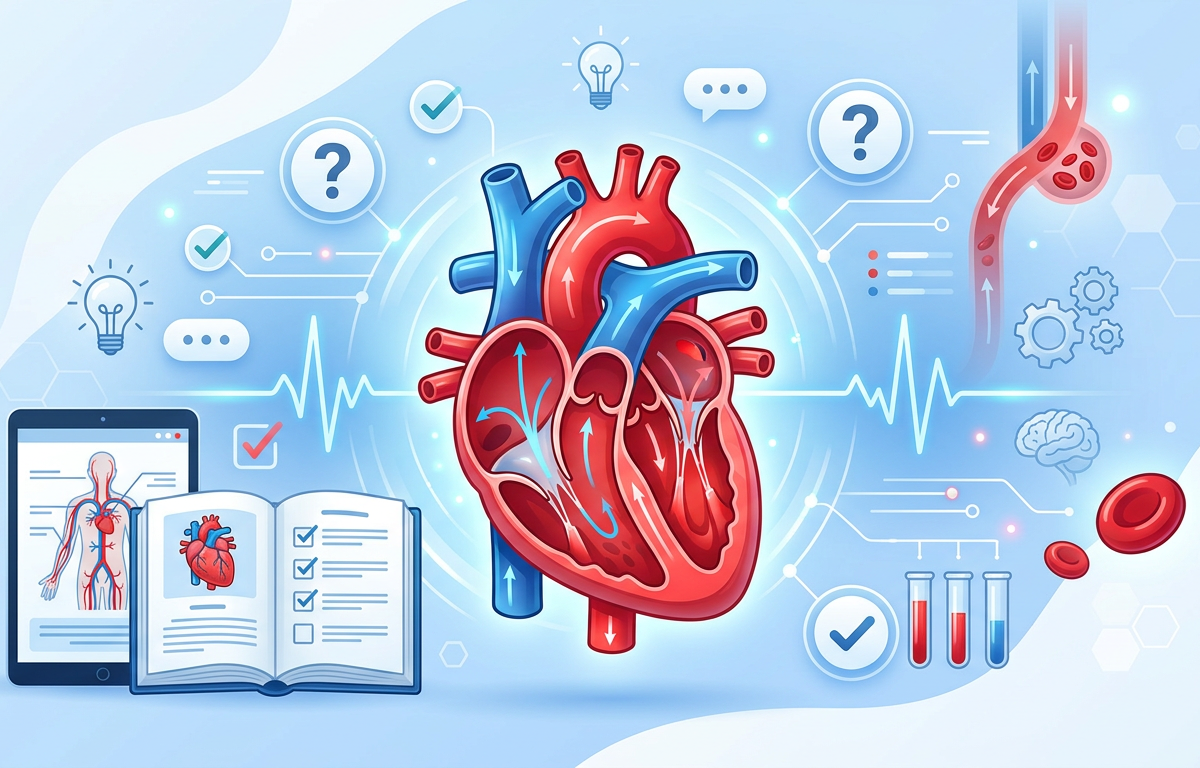
The cardiovascular system is a complex network of the heart, blood, and blood vessels responsible for transporting oxygen, nutrients, hormones, and cellular waste products throughout the entire body. Often called the circulatory system, it functions as the body's primary logistics and delivery infrastructure. The heart acts as a muscular pump, driving blood through two main circuits: the pulmonary circuit, which carries blood to the lungs for gas exchange, and the systemic circuit, which distributes oxygenated blood to the tissues. Understanding these Easy Cardiovascular System Questions Practice Questions requires a basic grasp of how the four chambers of the heart—the right and left atria and ventricles—work in unison to maintain blood pressure and flow. This system is closely linked to other vital structures, which you can explore in our Organ System Questions Practice Questions guide.
Key components of this system include:
The Heart: A four-chambered pump located in the mediastinum.
Arteries: Thick-walled vessels that carry blood away from the heart (usually oxygenated).
Veins: Vessels that return blood to the heart (usually deoxygenated) and contain valves to prevent backflow.
Capillaries: Microscopic vessels where the actual exchange of gases and nutrients occurs between blood and interstitial fluid.
To deepen your knowledge of how these structures fit into the broader biological framework, you might also find Anatomy Practice Questions helpful for your studies. According to the American Heart Association, maintaining cardiovascular health is essential for preventing long-term chronic diseases.
Solved Examples
Reviewing solved problems helps clarify how to approach Easy Cardiovascular System Questions Practice Questions by breaking down the physiological logic behind each answer.
Question: Which chamber of the heart receives deoxygenated blood from the body?
Solution:Identify the two sides of the heart: the right side handles deoxygenated blood, and the left side handles oxygenated blood.
Recall that atria are receiving chambers and ventricles are pumping chambers.
The superior and inferior vena cavae dump blood into the first chamber of the heart.
Answer: The Right Atrium.
Question: What is the primary function of the heart valves?
Solution:Consider the direction of blood flow required for efficiency.
Recognize that when a chamber contracts, blood could potentially flow backward if not restricted.
Valves like the mitral and tricuspid close during ventricular contraction.
Answer: To prevent the backflow of blood, ensuring one-way circulation.
Question: Which blood vessel type is responsible for the exchange of nutrients and gases?
Solution:Arteries and veins have thick walls (tunica media) that prevent diffusion.
Exchange requires a very thin barrier.
Capillaries consist of only a single layer of endothelial cells.
Answer: Capillaries.
3. Practice Questions
Test your knowledge with these Easy Cardiovascular System Questions Practice Questions. They range from basic anatomy to functional physiology.
What is the name of the thick muscular wall that separates the left and right sides of the heart?
Which large artery is the primary vessel carrying oxygenated blood away from the left ventricle to the rest of the body?
True or False: Pulmonary veins carry deoxygenated blood.
Start Learning Smarter Today
Join thousands of students using AI-powered study tools to achieve better results.
Get Started FreeWhich component of the blood is primarily responsible for carrying oxygen via hemoglobin?
What is the normal average resting heart rate for a healthy adult?
Which heart chamber has the thickest muscular wall because it must pump blood to the entire body?
What do we call the rhythmic expansion and contraction of an artery as blood is forced through it by the heart?
Which type of blood vessel contains one-way valves to assist blood in returning to the heart against gravity?
The "lub-dub" sound of a heartbeat is caused by the closing of what structures?
Which node in the right atrium is known as the \"natural pacemaker\" of the heart?
Answers & Explanations
Septum: The septum is a solid wall of muscle that prevents the mixing of oxygen-rich and oxygen-poor blood between the left and right halves of the heart.
Aorta: The aorta is the largest artery in the body. It originates from the left ventricle and branches out to supply all systemic tissues.
False: While most veins carry deoxygenated blood, the pulmonary veins are an exception; they carry freshly oxygenated blood from the lungs back to the left atrium.
Red Blood Cells (Erythrocytes): These cells contain hemoglobin, a protein that binds to oxygen molecules for transport.
60 to 100 beats per minute (BPM): According to the Mayo Clinic, a normal resting heart rate for adults ranges from 60 to 100 bpm, though athletes may have lower rates.
Left Ventricle: Because the left ventricle must generate enough pressure to drive blood through the entire systemic circuit (from head to toe), its myocardium is significantly thicker than the right ventricle's.
Pulse: The pulse is the tactile arterial palpation of the heartbeat. It can be felt anywhere an artery is compressed against a bone, such as the wrist (radial) or neck (carotid).
Veins: Because blood pressure in veins is very low, they rely on skeletal muscle pumps and one-way valves to ensure blood moves toward the heart and does not pool in the extremities.
Heart Valves: The "lub" occurs when the atrioventricular (mitral and tricuspid) valves close, and the \"dub\" occurs when the semilunar (aortic and pulmonary) valves close.
Sinoatrial (SA) Node: The SA node initiates the electrical impulses that set the pace and rhythm of the heartbeat.
1. Which of the following is the correct path of blood flow through the heart?
Frequently Asked Questions
What is the difference between an artery and a vein?
Arteries carry blood away from the heart and typically have thick, elastic walls to handle high pressure, whereas veins carry blood toward the heart and have thinner walls with valves to prevent backflow. Most arteries carry oxygenated blood, while most veins carry deoxygenated blood, with the pulmonary vessels being the notable exceptions.
Why is the left side of the heart larger than the right?
The left side of the heart, specifically the left ventricle, is larger because it must pump blood through the entire body, requiring significantly more force and pressure than the right side, which only pumps blood to the nearby lungs. This structural difference is a classic example of anatomy following function within the cardiovascular system.
What is a normal blood pressure reading?
A normal blood pressure reading for a healthy adult is typically around 120/80 mmHg. The top number (systolic) represents the pressure when the heart beats, and the bottom number (diastolic) represents the pressure when the heart rests between beats, as noted by the Centers for Disease Control and Prevention (CDC).
How do capillaries facilitate nutrient exchange?
Capillaries facilitate exchange through their extremely thin walls, which consist of only a single layer of cells (endothelium). This thinness allows oxygen, glucose, and other nutrients to diffuse easily out of the blood and into tissues, while carbon dioxide and wastes diffuse from the tissues back into the bloodstream.
What makes the heart beat?
The heart beats due to internal electrical signals generated by specialized cardiac muscle cells. The process begins at the sinoatrial (SA) node, which acts as a natural pacemaker, sending an impulse that causes the atria to contract before traveling to the AV node and ventricles to complete the pump cycle.
For more study materials on related topics, check out our Cardiovascular System Questions Practice Questions with Answers page for more advanced challenges.
Start Learning Smarter Today
Join thousands of students using AI-powered study tools to achieve better results.
Get Started FreeEnjoyed this article?
Share it with others who might find it helpful.
Related Articles
Hard Le Chatelier’s Principle Practice Questions
Master Hard Le Chatelier’s Principle Practice Questions with our comprehensive guide featuring solved examples, practice problems, and detailed explanations.
Mar 30, 2026
Hard Reaction Quotient (Q) Practice Questions
Hard Reaction Quotient (Q) Practice Questions
Mar 30, 2026
Grams to Moles Practice Questions with Answers
Master grams to moles conversions with our comprehensive guide. Includes step-by-step examples, practice questions, and detailed answers for chemistry students.
Mar 26, 2026
Avogadro’s Number Practice Questions with Answers
Master the mole concept with our Avogadro’s Number practice questions. Includes step-by-step solved examples, a quick quiz, and detailed explanations.
Mar 26, 2026
Empirical Formulas: Solving Ratios from Mass and Percent Data
Master empirical formula calculations with 10 practice questions, worked answers, and a free step-by-step calculator for mass, percentage, and combustion problems.
Mar 26, 2026