Easy Arrhenius Equation Practice Questions

Concept Explanation
The Arrhenius equation is a mathematical expression that describes how the rate constant of a chemical reaction depends on the absolute temperature and the activation energy of the process. Developed by Svante Arrhenius in 1889, this relationship is fundamental to chemical kinetics because it quantifies the impact of temperature changes on reaction speeds. The standard form of the equation is k = Ae-Ea/RT, where k is the rate constant, A is the pre-exponential factor (frequency factor), Ea is the activation energy in Joules per mole, R is the universal gas constant (8.314 J/mol·K), and T is the absolute temperature in Kelvin.
Understanding the rate law practice questions is a prerequisite for mastering this equation, as the rate constant k connects the concentration of reactants to the overall reaction rate. The exponential term in the equation represents the fraction of molecules that possess enough kinetic energy to overcome the activation energy barrier during a collision. As temperature increases, the value of the exponent becomes less negative, leading to a larger rate constant and a faster reaction. This explains why even a small increase in temperature can significantly accelerate chemical processes in a laboratory or industrial setting.
For practical calculations, scientists often use the logarithmic form: ln(k) = ln(A) - Ea/RT. This linear relationship allows researchers to determine the activation energy by plotting ln(k) against 1/T, where the slope of the resulting line is -Ea/R. This method is widely used in kinetics research at Khan Academy and other educational institutions to characterize new chemical reactions. Additionally, when comparing a reaction at two different temperatures, the two-point form is used: ln(k2/k1) = (Ea/R) * (1/T1 - 1/T2). Mastering these variations is essential for students learning how to study for exams in engineering school or chemistry programs.
Solved Examples
Below are fully worked examples showing how to apply the Arrhenius equation in different scenarios.
- Calculating the Rate Constant: A reaction has an activation energy of 50,000 J/mol and a frequency factor of 1.0 x 10¹¹ s-1. Calculate the rate constant at 300 K.
- Identify the variables: Ea = 50,000 J/mol, A = 1.0 x 10¹¹, R = 8.314 J/mol·K, T = 300 K.
- Set up the equation: k = A * e^(-Ea / (R * T)).
- Calculate the exponent: -50,000 / (8.314 * 300) = -20.046.
- Calculate k: k = (1.0 x 10¹¹) * e^(-20.046) ≈ 1.99 x 10^{2} s-1.
- Finding Activation Energy: The rate constant for a reaction increases from 0.010 s-1 at 298 K to 0.035 s-1 at 310 K. Find the activation energy.
- Use the two-point form: ln(k2/k1) = (Ea/R) * (1/T1 - 1/T2).
- Plug in values: ln(0.035/0.010) = (Ea / 8.314) * (1/298 - 1/310).
- Calculate the left side: ln(3.5) = 1.2527.
- Calculate the temperature difference: (0.0033557 - 0.0032258) = 0.0001299.
- Solve for Ea: 1.2527 = (Ea / 8.314) * 0.0001299 → Ea = (1.2527 * 8.314) / 0.0001299 ≈ 80,180 J/mol or 80.2 kJ/mol.
- Determining Temperature: At what temperature will a reaction have a rate constant of 0.050 s-1 if k = 0.010 s-1 at 300 K and Ea = 60 kJ/mol?
- Convert Ea to Joules: 60,000 J/mol.
- Use the two-point form: ln(0.050/0.010) = (60,000 / 8.314) * (1/300 - 1/T2).
- Simplify: ln(5) = 7216.7 * (0.003333 - 1/T2).
- 1.6094 / 7216.7 = 0.003333 - 1/T2 → 0.000223 = 0.003333 - 1/T2.
- 1/T2 = 0.00311 → T2 ≈ 321.5 K.
Practice Questions
Test your knowledge with these easy Arrhenius equation practice questions. Ensure you convert all units to Joules and Kelvin before calculating.
- A reaction has an activation energy of 45 kJ/mol. If the temperature is 25°C, what is the value of the exponential factor (e-Ea/RT)?
- If the pre-exponential factor A is 5.0 x 10¹³ s-1 and the rate constant k is 2.5 x 10³ s-1 at 400 K, calculate the activation energy in kJ/mol.
- A decomposition reaction has a rate constant of 0.0012 s-1 at 273 K. If the activation energy is 75 kJ/mol, what is the rate constant at 298 K?
Want unlimited practice questions like these?
Generate AI-powered questions with step-by-step solutions on any topic.
Try Question Generator Free →- Explain how the rate constant k changes if the activation energy is halved while the temperature remains constant.
- Calculate the ratio of rate constants (k2/k1) for a reaction when the temperature is raised from 300 K to 310 K, given Ea = 100 kJ/mol.
- A certain reaction has A = 1.0 x 10¹² M-1s-1. If the reaction must occur at a rate constant of at least 1.0 s-1 at 298 K, what is the maximum allowable activation energy?
- Identify the slope of a plot of ln(k) vs 1/T for a reaction with an activation energy of 120 kJ/mol.
- A catalyst lowers the activation energy of a reaction from 80 kJ/mol to 50 kJ/mol at 300 K. By what factor does the rate constant increase?
- If a reaction rate doubles when the temperature increases from 20°C to 30°C, what is the activation energy?
- What happens to the rate constant k as the temperature T approaches infinity according to the Arrhenius equation?
Answers & Explanations
- Answer: 1.3 x 10⁻⁸. First, convert 25°C to 298.15 K and 45 kJ/mol to 45,000 J/mol. The factor is e^(-45,000 / (8.314 * 298.15)). This equals e^(-18.15), which is approximately 1.3 x 10⁻⁸.
- Answer: 80.1 kJ/mol. Use ln(k/A) = -Ea/RT. ln(2.5x10³ / 5.0x10¹³) = -Ea / (8.314 * 400). ln(5x10-11) = -23.72. Thus, -23.72 = -Ea / 3325.6. Ea = 78,883 J/mol or ~80 kJ/mol depending on rounding.
- Answer: 0.016 s-1. Use ln(k2/0.0012) = (75,000/8.314) * (1/273 - 1/298). ln(k2/0.0012) = 9020.9 * (0.003663 - 0.003356) = 2.769. k2/0.0012 = e2.769 = 15.94. k2 = 0.019 s-1.
- Answer: It increases exponentially. Since Ea is in the negative exponent (-Ea/RT), decreasing Ea makes the exponent less negative (larger), which causes k to increase significantly.
- Answer: 3.65. ln(k2/k1) = (100,000 / 8.314) * (1/300 - 1/310). ln(k2/k1) = 12027.9 * 0.0001075 = 1.293. k2/k1 = e1.293 = 3.65.
- Answer: 68.5 kJ/mol. 1.0 = (1.0 x 10¹²) * e^(-Ea / (8.314 * 298)). 10-12 = e^(-Ea / 2477.6). ln(10-12) = -27.63. -27.63 = -Ea / 2477.6. Ea = 68,456 J/mol.
- Answer: -14,433 K. The slope of an Arrhenius plot is -Ea/R. -120,000 / 8.314 = -14,433.4.
- Answer: 1.67 x 10⁵. Factor = e^[(Ea_old - Ea_new) / RT]. e^[(80,000 - 50,000) / (8.314 * 300)] = e^(30,000 / 2494.2) = e^12.028 = 167,370.
- Answer: 51.2 kJ/mol. ln(2) = (Ea / 8.314) * (1/293 - 1/303). 0.693 = (Ea / 8.314) * (0.0001126). Ea = (0.693 * 8.314) / 0.0001126 = 51,168 J/mol.
- Answer: k approaches A. As T becomes very large, the term -Ea/RT approaches zero. Since e0 = 1, the rate constant k approaches the frequency factor A.
1. What does the variable 'A' represent in the Arrhenius equation?
Frequently Asked Questions
What is the physical meaning of activation energy?
Activation energy is the minimum amount of energy that colliding reactant molecules must possess for a chemical reaction to occur. It represents the energy barrier that must be overcome to reach the transition state and transform reactants into products.
Why must temperature always be in Kelvin for the Arrhenius equation?
The Arrhenius equation is derived from thermodynamic principles where energy is proportional to absolute temperature. Using Celsius or Fahrenheit would result in incorrect ratios and potentially negative values, which are physically impossible for absolute kinetic energy measurements.
How does a catalyst affect the Arrhenius plot?
A catalyst provides an alternative reaction pathway with a lower activation energy, which changes the slope of the Arrhenius plot to be less steep. It does not typically change the temperature or the gas constant, but it significantly increases the rate constant k at any given temperature.
Can the activation energy of a reaction be negative?
While extremely rare, negative activation energies can occur in complex, multi-step reactions where the rate decreases as temperature increases. However, for most elementary and simple reactions studied in reaction order practice questions, Ea is always a positive value.
What is the difference between the frequency factor A and the rate constant k?
The frequency factor A represents the total number of collisions with the correct orientation per unit time, while the rate constant k is the fraction of those collisions that actually result in a reaction. Therefore, k is always less than or equal to A.
How do I determine the units of the rate constant k?
The units of k depend entirely on the overall reaction order, which you can learn more about in Wikipedia's guide to rate constants. For first-order reactions, the unit is s-1, while for second-order reactions, it is M-1s-1.
Enjoyed this article?
Share it with others who might find it helpful.
Related Articles
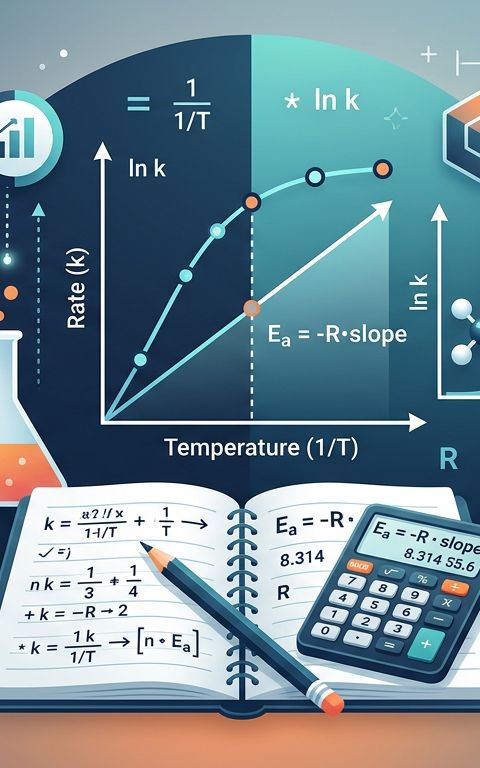
Medium Arrhenius Equation Practice Questions
Master the Arrhenius equation with our medium-level practice questions, including step-by-step solutions for activation energy and rate constant calculations.
Apr 2, 2026
Arrhenius Equation Practice Questions with Answers
Master the Arrhenius equation with our comprehensive guide featuring solved examples, practice questions, and detailed explanations for chemistry students.
Apr 2, 2026

Absolute Value Equation Practice Questions with Answers
Master the absolute value equation with our comprehensive guide. Includes step-by-step solved examples, practice questions, and detailed explanations.
Apr 6, 2026
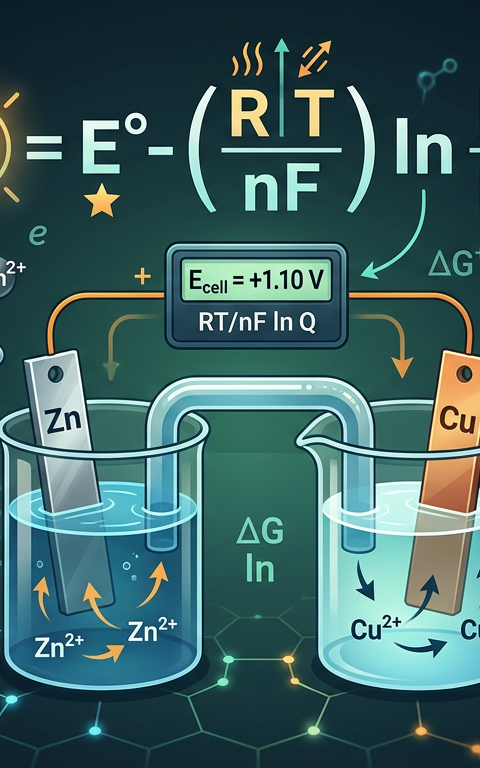
Hard Nernst Equation Practice Questions
Master the Nernst equation with these hard practice questions. Learn to calculate cell potentials under non-standard conditions with step-by-step solutions.
Apr 4, 2026

Medium Nernst Equation Practice Questions
Master the Nernst equation with these medium-level practice questions and detailed solutions. Perfect for chemistry students tackling non-standard cell potentials.
Apr 4, 2026
Easy Nernst Equation Practice Questions
Master the Nernst Equation with these easy practice questions and step-by-step solutions. Learn to calculate cell potentials under non-standard conditions.
Apr 4, 2026

Predicting Voltage: Solving Nernst Equation Problems at Non-Standard State
Master the Nernst equation with our comprehensive practice guide. Includes solved examples, step-by-step calculations, and a quick quiz to test your knowledge.
Apr 3, 2026
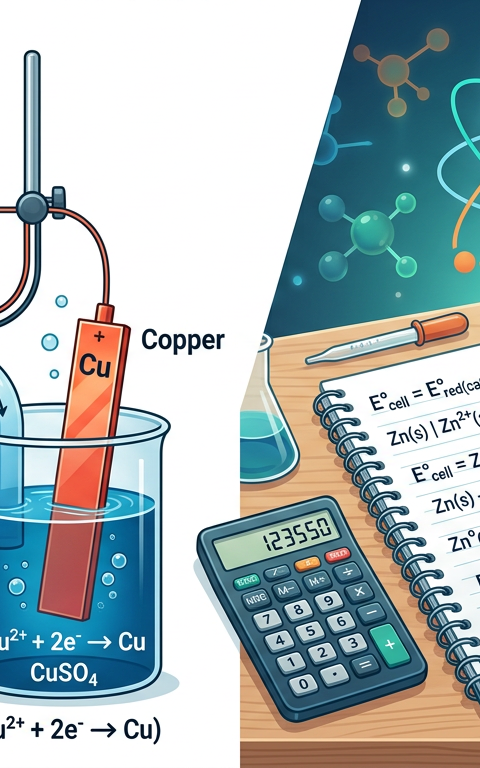
Mastering E°cell: Identifying Anodes and Using the Nernst Equation
Master cell potential calculations with our guide. Includes solved examples, Nernst equation practice, and 10 detailed questions with answers.
Apr 3, 2026