Easy Anatomy Practice Questions Practice Questions

Concept Explanation
Anatomy is the branch of biological science that focuses on the identification and description of the body structures of living things. When engaging with Easy Anatomy Practice Questions, you are primarily exploring gross anatomy, the study of structures that can be seen with the naked eye, and the basic organization of the human body. Understanding anatomy requires a firm grasp of the hierarchical levels of organization, starting from the chemical level and progressing through cells, tissues, organs, and organ systems.
The human body is often described using standard anatomical positions and planes to ensure clarity among medical professionals. For instance, the sagittal plane divides the body into left and right, while the transverse plane divides it into top and bottom. Key concepts for beginners include identifying major bones like the femur, understanding the chambers of the heart, and knowing the primary functions of the skin. According to the National Cancer Institute, the body maintains homeostasis through the coordinated efforts of 11 distinct organ systems. Mastering these basics is the first step toward excelling in more specialized fields like the cardiovascular system or the complex network of the nervous system.
Solved Examples
Review these examples to understand how to approach basic anatomical identification and terminology.
Question: Which bone is commonly referred to as the \"thigh bone\" and is the longest bone in the human body?
Solution:Identify the region: The thigh is the upper part of the leg.
Recall major bones: The major bone in this region is the femur.
Confirm facts: The femur is indeed the longest and strongest bone in the body.
Answer: Femur.
Question: In the anatomical position, are the palms of the hands facing forward or backward?
Solution:Define anatomical position: Standing upright, feet slightly apart, arms at sides.
Visualize the standard: In this standard medical reference position, the body faces the observer.
Determine hand orientation: The palms are rotated to face forward (anteriorly).
Answer: Forward.
Question: Which organ system is responsible for the exchange of oxygen and carbon dioxide between the body and the environment?
Solution:Identify the function: Gas exchange.
Match to system: The lungs, trachea, and nasal passages comprise the respiratory system.
Distinguish from others: While the circulatory system transports gases, the respiratory system performs the actual exchange.
Answer: Respiratory System.
Practice Questions
Test your knowledge with these Easy Anatomy Practice Questions. Start with the basics and move toward more specific structures.
What is the largest organ of the human body by surface area?
Which type of tissue is responsible for sending electrical signals throughout the body?
How many chambers are found in a healthy human heart?
Start Learning Smarter Today
Join thousands of students using AI-powered study tools to achieve better results.
Get Started FreeWhich bone protects the brain and forms the structure of the face?
What is the name of the tube that connects the throat to the stomach?
Which muscle is primarily responsible for the action of breathing?
What are the small air sacs in the lungs where gas exchange occurs?
Which directional term means \"closer to the head\"?
What is the primary function of the skeletal system besides providing structure?
Which organ is responsible for filtering blood and producing urine?
Answers & Explanations
Skin (Integumentary System): The skin is the largest organ, serving as a protective barrier and regulating temperature.
Nervous Tissue: Composed of neurons, this tissue transmits impulses that coordinate body activities.
Four: The heart consists of two atria (upper) and two ventricles (lower).
The Skull (Cranium): The skull is a bony structure that encases the brain and supports the facial features.
Esophagus: This muscular tube uses peristalsis to move food from the pharynx to the stomach.
Diaphragm: A dome-shaped muscle located below the lungs that contracts to allow inhalation.
Alveoli: These tiny sacs provide a massive surface area for oxygen to enter the blood and carbon dioxide to leave.
Superior (or Cranial): In anatomical terminology, superior refers to a structure being higher or closer to the head than another.
Mineral storage and blood cell production: The skeleton stores calcium and houses bone marrow, which produces red and white blood cells.
Kidneys: These bean-shaped organs filter waste products from the blood to create urine.
1. Which of the following is considered the basic functional unit of the human body?
Frequently Asked Questions
What is the difference between anatomy and physiology?
Anatomy is the study of the physical structure and organization of the body, whereas physiology focuses on how those structures function and work together to support life. Essentially, anatomy is the \"map\" of the body, and physiology is the "manual" for how it operates.
What are the four main types of tissue in the human body?
The four primary tissue types are epithelial tissue (covering surfaces), connective tissue (support and binding), muscle tissue (movement), and nervous tissue (communication). Every organ in the body is composed of a combination of these four tissues.
What is the anatomical position?
The anatomical position is a standardized posture where the individual stands upright, facing forward, with feet flat and arms at the sides with palms facing out. This universal reference point prevents confusion when describing the location of body parts.
Which bone is the smallest in the human body?
The stapes, located in the middle ear, is the smallest bone in the human body. It is roughly 3 millimeters long and plays a critical role in transmitting sound vibrations to the inner ear.
Why is the left ventricle thicker than the right ventricle?
The left ventricle is thicker because it must pump oxygenated blood to the entire body, which requires high pressure. In contrast, the right ventricle only pumps blood a short distance to the lungs.
Start Learning Smarter Today
Join thousands of students using AI-powered study tools to achieve better results.
Get Started FreeEnjoyed this article?
Share it with others who might find it helpful.
Related Articles
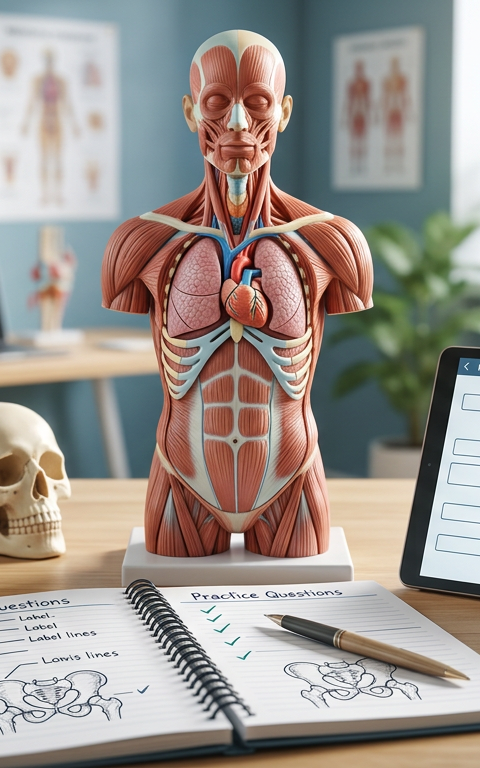
Medium Anatomy Practice Questions Practice Questions
Medium Anatomy Practice Questions Practice Questions
Apr 25, 2026
Hard Anatomy Practice Questions Practice Questions
Master advanced human anatomy with our comprehensive guide featuring hard practice questions, detailed solved examples, and clinical correlations for medical students.
Apr 25, 2026
Anatomy Practice Questions Practice Questions with Answers
Anatomy Practice Questions Practice Questions with Answers
Apr 25, 2026

Hard Microbiology Practice Questions Practice Questions
Hard Microbiology Practice Questions Practice Questions
Apr 26, 2026

Medium Microbiology Practice Questions Practice Questions
Master microbiology with our medium-level practice questions covering bacterial growth, genetics, and metabolism. Includes solved examples and a quick quiz.
Apr 26, 2026

Easy Microbiology Practice Questions Practice Questions
Easy Microbiology Practice Questions Practice Questions
Apr 26, 2026

Hard Enzyme Questions Practice Questions
Master complex biochemistry with these hard enzyme questions. Cover Michaelis-Menten kinetics, inhibition types, and Lineweaver-Burk plots with solved examples.
Apr 26, 2026

Medium Enzyme Questions Practice Questions
Master enzyme kinetics and regulation with our Medium Enzyme Questions Practice Questions. Includes solved examples, detailed explanations, and a quick quiz.
Apr 26, 2026