Easy ACT Biology Practice Questions
Concept Explanation
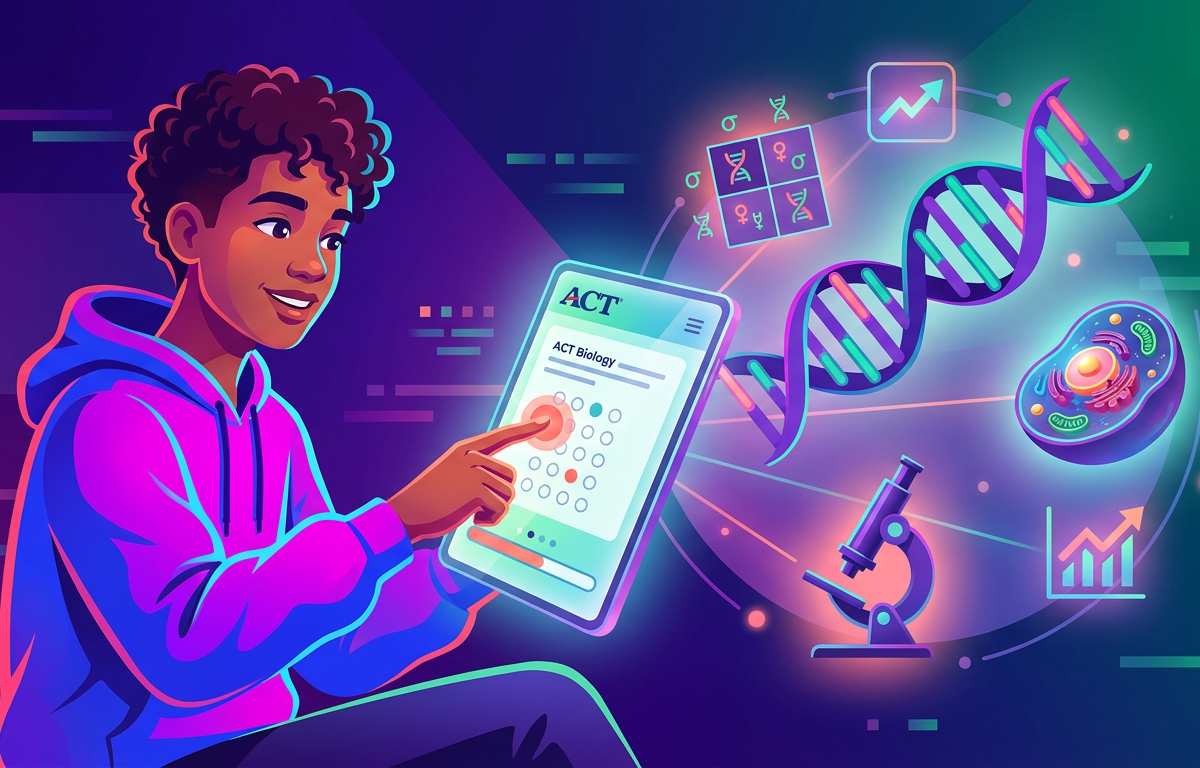
Easy ACT Biology practice questions focus on fundamental biological principles including cell structure, basic genetics, photosynthesis, and ecosystems. These foundational topics serve as the building blocks for the Science section of the ACT Prep curriculum. On the exam, biology-related passages often appear as Data Representation or Research Summary tasks. To succeed, you must understand how living organisms function at a microscopic level and how they interact within larger environments. Key concepts involve identifying organelles like the mitochondria or chloroplasts, understanding the flow of energy through a food web, and predicting offspring traits using simple Punnett squares. This section of the test doesn't require deep memorization of obscure facts but rather the ability to apply basic knowledge to interpret given data or experimental results.
Solved Examples
Review these examples to understand the logic used to solve typical biology questions on the ACT.
- Cell Biology: A student observes a cell under a microscope and notices a rigid cell wall and a large central vacuole. Which type of organism is this most likely from?
1. Identify the unique structures: Cell wall and large central vacuole.
2. Recall that animal cells lack a cell wall and usually have small, temporary vacuoles.
3. Recognize that these features are characteristic of plant cells.
Solution: The organism is a plant. - Genetics: In a specific plant species, the allele for tall height is dominant over the allele for short height . If two heterozygous plants are crossed, what is the probability of producing a short plant?
1. Set up a Punnett square for .
2. The possible genotypes are and .
3. Count the number of (short) outcomes: 1 out of 4.
Solution: The probability is . - Ecology: In a food chain consisting of grass grasshopper frog snake, which organism is the primary consumer?
1. Define primary consumer: An organism that eats producers (plants).
2. Identify the producer: Grass.
3. Identify the organism that eats the grass: Grasshopper.
Solution: The grasshopper is the primary consumer.
Practice Questions
Test your knowledge with these easy ACT Biology practice questions. Be sure to use our AI Question Generator if you need additional customized drills.
- Which organelle is primarily responsible for producing energy in the form of ATP through cellular respiration?
- If a DNA strand has the sequence 5'-ATCG-3', what is the complementary DNA sequence?
- In a desert ecosystem, which of the following would be considered an abiotic factor: cacti, sand, lizards, or bacteria?
Want a higher ACT score?
Practice with AI-powered ACT questions, personalized quizzes, and smart study tools designed to help you improve faster.
Start ACT Prep Free- During which phase of the cell cycle does DNA replication occur?
- What is the name of the process by which plants convert sunlight, water, and carbon dioxide into glucose and oxygen?
- A researcher is studying ACT Scientific Method Practice Questions and sets up an experiment. If the independent variable is the amount of fertilizer, what is the dependent variable likely to be?
- Which macromolecule is composed of amino acids and serves as the primary building block for muscles and enzymes?
- In a symbiotic relationship where one organism benefits and the other is neither helped nor harmed, what is the relationship called?
- Which type of RNA carries the genetic code from the DNA in the nucleus to the ribosome?
- If an organism has 20 chromosomes in its somatic (body) cells, how many chromosomes will be in its gametes (sex cells)?
Answers & Explanations
- Mitochondria: Often called the "powerhouse" of the cell, mitochondria perform cellular respiration to generate ATP.
- 3'-TAGC-5': In DNA, Adenine (A) pairs with Thymine (T), and Cytosine (C) pairs with Guanine (G).
- Sand: Abiotic factors are non-living components of an environment, whereas cacti, lizards, and bacteria are biotic (living).
- S phase: During the Synthesis (S) phase of interphase, the cell replicates its DNA to prepare for division.
- Photosynthesis: This process occurs in the chloroplasts and is the primary way energy enters most ecosystems.
- Plant growth: The dependent variable is the outcome being measured, which in this case would be the growth or health of the plant.
- Proteins: Proteins are polymers of amino acids and perform various structural and catalytic functions.
- Commensalism: This is a specific type of symbiosis; for example, barnacles attaching to whales.
- mRNA (messenger RNA): It acts as the "messenger" that translates the genetic blueprint into a protein sequence.
- 10: Gametes are haploid, meaning they contain half the number of chromosomes as diploid somatic cells.
1. Which of the following is found in eukaryotic cells but NOT in prokaryotic cells?
Frequently Asked Questions
What are the most common biology topics on the ACT?
The ACT typically covers cell biology, DNA/RNA, basic genetics, evolution, and ecology. You should focus on understanding big-picture processes rather than memorizing every specific enzyme or chemical intermediate.
Do I need to memorize the periodic table for ACT biology?
No, the periodic table is more relevant for chemistry passages. For biology, you only need to know basic elements like Carbon, Hydrogen, Oxygen, and Nitrogen that make up living things.
How is biology tested in the Science section?
Biology is usually presented through ACT Science Passage Practice Questions where you must interpret graphs or data from a biological experiment. Success depends more on data analysis than on outside knowledge.
Are Punnett squares frequently on the exam?
Yes, basic Mendelian genetics is a common topic. You should be comfortable performing a simple monohybrid cross to determine the probability of specific traits appearing in offspring.
How can I practice more biology questions?
Using an AI Exam Simulator can help you get used to the timing and format of biology-related science passages. Consistent practice with realistic data sets is the best way to improve your score.
Want a higher ACT score?
Practice with AI-powered ACT questions, personalized quizzes, and smart study tools designed to help you improve faster.
Start ACT Prep FreeTags
Enjoyed this article?
Share it with others who might find it helpful.
Related Articles

Hard ACT Biology Practice Questions
Hard ACT Biology Practice Questions
Jun 8, 2026
Medium ACT Biology Practice Questions
Medium ACT Biology Practice Questions
Jun 8, 2026

ACT Biology Practice Questions with Answers
ACT Biology Practice Questions with Answers
Jun 8, 2026

Hard ACT Mixed Subject Practice Questions
Hard ACT Mixed Subject Practice Questions
Jun 8, 2026

Hard ACT Graph Practice Questions
Hard ACT Graph Practice Questions
Jun 8, 2026

Hard ACT Mixed Science Practice Questions
Hard ACT Mixed Science Practice Questions
Jun 8, 2026

Hard ACT Scientific Method Practice Questions
Hard ACT Scientific Method Practice Questions
Jun 8, 2026

Hard ACT Mixed Reading Practice Questions
Hard ACT Mixed Reading Practice Questions
Jun 8, 2026