Solving SAT Geometry Word Problems: Turning Text into Diagrams

When the Digital SAT describes a cylindrical grain silo with a radius of 4 feet and a height of 10 feet, most students immediately reach for the V = πr²h formula. However, the College Board rarely asks for a direct calculation. Instead, they might ask for the volume when the silo is 70% full or require you to convert the final answer from cubic feet to cubic yards. The primary hurdle isn't the geometry itself, but the linguistic layering that hides the necessary dimensions within a paragraph of text.
Misreading a single word like diameter for radius or failing to account for a scale factor in similar triangles can invalidate your entire calculation. Success requires a shift from passive reading to active modeling. You must learn to extract the geometric skeleton from the narrative, sketching the scenario immediately if a diagram isn't provided. This article focuses on that translation process, ensuring you don't lose points to unit conversion traps or overlooked spatial constraints in multi-step word problems.
SAT Geometry Word Practice Questions with Answers
Mastering SAT geometry word practice questions is essential for students aiming for a top-tier score on the digital SAT Math section. Unlike standard calculation problems, geometry word problems require you to translate descriptive scenarios into geometric models, applying properties of shapes, angles, and volumes to real-world contexts. This guide provides comprehensive explanations, worked examples, and a diverse set of practice questions to sharpen your spatial reasoning and problem-solving skills.
Concept Explanation
SAT geometry word problems are mathematical challenges that embed geometric principles—such as area, volume, trigonometry, and circle theorems—within a narrative or descriptive context. These problems test your ability to visualize a scenario and apply the correct formula or property to find a missing measurement. Success in this area requires a deep understanding of the Euclidean geometry fundamentals provided in the SAT reference sheet.
To solve these problems effectively, you should follow a structured approach:
- Sketch the Scenario: If no diagram is provided, draw one based on the text. Label all given dimensions and the variable you need to find.
- Identify the Geometric Goal: Determine if the question asks for a length (perimeter, circumference, side), an area, a volume, or an angle measure.
- Recall Relevant Formulas: Common formulas include the area of a circle , the Pythagorean theorem , and volume of a cylinder .
- Unit Conversion: Pay close attention to units. If the dimensions are in inches but the answer must be in feet, convert before or after the calculation as required.
For more complex scenarios, you might need to combine geometry with other math skills, such as those found in SAT algebra word practice questions, where variables represent geometric dimensions.
Solved Examples
Example 1: A rectangular garden has a length that is 4 feet longer than its width. If the perimeter of the garden is 48 feet, what is the area of the garden in square feet?
- Define variables: Let the width be and the length be .
- Use the perimeter formula: . Substitute the given values:
- Simplify and solve for :
- Find the length: .
- Calculate the area: . The area is 140 square feet.
Example 2: A cylindrical water tank has a radius of 3 meters and a height of 5 meters. If the tank is filled to 80% of its capacity, what is the volume of water in the tank in terms of ?
- Identify the volume formula for a cylinder: .
- Calculate the total capacity:
- Calculate 80% of the total volume:
- The volume of water is cubic meters.
Example 3: A right triangle has a hypotenuse of 13 cm and one leg of 5 cm. A second triangle is similar to the first, and its longest side is 39 cm. What is the area of the second triangle?
- Find the missing leg of the first triangle using the Pythagorean theorem:
- Determine the scale factor between the triangles. The hypotenuse of the first is 13 and the second is 39. Scale factor .
- Find the dimensions of the second triangle: Legs are and .
- Calculate the area of the second triangle:
- The area is 270 square centimeters.
Practice Questions
- A square window has a diagonal of inches. What is the perimeter of the window in inches?
- A circular pizza is cut into 8 equal slices. If the radius of the pizza is 6 inches, what is the area of a single slice in square inches?
- A cone-shaped paper cup has a height of 6 inches and a base radius of 2 inches. If the cup is filled with water to half its height, what is the volume of the water? (Hint: The water forms a smaller similar cone).
- In triangle , the measure of angle is . If and the length of side is 9, what is the length of the hypotenuse ?
- A rectangular prism has a volume of 120 cubic units. If the length is doubled, the width is tripled, and the height remains the same, what is the new volume?
- A circle in the -plane has the equation . What is the circumference of this circle?
- An equilateral triangle has a side length of 10. What is the area of the triangle?
- A spherical balloon is being inflated. If the radius increases from 3 inches to 6 inches, by what factor does the volume increase?
- A wire 40 cm long is bent to form a rectangle. If the width of the rectangle is and the length is , find the value of .
- A ladder 10 feet long leans against a vertical wall. If the bottom of the ladder is 6 feet from the base of the wall, how high up the wall does the ladder reach?
Answers & Explanations
- Answer: 32. In a square, the diagonal . Given , the side . Perimeter .
- Answer: . The area of the whole pizza is . Since there are 8 equal slices, one slice is .
- Answer: . When the height is halved (), the radius is also halved () due to similar triangles. Volume of water .
- Answer: 15. In a right triangle, . Here, the side opposite to angle is . So, . Solving for : .
- Answer: 720. Volume . If becomes and becomes , the new volume is . . Check out SAT word problems practice questions for more on scaling.
- Answer: . The equation of a circle is . Here, , so . Circumference .
- Answer: . The area of an equilateral triangle is . With , .
- Answer: 8. Volume of a sphere is proportional to . If the radius doubles (), the volume increases by a factor of .
- Answer: 8. Perimeter . . This logic is similar to SAT linear equations practice questions.
- Answer: 8. This forms a right triangle where the ladder is the hypotenuse. Using the Pythagorean theorem: .
1. If the radius of a circle is tripled, by what factor does the area increase?
Frequently Asked Questions
What geometry formulas are provided on the SAT?
The SAT provides a reference sheet at the start of every math section including formulas for the area of circles, rectangles, and triangles, as well as the volume of prisms, cylinders, spheres, and cones. It also includes the Pythagorean theorem and special right triangle ratios.
How do I solve geometry word problems without a diagram?
Always start by drawing a rough sketch based on the verbal description provided in the prompt. Label all known sides, angles, and variables to help visualize the spatial relationships and identify which geometric theorem applies.
Are trigonometry questions included in SAT geometry?
Yes, the SAT tests basic trigonometry, primarily focusing on SOH CAH TOA (Sine, Cosine, Tangent) relationships in right triangles and the relationship between sine and cosine of complementary angles. These are often presented as word problems involving heights or distances.
What is the most common geometry topic on the SAT?
Properties of triangles—specifically right triangles and similar triangles—are among the most frequently tested concepts. You should also be very comfortable with circle equations and coordinate geometry involving distances and slopes.
How do units affect SAT geometry word problems?
The SAT often uses different units for the given dimensions and the final answer to test your attention to detail. Always verify if you need to convert units (e.g., inches to feet or centimeters to meters) before performing your final calculation.
Should I use 3.14 or the pi button on my calculator?
Most SAT questions will ask for the answer "in terms of " or provide options using the symbol. If a decimal is required, using the button on your calculator is more accurate than 3.14 and is recommended to avoid rounding errors.
Enjoyed this article?
Share it with others who might find it helpful.
Related Articles

Hard SAT Geometry Word Practice Questions
Hard SAT Geometry Word Practice Questions
Apr 27, 2026
Hard SAT Coordinate Geometry Practice Questions
Hard SAT Coordinate Geometry Practice Questions
Apr 27, 2026
Solving the Hidden Geometry Traps in SAT Triangle Problems
Hard SAT Triangle Practice Questions
Apr 27, 2026
Solving Multistep SAT Geometry: From Circle Equations to Radians
Hard SAT Geometry Practice Questions
Apr 27, 2026

Medium SAT Geometry Word Practice Questions
Medium SAT Geometry Word Practice Questions
Apr 27, 2026
Medium SAT Coordinate Geometry Practice Questions
Medium SAT Coordinate Geometry Practice Questions
Apr 27, 2026
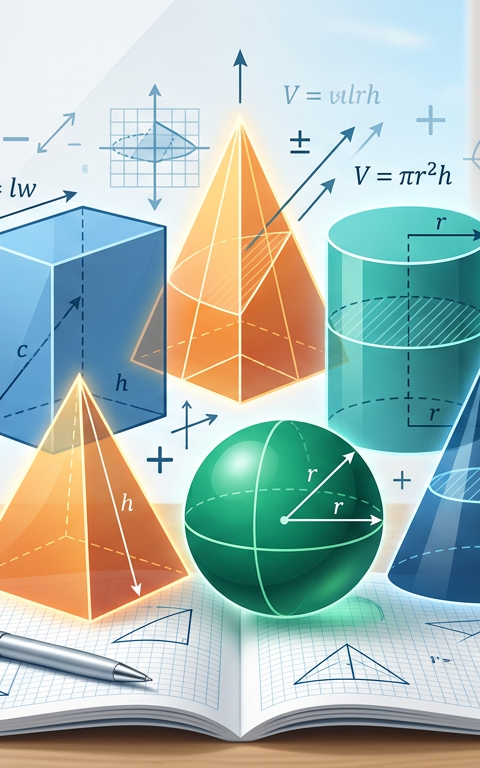
Solving Multistep SAT Geometry: Area and Volume Relationships
Master Medium SAT Area and Volume Practice Questions with our comprehensive guide, featuring solved examples, practice problems, and a quick quiz.
Apr 27, 2026
Medium SAT Geometry Practice Questions
Medium SAT Geometry Practice Questions
Apr 27, 2026