SAT Geometry Practice Questions with Answers

SAT Geometry Practice Questions with Answers
Mastering SAT Geometry is essential for achieving a high score on the Math section, as these topics typically make up about 15% of the exam. This guide provides comprehensive SAT Geometry practice questions with answers, covering everything from basic angle relationships to complex 3D volume problems. By understanding the core theorems and practicing with realistic examples, you can approach the test with confidence and precision.
Concept Explanation
SAT Geometry focuses on the properties of lines, angles, triangles, circles, and three-dimensional solids. The exam tests your ability to apply geometric theorems to solve for unknown lengths, areas, and volumes. Key concepts include the Pythagorean theorem, properties of special right triangles (30-60-90 and 45-45-90), circle equations, and coordinate geometry. You will also encounter concepts related to linear equations when dealing with lines in the -plane. According to the College Board, students must also be familiar with basic trigonometry, such as sine, cosine, and tangent, which are often integrated into triangle problems.
Core Geometric Principles
- Triangles: The sum of interior angles is always . The area is calculated as .
- Circles: The equation of a circle in the -plane is , where is the center and is the radius.
- Special Right Triangles: In a 45-45-90 triangle, sides follow the ratio . In a 30-60-90 triangle, sides follow .
- Volume: You must know the volume formulas for cylinders (), rectangular prisms (), and spheres ().
Solved Examples
Review these step-by-step solutions to understand how to approach common SAT Geometry problems.
- Example 1: Circle Equations
A circle in the -plane has the equation . What is the radius of the circle?- Group terms: .
- Complete the square: .
- Simplify: .
- Identify : Since , the radius .
- Example 2: Special Right Triangles
An equilateral triangle has a side length of 10. What is the area of the triangle?- An equilateral triangle can be split into two 30-60-90 triangles.
- The base of one 30-60-90 triangle is half the side: .
- The height (opposite the angle) is .
- Use the area formula: .
- Example 3: Similar Triangles
Triangle is similar to triangle . If the ratio of their corresponding sides is and the area of triangle is 20, what is the area of triangle ?- The ratio of areas is the square of the ratio of sides.
- Area ratio = .
- Set up the proportion: .
- Solve for : .
Practice Questions
- A rectangular prism has a length of 8, a width of 3, and a height of . If the surface area is 158, what is the value of ?
- In the -plane, a circle with center is tangent to the -axis. What is the equation of the circle?
- A right circular cylinder has a volume of and a height of 8. What is the circumference of its base?
- Two parallel lines are intersected by a transversal. If one of the alternate interior angles is and the other is , what is the value of ?
- A triangle has side lengths of 7 and 10. Which of the following could be the length of the third side? (Choose all that apply: 2, 5, 12, 17, 18)
- In circle , a central angle of intercepts an arc of length . What is the area of the circle?
- A square is inscribed in a circle with a radius of . What is the area of the square?
- What is the distance between the points and in the coordinate plane?
- A cone has a radius of 6 and a slant height of 10. What is the volume of the cone in terms of ?
- If the measure of an interior angle of a regular polygon is , how many sides does the polygon have?
Answers & Explanations
Check your work against these detailed explanations to identify areas for improvement.
- Answer: 5. The surface area formula is . Substituting the given values: . This type of calculation is similar to solving word problems found in other math sections.
- Answer: . Since the circle is tangent to the -axis, the radius is the distance from the center's -coordinate to the axis. The distance from to 0 is 3. Thus, and .
- Answer: . Volume . So, . Circumference .
- Answer: 15. Alternate interior angles are equal when lines are parallel. Set the expressions equal: .
- Answer: 5 and 12. According to the Triangle Inequality Theorem, the third side must be: , or . Only 5 and 12 fit this range.
- Answer: . The arc length is a fraction of the circumference: . Area .
- Answer: 100. The diagonal of the square is the diameter of the circle. Diameter . Let the side of the square be . Using the Pythagorean theorem for the square's diagonal: . The area is .
- Answer: 10. Use the distance formula: . You can find more coordinate geometry practice in our SAT Math Practice Set.
- Answer: . First, find the vertical height using the Pythagorean theorem with radius and slant height : . Volume .
- Answer: 10. The exterior angle is . The sum of exterior angles is always . Number of sides .
1. What is the sum of the exterior angles of any convex polygon?
Frequently Asked Questions
What geometry formulas are provided on the SAT?
The SAT provides a reference sheet at the beginning of each math section containing formulas for the area of circles, rectangles, and triangles, as well as the volume of prisms, cylinders, spheres, cones, and pyramids. It also includes the Pythagorean theorem and special right triangle ratios.
How many geometry questions are on the SAT?
Geometry and Trigonometry typically account for approximately 6 out of the 44 questions on the Digital SAT Math section. While it is a smaller portion compared to Algebra, these questions are often where students lose points due to forgotten theorems.
Do I need to know radians for SAT Geometry?
Yes, you must be able to convert between degrees and radians using the relationship . Many circle sector and arc length problems on the SAT use radians to test your fluency with different units of measurement.
What is the most important geometry theorem for the SAT?
The Pythagorean theorem () is arguably the most frequently used tool in SAT Geometry. It is used not only for right triangles but also to find distances in the coordinate plane and heights in 3D figures.
Are there proofs on the SAT?
No, the SAT does not require you to write out formal geometric proofs. However, you must understand the logic behind proofs, such as knowing that vertical angles are congruent or that alternate interior angles of parallel lines are equal, to solve multiple-choice questions.
Enjoyed this article?
Share it with others who might find it helpful.
Related Articles
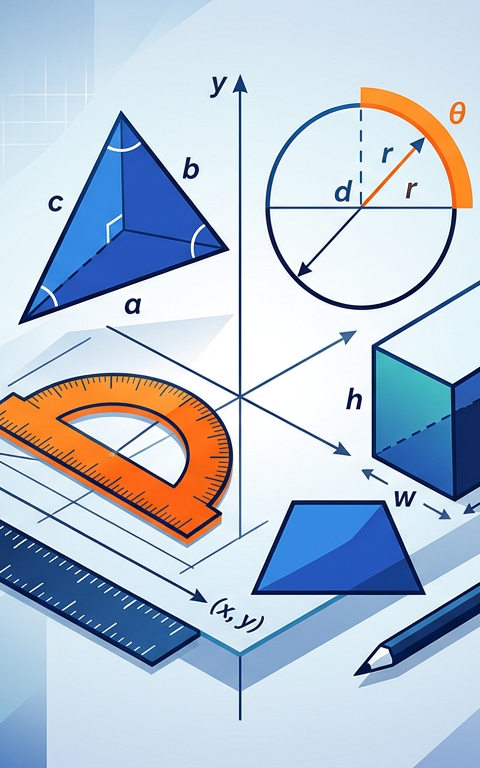
Medium SAT Geometry Practice Questions
Medium SAT Geometry Practice Questions
Apr 27, 2026
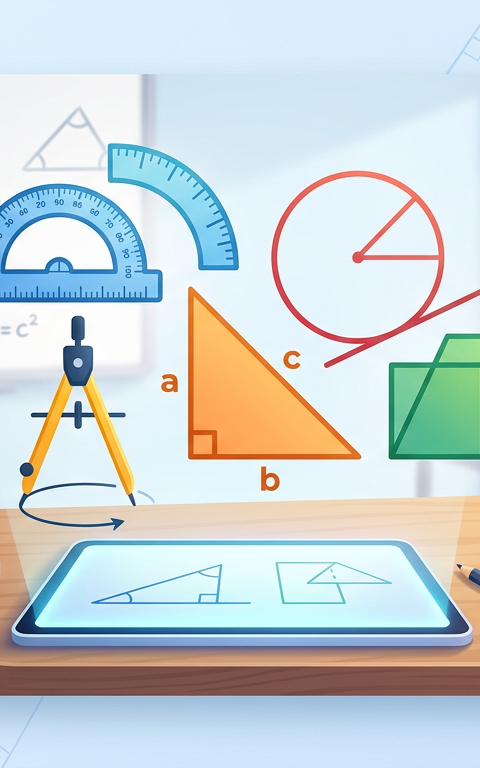
Easy SAT Geometry Practice Questions
Easy SAT Geometry Practice Questions
Apr 27, 2026

Hard SAT Geometry Word Practice Questions
Hard SAT Geometry Word Practice Questions
Apr 27, 2026
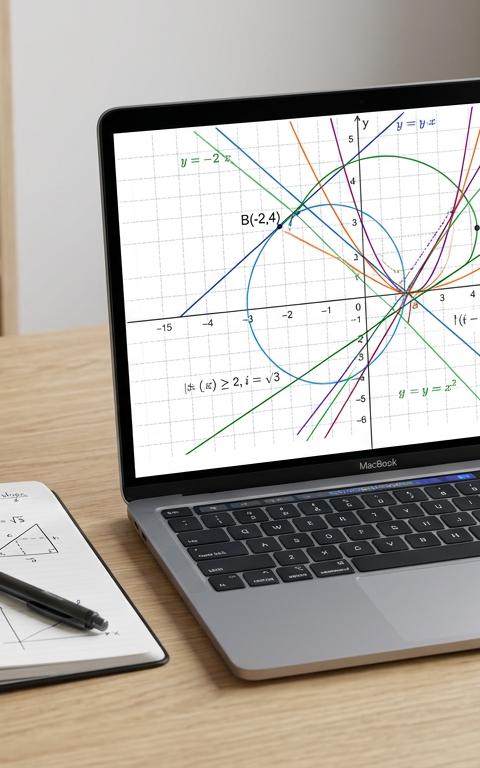
Hard SAT Coordinate Geometry Practice Questions
Hard SAT Coordinate Geometry Practice Questions
Apr 27, 2026
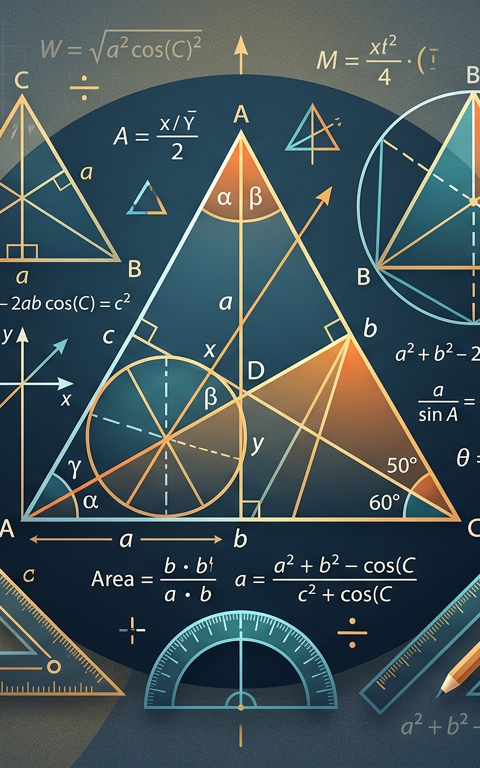
Solving the Hidden Geometry Traps in SAT Triangle Problems
Hard SAT Triangle Practice Questions
Apr 27, 2026

Medium SAT Geometry Word Practice Questions
Medium SAT Geometry Word Practice Questions
Apr 27, 2026
Medium SAT Coordinate Geometry Practice Questions
Medium SAT Coordinate Geometry Practice Questions
Apr 27, 2026
Easy SAT Geometry Word Practice Questions
Easy SAT Geometry Word Practice Questions
Apr 27, 2026