SAT Area and Volume Practice Questions with Answers
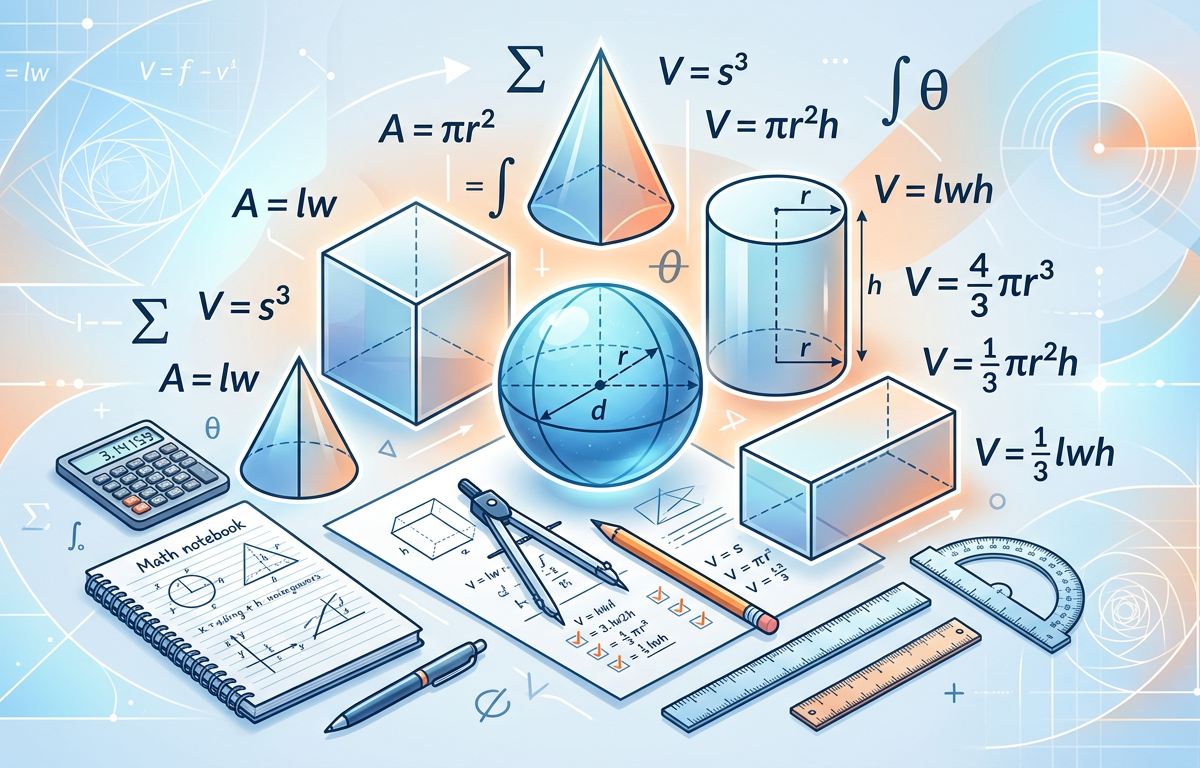
Concept Explanation
SAT Area and Volume concepts refer to the mathematical principles used to calculate the space occupied by two-dimensional shapes and three-dimensional objects, respectively. Mastering these geometry topics is essential for success on the Math section of the SAT, as they frequently appear in both calculator and no-calculator portions. Area measures the surface within a boundary, such as a square or circle, and is expressed in square units. Volume measures the capacity of a solid, such as a cylinder or rectangular prism, and is expressed in cubic units. The SAT provides a reference sheet with most common formulas, but understanding how to manipulate these formulas for complex figures is the key to a high score.
Key formulas you must be familiar with include:
- Area of a Circle:
- Circumference of a Circle:
- Area of a Rectangle:
- Area of a Triangle:
- Volume of a Rectangular Prism:
- Volume of a Cylinder:
- Volume of a Sphere:
When solving these problems, always pay attention to units. If a question provides dimensions in inches but asks for the answer in feet, you must convert the units before performing calculations. For more practice on related quantitative reasoning, check out our SAT Math Practice Questions Set 3.
Solved Examples
Below are worked examples demonstrating how to apply geometry formulas to typical SAT-style problems.
- Example 1: A rectangular garden has a length of 12 feet and a width of 8 feet. If a 2-foot wide stone path is built around the entire outside of the garden, what is the area of the path in square feet?
- Calculate the area of the original garden: square feet.
- Determine the dimensions of the larger rectangle (garden + path). The length increases by 2 feet on both sides: feet. The width also increases by 2 feet on both sides: feet.
- Calculate the area of the larger rectangle: square feet.
- Subtract the garden area from the total area: . The area of the path is 96 square feet.
- Example 2: A cylindrical water tank has a radius of 3 meters and a height of 5 meters. If the tank is currently half full, what is the volume of water in the tank in cubic meters?
- Identify the volume formula for a cylinder: .
- Plug in the given values: .
- Since the tank is half full, divide the total volume by 2: .
- Example 3: A square is inscribed in a circle with a radius of . What is the area of the square?
- Recognize that the diameter of the circle is equal to the diagonal of the square.
- Calculate the diameter: .
- Use the relationship between the diagonal and side length of a square: .
- Set up the equation: , which means .
- Calculate the area: .
Practice Questions
Test your knowledge with these SAT area and volume practice questions. Many of these require multi-step reasoning similar to SAT Word Problems Practice Questions.
- A rectangle has a perimeter of 40 centimeters. If the length is 4 centimeters longer than the width, what is the area of the rectangle in square centimeters?
- A right circular cone has a height of 9 inches and a base radius of 4 inches. What is the volume of the cone in cubic inches? (Formula: )
- The volume of a cube is 216 cubic inches. What is the total surface area of the cube in square inches?
- A circle is graphed in the xy-plane with the equation . What is the area of the circle?
- A sphere has a volume of cubic centimeters. What is the surface area of the sphere in square centimeters? (Surface Area Formula: )
- A rectangular prism has a length of 10, a width of , and a height of 5. If the volume is 300, what is the value of ?
- A right triangle has a hypotenuse of 13 and one leg of 5. What is the area of the triangle?
- If the radius of a cylinder is doubled and the height is halved, how does the volume change?
- A trapezoid has bases of 10 and 16 and a height of 8. What is the area of the trapezoid?
- The area of a circle is . What is the circumference of the circle?
Answers & Explanations
- Answer: 96. Let width be and length be . Perimeter . Set , so and . Length is . Area = .
- Answer: . Using the formula , we get .
- Answer: 216. Volume of a cube is , so side . Surface area is .
- Answer: . The standard form of a circle is . Here, . Area = .
- Answer: . Volume . Multiplying both sides by gives , so . Surface Area = .
- Answer: 6. Volume . So, , which simplifies to . Dividing by 50, .
- Answer: 30. Use the Pythagorean theorem to find the other leg: → → → . Area = .
- Answer: It doubles. Original volume: . New volume: . The volume is twice the original.
- Answer: 104. Area of a trapezoid = .
- Answer: . Area implies . Circumference .
1. If the side of a square is tripled, by what factor does the area increase?
Frequently Asked Questions
What geometry formulas are provided on the SAT?
The SAT provides a reference sheet at the beginning of each math section including formulas for the area of circles, rectangles, and triangles, as well as the volume of prisms, cylinders, spheres, and cones. However, you must know how to apply them to composite shapes and word problems.
How do I find the area of a shaded region?
To find the area of a shaded region, you usually calculate the area of the larger outer shape and subtract the area of the smaller inner shapes. This technique is common in problems involving circles inscribed in squares or vice versa.
Does the SAT focus more on area or volume?
Both concepts appear frequently, but area problems are slightly more common as they integrate with coordinate geometry and algebra. Volume problems often appear as realistic word problems involving fluid capacity or material density.
What is the relationship between the radius and the area of a circle?
The area of a circle is proportional to the square of its radius, defined by the formula . If the radius doubles, the area increases by a factor of four; if the radius triples, the area increases by a factor of nine.
How should I handle units in SAT geometry problems?
Always check the units provided in the question and the units required for the final answer before calculating. If a conversion is necessary, such as converting inches to feet, perform the conversion on the linear dimensions first to avoid confusion with square or cubic units.
Enjoyed this article?
Share it with others who might find it helpful.
Related Articles

Hard SAT Area and Volume Practice Questions
Hard SAT Area and Volume Practice Questions
Apr 27, 2026
Easy SAT Area and Volume Practice Questions
Easy SAT Area and Volume Practice Questions
Apr 27, 2026
Solving Multistep SAT Geometry: Area and Volume Relationships
Master Medium SAT Area and Volume Practice Questions with our comprehensive guide, featuring solved examples, practice problems, and a quick quiz.
Apr 27, 2026
Solving High-Level SAT Integer Logic and Number Theory Problems
Hard SAT Integers Practice Questions
Apr 27, 2026

Hard SAT Number Properties Practice Questions
Hard SAT Number Properties Practice Questions
Apr 27, 2026

Defeating Extraneous Solutions and Rational Exponents on the SAT
Hard SAT Radicals Practice Questions
Apr 27, 2026
Hard SAT Exponents Practice Questions
Hard SAT Exponents Practice Questions
Apr 27, 2026

Hard SAT Percent Practice Questions
Hard SAT Percent Practice Questions
Apr 27, 2026