Retrieval Practice vs Highlighting Notes: The Best Way to Learn
The Battle of Daily Study Habits
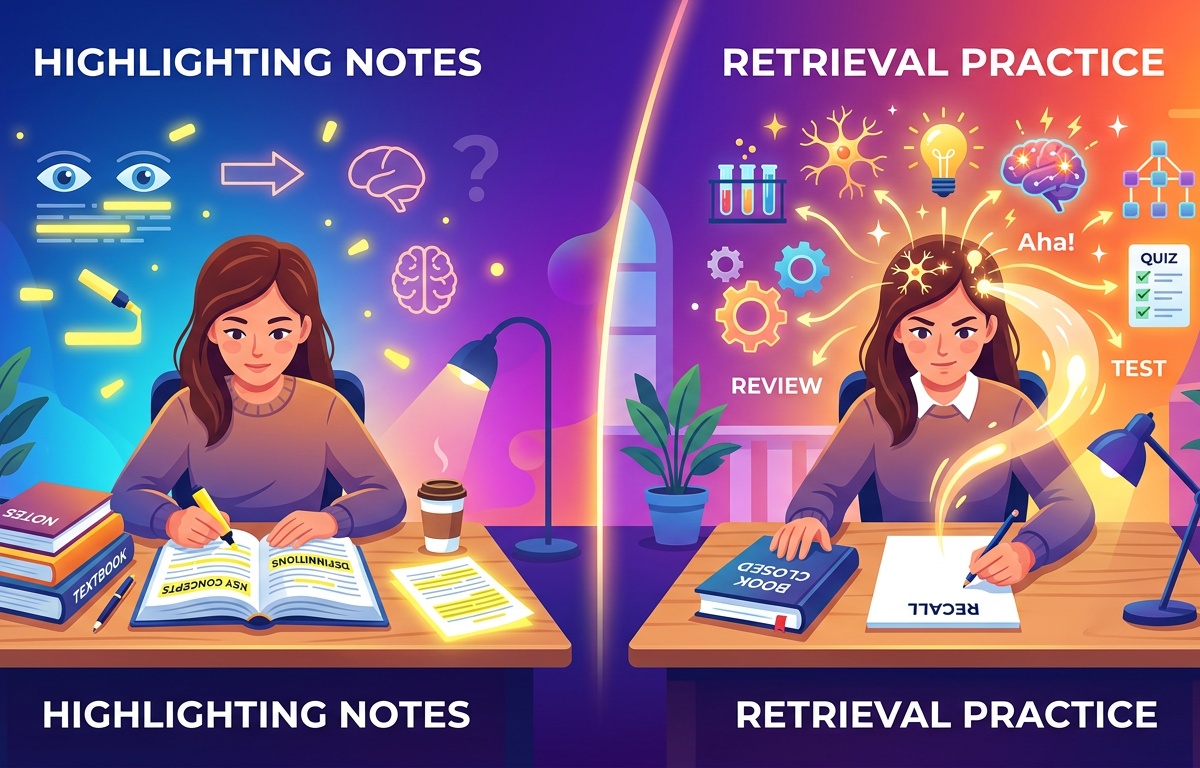
Walk into any university library and you will see a sea of neon yellow and pastel pink. Students hunched over textbooks, diligently dragging plastic tips across lines of text, are a staple of academic life. However, this visual of "hard work" often hides a lack of actual learning. The debate of retrieval practice vs highlighting notes isn't just a matter of preference; it is a clash between what feels good and what actually sticks.
Most learners default to highlighting because it feels productive. You see the page turning colors, you feel like you are "doing" something, and the content looks familiar the second time you see it. This is the metacognitive illusion in learning, where fluency is mistaken for mastery. We assume that because we recognize the words, we have successfully stored them in our long-term memory.
Retrieval practice involves the act of calling information to mind from memory, rather than looking at it. Highlighting is a form of passive review, where information is simply recognized as it sits on the page. To truly understand how retrieval practice boosts long-term memory, we must acknowledge that the brain is not a recording device, but a muscle that grows through the effort of recall.
Shifting from passive to active methods is the single most effective way to deepen your understanding. If you want to stop "re-learning" the same material every time a test rolls around, you must move beyond the highlighter. This guide breaks down the science of why active recall wins every time and how you can change your habits today.
What is Retrieval Practice? The Science of Active Recall
Retrieval practice is a learning strategy where you deliberately bring information to mind to strengthen your memory. Instead of trying to shove information "into" your brain, you are practicing pulling it "out." This shift in direction changes the underlying neurobiology of how you learn, moving data from temporary working memory into more permanent storage.
Psychologists often refer to this as the "testing effect." Research published by The Association for Psychological Science consistently shows that people who take a practice test after reading a text retain significantly more than those who read the text twice. It turns out that the act of failing to remember something, then checking the answer, creates a more durable memory trace than simply reading the correct answer in the first place.
When you engage in active recall, your brain strengthens the neural pathways associated with that specific piece of knowledge. Think of it like a forest path: every time you walk the path (retrieve the memory), the trail becomes clearer and easier to follow. Passive review, by contrast, is like looking at a map of the forest without ever stepping foot among the trees.
Why does retrieval feel so much harder than highlighting? It utilizes "desirable difficulties," a term coined by cognitive psychologist Robert Bjork. The mental strain you feel when trying to remember a concept is the exact biological signal that tells your brain to prioritize that information. If learning feels easy, you probably aren't doing it right. For those looking for concrete ways to apply this, exploring power retrieval practice examples can provide a roadmap for your next study session.
The Highlighting Myth: Why Passive Review Fails
Highlighting is often the least effective study tool because it requires almost no cognitive engagement. You can highlight an entire chapter while thinking about what you want for dinner. Because it lacks a challenge, it fails to trigger the brain's "need to know" mechanism, leaving the information on the surface of your mind.
This creates a "coloring book" effect. You end up with a beautifully aesthetic set of notes that give you a false sense of progress. According to The National Center for Education Statistics, students who rely on passive strategies often struggle with higher-order thinking tasks, as they have only memorized fragments rather than understanding systems.
Passive review fails because it ignores cognitive load theory in education. When you highlight, you aren't reorganizing the information or connecting it to what you already know. You are merely identifying what is important without actually learning it. This leads to the "familiarity trap": you recognize the text on the exam, but you realize you cannot explain the concept in your own words.
The differences between retrieval practice and rereading are stark. While rereading or highlighting might help you pass a quiz the next morning, that information will likely vanish within 48 hours. If your goal is long-term retention—especially for high-stakes environments—passive marks on a page will never be enough.
Ready to Stop Highlighting and Start Learning?
Use our AI-powered question generator to turn your notes into active recall challenges instantly. Master your exams by practicing the way you'll be tested.
Get Started FreeRetrieval Practice vs Highlighting Notes: Side-by-Side Comparison
When comparing retrieval practice vs highlighting notes, the most dramatic difference appears after a week has passed. In a typical study, students using retrieval techniques remember about 50% more than those using passive review. While highlighting might offer a slight edge in the short-term (minutes after studying), it fails spectacularly over longer durations.
Depth of processing is another critical metric. Highlighting focuses on "surface" learning—identifying keywords and phrases. Retrieval, specifically when paired with self-explanation, forces "structural" learning. You begin to see how Idea A connects to Idea B, which is essential for complex problem solving in fields like medicine or engineering. For instance, retrieval practice for medical students is often the difference between identifying a symptom and making a correct diagnosis.
Retention: Retrieval offers 3x better long-term retention than highlighting.
Application: Active recall prepares you for "unseen" questions; highlighting only prepares you for recognition.
Time Efficiency: While retrieval takes more effort per minute, it requires fewer total hours because you don't need to re-study the same material repeatedly.
Anxiety: Regular retrieval practice acts as a "vaccine" for test anxiety by making the testing environment feel familiar.
Using effective study strategies means valuing "output" over "input." If you are preparing for the SAT, you can't just highlight formulas; you must apply them. Many students struggle with the fast-paced nature of SAT math precisely because their study habits were too passive. They learned what the formulas looked like, but they never practiced retrieving them under pressure.
How to Implement Retrieval Practice: Step-by-Step Strategies
Switching to retrieval practice doesn't mean you need to discard your textbooks. It means you change how you interact with them. One of the most effective methods is the "Blurting" technique: read a section of text, close the book, and write down everything you remember on a blank sheet of paper. Afterward, use a different colored pen to fill in what you missed.
Flashcards are another staple, but they must be used correctly. Don't just look at the word and think, "I know that." You must say the answer out loud or write it down before flipping the card. This distinction between active recall vs passive review is what makes the strategy effective. For younger learners, a tailored high school retrieval guide can help simplify these steps into daily routines.
Another powerful method is "Question-Based Note Taking." Instead of writing summaries, write questions. If you are learning about photosynthesis, your note shouldn't be "Photosynthesis is the process by which plants make food." Instead, write: "What is the primary process plants use to convert light into energy?" When you review your notes later, you are forced to retrieve the answer.
Self-explanation, or elaborative interrogation, takes this a step further. Ask yourself "Why" and "How" questions as you go. For example, if you're working on hard SAT geometry questions, don't just find the area of the circle—explain why the formula works. This forces your brain to integrate new facts with existing knowledge, creating a denser web of memory.
Can You Save Highlighting? The Hybrid Approach
Highlighting isn't inherently evil; it is just often misused as a final destination. You can use highlighting as a scaffolding tool during your "first pass" of new material. Use it to identify the structural hierarchy of a chapter, the major headings, the primary definitions, and the key examples. This helps reduce initial cognitive load theory in education concerns by organizing the visual field.
The trick is to move immediately to the "Highlight-then-Hide" strategy. Once you've marked a key concept, cover it up. Can you explain what you just highlighted without looking? If not, you haven't learned it yet. This turns the highlighter into a signal for what needs to be retrieved, rather than a substitute for memory.
You can also convert your marks into questions for later use. If you highlight a sentence about the 14th Amendment, immediately write a question in the margin that would prompt that exact information as an answer. This transforms a static page into a dynamic study tool. This approach is particularly helpful for those following a comprehensive college retrieval guide, where the sheer volume of reading can otherwise be overwhelming.
Highlighting is also appropriate when skimming for structure or looking for a specific data point in a large document. In these cases, you aren't trying to learn long-term; you are just performing a task. But for any information you need to know a month from now, the highlighter must be replaced by a practice test.
The Role of Spaced Repetition and Interleaving
The spaced repetition benefits are most apparent when combined with retrieval. If you retrieve a fact once, you've started the process. If you retrieve it again two days later, then four days later, then two weeks later, you are fighting the "Forgetting Curve" described by Harvard University researchers. Each successful retrieval session extends the life of that memory significantly.
Interleaving is another high-level strategy that beats "blocked" practice. Instead of studying all your math notes for three hours, mix them up. Do twenty minutes of math, then twenty minutes of history, then twenty minutes of biology. This feels more difficult and "messy," but it forces the brain to constantly reload different sets of information, which is a much more powerful form of retrieval.
Consider how this looks in practice for standardized testing. If you are practicing hard SAT statistics in one giant block, you might start coasting on autopilot. But if you mix those statistics questions with hard SAT circle questions, your brain has to work harder to identify which strategy to use for each question. This variety strengthens the "retrieval cues" you'll need on test day.
Digital tools like Anki, Quizlet, or specialized AI platforms can automate this for you. They use algorithms to show you the hardest material more frequently while pushing known facts into the future. This ensures you are always working at the edge of your ability, the "sweet spot" for cognitive growth.
Master Any Subject with Scientific Precision
Stop wasting hours on passive review. Generate high-quality practice questions and flashcards from your custom study materials in seconds.
Get Started FreeMoving Toward Evidence-Based Learning
The journey from highlighting to retrieval practice is fundamentally a psychological one. You have to be willing to be wrong. When you highlight, you are never wrong, you are just reading. When you use retrieval, you will often find that you've forgotten things you thought you knew. This can be frustrating, but it is precisely where the learning happens.
Embracing the struggle of "hard" learning pays dividends. You will find that your total study time actually decreases because you no longer need to review the same notes five times before an exam. Once you've successfully retrieved a concept several times over a few weeks, it becomes a part of your permanent knowledge base.
Your new roadmap is simple: Read a little, then retrieve a lot. Use your pens to write answers, not to color code paragraphs. Shift your focus from how much you can "get through" to how much you can "bring back." The data is clear: the more you test yourself, the better you perform. Whether you are a freshman or a PhD candidate, the science remains the same.
Frequently Asked Questions
Which is more effective, highlighting or retrieval practice?
Retrieval practice is significantly more effective than highlighting. Scientific studies consistently show that active recall leads to much higher long-term retention and better conceptual understanding than passive strategies like marking text or rereading.
Is highlighting a complete waste of time?
It is not a complete waste if used as a preliminary step to organize information. However, if highlighting is your primary study method, it is inefficient. It should only be used to identify key areas that you will later study through active recall and retrieval.
What are some examples of retrieval practice for students?
Common examples include taking practice tests, using flashcards without looking at the back first, "blurting" (writing down everything you know on a blank sheet), and answering end-of-chapter questions without referring to the text.
How often should I use retrieval practice?
Retrieval practice should be used every time you study. It is most effective when combined with spaced repetition—testing yourself on material shortly after learning it, then again after a few days, and again after a week.
Can I combine highlighting with retrieval practice?
Yes. A common strategy is to highlight the most important concepts during your first reading and then immediately turn those highlights into questions or flashcards for retrieval practice later in the session.
Reviewed by
Michael Danquah, MS, PhD
Dr. Michael Danquah is a professor of pharmaceutical sciences and founder of several educational technology platforms focused on improving student learning and performance.
Enjoyed this article?
Share it with others who might find it helpful.
Related Articles

How to Solve Molarity Problems: Step-by-Step Mastery
Learn how to solve molarity problems step-by-step with formulas, unit tips, and worked examples so you can calculate concentration with confidence.
Mar 26, 2026

Avoid These 7 Common Molarity Mistakes in Chemistry
Master chemistry calculations! Avoid common molarity mistakes with our expert guide on unit conversions, dilution errors, and proper lab techniques.
Mar 26, 2026

What Is Molarity? The Complete Guide to Molar Concentration
Master molarity with our complete guide. Learn the formula, step-by-step calculations, and the critical differences between molarity and molality.
Mar 26, 2026

Why Molarity Matters: Converting Mass to Moles for Lab Solutions
Master chemistry with our guide to the molarity formula. Learn how to calculate concentration with step-by-step examples, units, and practical lab tips.
Mar 26, 2026

Molarity vs Molality: The Essential Difference Explained
Master the difference between molarity vs molality. Learn the formulas, key differences, and when to use each in this comprehensive chemistry guide.
Mar 26, 2026