Master Retrieval Practice for Online Learning: The Ultimate Guide
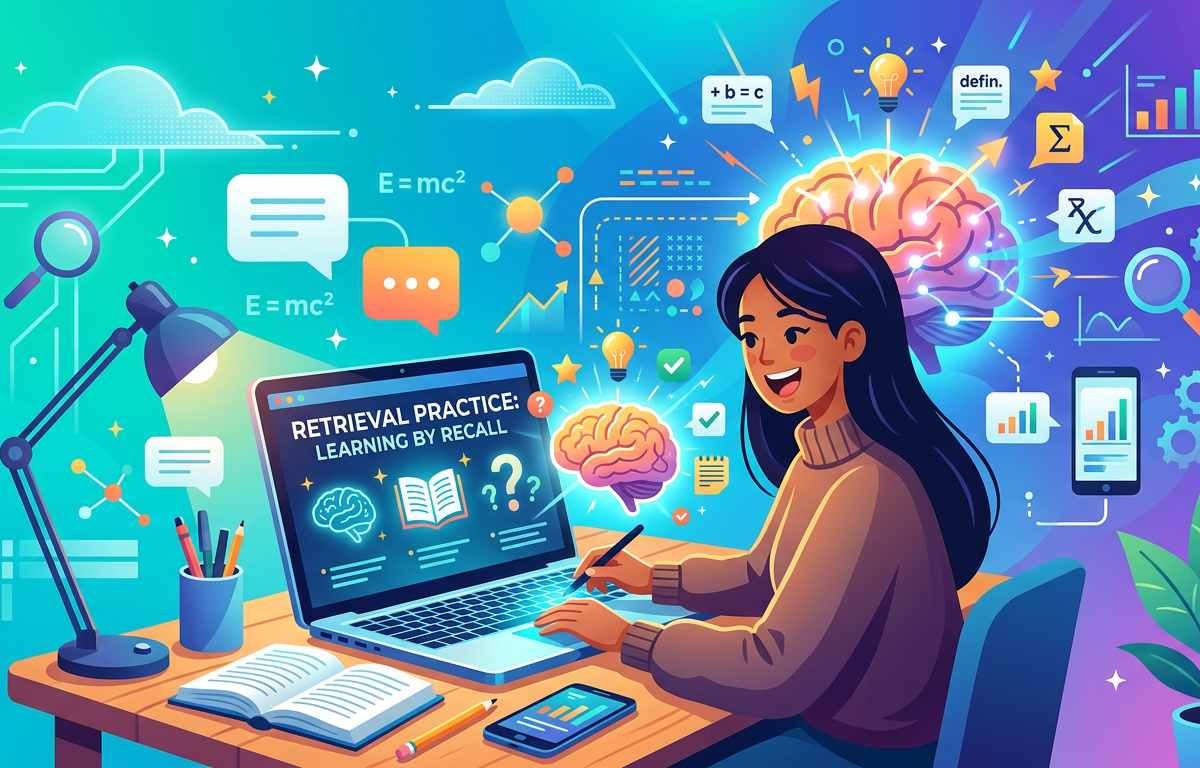
Understanding Retrieval Practice: The Science of Learning
Retrieval practice for online learning involves the deliberate act of pulling information out of your head rather than simply trying to shove more information into it. While traditional online courses often focus on "input"—watching videos, reading PDFs, and listening to podcasts—true mastery happens during "output." When you force your brain to recall a fact or concept, you strengthen the neural pathways associated with that knowledge, making it significantly easier to access in the future.
The cognitive science behind this is known as the "testing effect." Research published by the Association for Psychological Science demonstrates that taking a test on material often leads to better long-term retention than spending the same amount of time studying. This happens because the effort required to retrieve data signals to the brain that the information is important enough to keep. In contrast, passive study methods like re-reading or highlighting only create a sense of familiarity, not actual mastery.
Why do so many digital students fall into the trap of passive consumption? It comes down to the "fluency illusion." When you watch a polished video lecture or read a well-written article, the content feels easy to understand, leading you to believe you have learned it. However, this feeling is deceptive. You haven't actually learned the material until you can reproduce it without the source in front of you. To see why this matters, compare retrieval practice vs highlighting notes to see which one actually moves the needle on your grades.
Memory consolidation requires labor. When you retrieve information, your brain undergoes a process of "reconsolidation," where the memory is updated and woven more tightly into your existing knowledge web. Think of your brain like a forest: "input" is like walking through the brush once, while "retrieval" is like treading a clear path. Each time you recall a fact, the path becomes wider and easier to follow next time.
The 4 Core Principles of Effective Retrieval Practice
Effective retrieval practice for online learning works best when assessments are kept low-stakes to minimize the crippling effects of test anxiety. If every quiz is a major grade, your brain enters a stress-induced "fight or flight" mode that actually hinders the formation of new memories. By treating retrieval as a discovery tool rather than a judgment tool, you give yourself the freedom to make mistakes—which is exactly where the deepest learning occurs.
Immediate feedback serves as the vital second pillar of this strategy. It is not enough to simply realize you got an answer wrong; you must understand why the error occurred to close the gap between your current knowledge and the target application. Digital platforms offer a unique advantage here, as they can provide instant corrections and explanations that traditional paper-based methods can't match. This loop ensures that you aren't accidentally reinforcing "false memories" or incorrect facts.
The third principle is the use of spaced repetition systems to combat the Ebbinghaus Forgetting Curve. Information vanishes from our minds at an exponential rate unless we revisit it at strategic intervals. Instead of cramming for six hours on a Sunday, it is mathematically superior to study for 30 minutes every day. You can find a detailed breakdown of how to structure this in our Ultimate Retrieval Practice Study Schedule Template.
Interleaving is the final, often ignored, secret to mastery. Most students study in "blocks"—Topic A, then Topic B, then Topic C. Mastery, however, comes from mixing these topics together during a single session. This forces your brain to identify which strategy to use for a particular problem, rather than just mindlessly repeating the same process. This is particularly useful for medical students who must differentiate between similar symptoms and pathologies under pressure.
Practical Retrieval Strategies for Online Learners
The 'Brain Dump' method is the most accessible way to start using retrieval practice for online learning without needing any specialized software. After you finish a video module or a chapter, close your laptop and take a blank piece of paper. Write down every single thing you remember about the topic for five minutes straight. Once you're done, go back to your notes with a different colored pen and fill in the gaps you missed. This highlights exactly what you don't know yet.
Flashcards remain a powerhouse, but only if you use them correctly as active recall techniques. Do not just read the back of the card; you must state the answer out loud or write it down before flipping it over. Modern learners often find success by integrating these into advanced flashcard systems that automate the review process. Don't be afraid to make your cards "ugly"—as long as they force your brain to work, they are doing their job.
Cornell note-taking is another digital-friendly strategy that naturally integrates active recall. Divide your digital document into two columns: a narrow "cue" column on the left and a wider "notes" column on the right. During a live webinar or video, take notes on the right. Afterward, generate questions based on those notes in the left column. To study, cover the right side and see if you can answer the questions on the left. This turns your static notes into a dynamic testing tool.
The Feynman Technique takes retrieval a step further by emphasizing "self-explanation." Imagine you are teaching the concept you just learned to a ten-year-old child. If you find yourself using jargon or complex terms you can't quite explain, you've identified a hole in your understanding. Many online students record themselves explaining a concept using their phone's voice memo app, then listen back to check for clarity and accuracy. This identifies the "illusion of competence" before it's too late.
Stop Passive Studying Today
Use our AI-powered question generator to transform your course materials into high-impact retrieval practice quizzes in seconds.
Get Started FreeEssential Digital Tools and Apps for Retrieval Practice
Spaced Repetition Systems (SRS) are the gold standard for managing retrieval practice for online learning. Apps like Anki and RemNote use algorithms to track how well you know a specific concept, showing it to you just as you are about to forget it. While these tools have a slight learning curve, the ROI on your time is massive. For those who prefer a more social or gamified experience, Quizlet offers a massive library of peer-generated sets across almost every subject imaginable.
Don't overlook the built-in features of your Learning Management System (LMS) like Canvas, Moodle, or Blackboard. Many students ignore the "ungraded practice" sections, but these are often the best sources for digital learning strategies that align with your instructor's expectations. If your course provides self-check quizzes at the end of modules, do them twice: once immediately after the lesson and once three days later. This exploits the testing effect to its fullest potential.
Artificial Intelligence has revolutionized how we create retrieving opportunities. Tools now exist that can take a 20-minute YouTube lecture or a 50-page PDF and instantly generate a set of open-ended questions. This saves you the time of "creating" the study material and allows you to jump straight into the "doing." Using AI to generate practice questions ensures you are constantly faced with novel challenges rather than just reciting what you wrote in your own notes.
Collaborative retrieval is also possible in the digital space through tools like Miro or Mural. You and your virtual classmates can hop on a digital whiteboard and perform a collective "brain dump" on a difficult topic. Seeing how others structure their knowledge can help you organize your own thoughts more effectively. Discussion forums can also be repurposed; instead of just posting "I agree," try to summarize a classmate's point in your own words without looking at the original post.
Designing Online Courses with Retrieval in Mind (For Educators)
Interactive video transforms passive watching into an active learning experience. By using platforms like Edpuzzle, instructors can pause a video at critical moments and require students to answer a question before proceeding. This "mid-stream quizzing" prevents the mind from wandering and ensures that the student is actually processing the information as it is delivered. It turns a 10-minute lecture into a sequence of small, manageable cognitive hurdles.
Pre-testing is a counterintuitive but powerful method to prime the brain for discovery. Even if students don't know the answers yet, trying to guess the solution to a problem makes them more attuned to the correct information when it's finally presented. This "pre-retrieval" creates a mental hook that the upcoming lesson can latch onto. Educators can implement this through simple one-minute polls or "prediction questions" at the very beginning of a new online module.
Peer-generated questions empower students to think like examiners. When learners are tasked with creating a quiz for their classmates, they must look at the material from a higher perspective, identifying the most important concepts and common pitfalls. This metacognitive exercise is arguably more effective than taking a quiz created by someone else. Digital forums are excellent places to host "Question of the Day" threads where students challenge each other with difficult prompts.
Activity-based modules should replace lecture-heavy structures. Instead of three hours of video, try one hour of content followed by two hours of varied retrieval tasks. This might include case studies, simulations, or virtual labs where the information is applied in real-time. The goal is to maximize online education retention by ensuring the student never goes more than 15 minutes without being asked to do something with what they've learned.
Overcoming Challenges in Digital Retrieval Practice
The "Desirable Difficulty" mindset is the biggest hurdle online learners face. Retrieval practice feels hard because it is hard; it requires more mental calories than re-reading. Many students mistake this struggle for a lack of progress, leading them to revert to easier, less effective habits. However, it is precisely this "clunky" feeling that signals your brain is re-wiring itself. Read more about why retrieval practice feels hard to stay motivated when the going gets tough.
Digital fatigue and cognitive overload are real threats in the virtual classroom. To combat this, keep your retrieval sessions short and high-intensity. Fifteen minutes of focused active recall is worth two hours of "zoning out" while highlights roll across a screen. Use tools that allow for offline study to give your eyes a break from the blue light. Remember, the brain needs downtime to consolidate those new connections you're working so hard to form.
Building a habit is the only way to make retrieval practice for online learning sustainable. Tie your retrieval sessions to existing habits—for example, do five minutes of digital flashcards immediately after you shut down your work email. Consistency is far more important than intensity when it comes to long-term memory. Over time, the process becomes less of a chore and more of a standard part of your learning identity.
Finally, ensure your retrieval methods are inclusive. Not everyone thrives with timed multiple-choice tests. If you find that one format causes too much stress, pivot to another. The beauty of digital learning is its flexibility; you can use voice-to-text for brain dumps, screen readers for feedback, or visual mind maps for recall. The key is simply to ensure you are pulling the information out of your mind rather than just looking at it.
Master Your Next Online Course
Stop wasting hours on passive study. Generate high-quality practice questions instantly and start learning smarter with Bevinzey.
Get Started FreeFrequently Asked Questions
What is the simplest way to use retrieval practice in online learning?
The simplest way is the "Brain Dump." After watching a lesson, close your browser and write everything you remember on a piece of paper for five minutes. This forces immediate active recall without needing any special software.
How does retrieval practice differ from re-reading or highlighting?
Re-reading and highlighting are passive "input" activities that create a false sense of familiarity. Retrieval practice is an active "output" activity that requires you to generate information from your own memory, which is the only way to build long-term retention.
Can retrieval practice be used for complex subjects like math or coding?
Yes. In math or coding, retrieval practice means solving problems from scratch without looking at a tutorial. Try to replicate a piece of code or solve a complex math problem after the guide has been hidden from view.
How often should students perform retrieval practice for the best results?
Short, frequent sessions are best. Use a spaced repetition schedule where you review new material after one day, three days, one week, and one month to move information from short-term to long-term storage effectively.
Is retrieval practice better for long-term or short-term memory?
While retrieval practice is excellent for both, its greatest strength is long-term memory. It builds durable neural connections that allow you to retain information months or even years after you've finished a course.
Reviewed by
Michael Danquah, MS, PhD
Dr. Michael Danquah is a professor of pharmaceutical sciences and founder of several educational technology platforms focused on improving student learning and performance.
Enjoyed this article?
Share it with others who might find it helpful.
Related Articles

How to Solve Molarity Problems: Step-by-Step Mastery
Learn how to solve molarity problems step-by-step with formulas, unit tips, and worked examples so you can calculate concentration with confidence.
Mar 26, 2026

Avoid These 7 Common Molarity Mistakes in Chemistry
Master chemistry calculations! Avoid common molarity mistakes with our expert guide on unit conversions, dilution errors, and proper lab techniques.
Mar 26, 2026

What Is Molarity? The Complete Guide to Molar Concentration
Master molarity with our complete guide. Learn the formula, step-by-step calculations, and the critical differences between molarity and molality.
Mar 26, 2026

Why Molarity Matters: Converting Mass to Moles for Lab Solutions
Master chemistry with our guide to the molarity formula. Learn how to calculate concentration with step-by-step examples, units, and practical lab tips.
Mar 26, 2026

Molarity vs Molality: The Essential Difference Explained
Master the difference between molarity vs molality. Learn the formulas, key differences, and when to use each in this comprehensive chemistry guide.
Mar 26, 2026