Stop Failing: 6 Retrieval Practice Mistakes Students Make
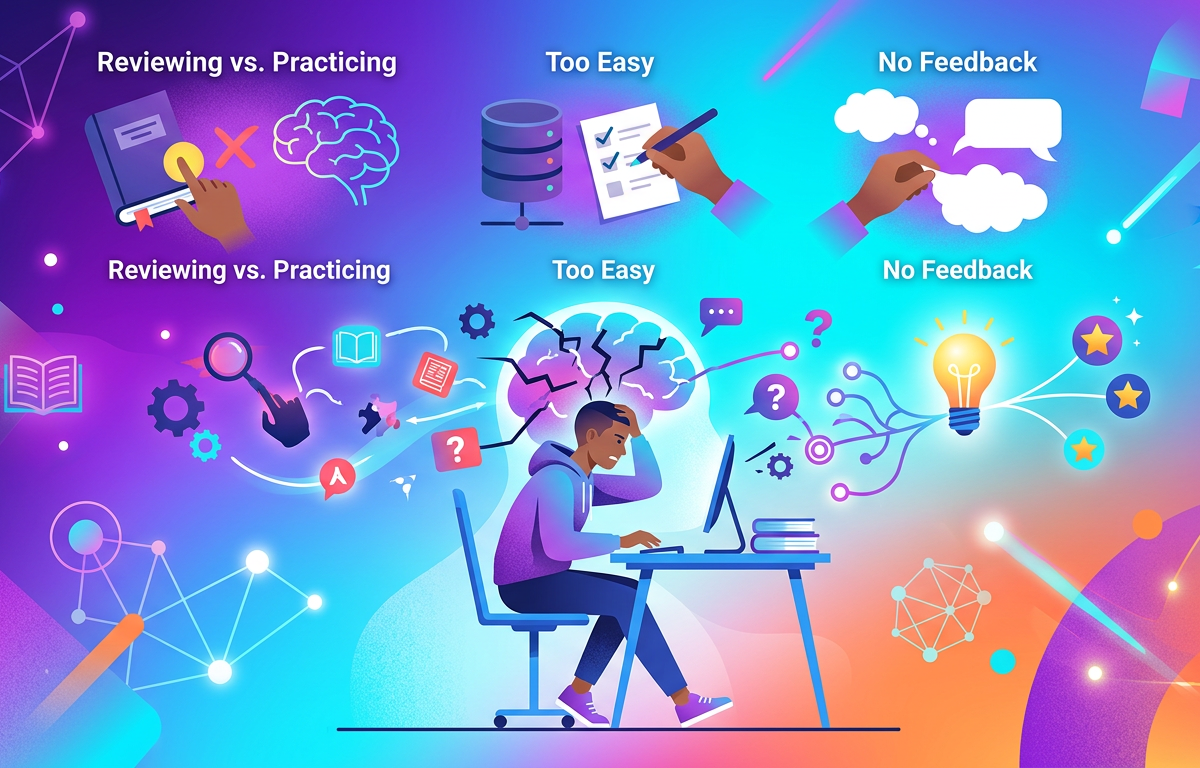
Understanding Retrieval Practice and Its High-Stakes Benefits
Retrieval practice is the act of pulling information out of the brain rather than trying to cram it in. When you read a textbook, you are focused on input. When you close that book and try to explain the concept of osmosis to an empty room, you are practicing retrieval. It is a fundamental shift from consuming content to producing it.
Cognitive scientists consider this the "gold standard" of learning because it leverages the testing effect. Research shows that the very act of searching your memory strengthens the neural pathways associated with that information. This makes the knowledge more accessible in the future, especially under the pressure of a high-stakes exam. This is why retrieval practice and the testing effect are often discussed as the most powerful duo in educational psychology.
Why does it feel so exhausting compared to highlighting or rereading? It feels difficult because it is cognitively demanding. This "desirable difficulty" is exactly what creates long-term retention. If your brain doesn't have to work, it doesn't have to grow. Understanding why retrieval practice feels hard is the first step toward embracing the mental strain required for true mastery.
Mistake 1: Relying on Recognition Instead of Recall
Recognition is not the same as mastery, yet many students fall into the "fluency illusion." When you look at your notes and think, "I know this," you are often just recognizing the words on the page. Your brain is acknowledging that it has seen the information before, which is a shallow cognitive process. True recall requires you to generate the answer from scratch without any external cues.
Multiple-choice questions can sometimes exacerbate Retrieval Practice Mistakes. If you can eliminate three wrong answers to find the right one, you aren't necessarily retrieving the information; you are performing a logic puzzle. While this is a useful test-taking skill, it doesn't build the same memory strength as an open-ended question. Aim for "pure" recall by using blank sheets of paper or unprompted verbal explanations.
To transition from recognition to true retrieval, you must remove the training wheels. Close the book, put away the highlighter, and try a "brain dump." This involves writing down everything you know about a topic on a blank page. You will quickly realize that retrieval practice vs highlighting is a lopsided battle; one builds a beautiful book, while the other builds a powerful brain.
Mistake 2: Practicing Retrieval Too Soon (The Cramming Paradox)
Immediate testing after reading a chapter is a common trap that provides a false sense of security. If you retrieve information while it is still in your short-term working memory, you aren't actually "retrieving" it from long-term storage. You are merely echoing what you just heard. This leads to the cramming paradox: you feel like you know the material today, but it vanishes by the time the exam rolls around.
Timing is everything when navigating Retrieval Practice Mistakes. You need to allow for a "desirable difficulty" gap where a small amount of forgetting occurs. According to the forgetting curve, memory decay begins almost immediately. By waiting a few hours or a day before your first retrieval session, you force your brain to work harder to reconstruct the memory, which signals to the brain that the information is important to keep.
The secret sauce of retention is the struggle. If you find it slightly difficult to remember the details, you are doing it right. This is why many top achievers use the retrieval practice vs spaced repetition strategy to time their sessions perfectly. They wait until they are on the verge of forgetting before they pull the information back to the surface.
Mistake 3: Skipping the Feedback Loop (The Corrective Step)
One of the most dangerous Retrieval Practice Mistakes is retrieving incorrect information and failing to correct it. If you confidently "recall" a fact that is wrong and move on, you are essentially practicing a lie. This reinforces the wrong neural pathways, making it harder to learn the correct version later. Without a feedback loop, retrieval can be counterproductive.
Effective retrieval requires an audit. After you attempt to recall a concept, you must check your accuracy against an authoritative source. This "corrective step" is where the most significant learning happens. Seeing where you went wrong creates a distinct cognitive "ping" that helps the correct information "seal" into your memory. It transforms a simple memory test into a dynamic learning event.
Don't be discouraged by getting things wrong. Errors are not failures; they are data points. When you realize you've made common SAT math mistakes, for example, the act of identifying the error actually makes you more likely to remember the right method next time. Always pair your retrieval with a prompt review of the source material to ensure accuracy.
Mistake 4: Over-Retrieving Easy Information (The 'Goldilocks' Zone)
Students often stick to the information they already know because it feels good to get things right. However, spending your limited study time on concepts you have already mastered leads to diminishing returns. This is a classic example of Retrieval Practice Mistakes involving efficiency. You are staying in your comfort zone instead of venturing to the "fringe of knowledge."
In cognitive science, we distinguish between "storage strength" and "retrieval strength." You might have high storage strength for a concept (it's deep in your brain), but low retrieval strength (you can't pull it out quickly). Once both are high, you should stop practicing that specific fact and move on. Learning occurs most rapidly when you operate in the "Goldilocks Zone"—not too easy, not impossible, but just right.
Pivot your focus daily to the topics that make you sweat. If you are a medical student, don't keep reviewing the basics of the circulatory system if you could explain it in your sleep. Instead, move toward retrieval practice for medical students that focuses on complex pathologies or drug interactions. Always hunt for the "weak links" in your mental chain.
Ready to Master Retrieval Practice?
Stop guessing and start knowing. Use our advanced AI-powered tools to generate custom retrieval questions that target your specific knowledge gaps and eliminate common study errors.
Get Started FreeMistake 5: Lack of Variety and Interleaving
Doing the same type of retrieval in the same order every time is called "blocked practice," and it's remarkably ineffective. If you always study your history flashcards in chronological order, your brain starts to rely on the sequence rather than the content. This is one of the most subtle Retrieval Practice Mistakes because it makes you feel like you've mastered the material when you've actually just mastered the pattern.
Interleaving is the process of mixing up different topics or types of problems within a single session. Instead of doing twenty algebra problems in a row, mix in a few geometry and calculus questions. This forces the brain to not only retrieve the solution but also to first identify what kind of problem it is looking at. This discrimination is a higher-level cognitive skill that translates directly to better exam performance.
Building "mental models" requires you to see how different facts relate to one another. When you compare retrieval practice vs concept mapping, you see how variety helps connect the dots. Don't let your knowledge live in silos. Shuffle your flashcards, jump between chapters, and ask your brain to work in a non-linear fashion.
Mistake 6: Over-Reliance on Low-Level Factual Recall
Retrieval isn't just for vocabulary words and dates. A major error in many study routines is focusing exclusively on "what" instead of "how" and "why." If you only practice retrieving isolated facts, you will struggle when an exam asks you to apply that knowledge to a new scenario or analyze a complex process. You must move up Bloom’s Taxonomy during your practice sessions.
To fix this, use "elaborative interrogation." When you retrieve a fact, immediately ask yourself "Why is this true?" or "How does this relate to X?" This forces you to retrieve the connections between concepts, not just the concepts themselves. For instance, in retrieval practice for STEM subjects, you shouldn't just recall a formula; you should retrieve the derivation of that formula and the conditions under which it fails.
Free recall "brain dumps" are excellent for complex topics. Instead of using a flashcard for a single definition, try to map out an entire argumentative structure or a biological sequence on a whiteboard. This high-level retrieval ensures you understand the "big picture" and the intricate details simultaneously. It moves you past rote memorization toward genuine conceptual expertise.
Practical Solutions: Building a Better Retrieval Routine
Fixing Retrieval Practice Mistakes starts with a structured approach. The "Read-Recite-Review" (3R) method is a simple but powerful framework: read a section, recite what you remember out loud or in writing, and then review the text to check for errors. This keeps the feedback loop tight and ensures you are focused on output rather than input throughout your entire session.
Technology can also be a massive ally if used correctly. Spaced repetition software like Anki or digital retrieval practice with flashcards tools allow you to automate the timing of your sessions. These algorithms handle the "forgetting curve" for you, ensuring you only see the most difficult cards at the optimal time. Just make sure the cards are designed to test recall, not just recognition.
Finally, lower the stakes to reduce anxiety. Retrieval practice should not feel like a "test" in the scary sense; it should feel like a mental workout. Keep your practice environment low-pressure so you aren't afraid to get things wrong. Whether you are using a retrieval practice study schedule or doing quick verbal check-ins with a peer, the goal is consistency. Success comes from the cumulative effect of these "small wins" over time.
Stop Guessing, Start Mastering
Transform your study sessions into powerful learning experiences. Our platform helps you avoid retrieval mistakes by serving up high-quality, concept-based questions exactly when your brain needs them most.
Get Started FreeFrequently Asked Questions
Is retrieval practice better than re-reading?
Yes, retrieval practice is significantly more effective than re-reading. Research consistently shows that students who use retrieval practice retain 50% more information long-term compared to those who simply reread their notes or textbooks.
How often should I do retrieval practice to avoid burnout?
Frequency depends on the difficulty of the material, but a common rhythm is to retrieve information 24 hours after learning, then 3 days later, then 1 week later. Short, 15-minute bursts are often more sustainable than multi-hour marathons.
Can retrieval practice be used for creative subjects like art or writing?
Absolutely. For art, you can practice retrieving anatomy or color theory principles from memory. For writing, you can retrieve effective rhetorical structures or vocabulary words without looking at a guide.
What should I do if I can't remember anything during a retrieval session?
Don't panic—this is a sign that the "gap" was too long. Give yourself a tiny hint (a "scaffold") to help the memory surface, or go back and review the material briefly before trying again in one hour.
Does retrieval practice work for students with ADHD?
Yes, and it is often more effective because it is active. The high-engagement nature of retrieval can help students with ADHD stay focused better than the passive, repetitive nature of reading or highlighting.
Reviewed by
Michael Danquah, MS, PhD
Dr. Michael Danquah is a professor of pharmaceutical sciences and founder of several educational technology platforms focused on improving student learning and performance.
Enjoyed this article?
Share it with others who might find it helpful.
Related Articles

How to Solve Molarity Problems: Step-by-Step Mastery
Learn how to solve molarity problems step-by-step with formulas, unit tips, and worked examples so you can calculate concentration with confidence.
Mar 26, 2026

Avoid These 7 Common Molarity Mistakes in Chemistry
Master chemistry calculations! Avoid common molarity mistakes with our expert guide on unit conversions, dilution errors, and proper lab techniques.
Mar 26, 2026

What Is Molarity? The Complete Guide to Molar Concentration
Master molarity with our complete guide. Learn the formula, step-by-step calculations, and the critical differences between molarity and molality.
Mar 26, 2026

Why Molarity Matters: Converting Mass to Moles for Lab Solutions
Master chemistry with our guide to the molarity formula. Learn how to calculate concentration with step-by-step examples, units, and practical lab tips.
Mar 26, 2026

Molarity vs Molality: The Essential Difference Explained
Master the difference between molarity vs molality. Learn the formulas, key differences, and when to use each in this comprehensive chemistry guide.
Mar 26, 2026