Retrieval Practice: The Secret to Peak Exam Performance
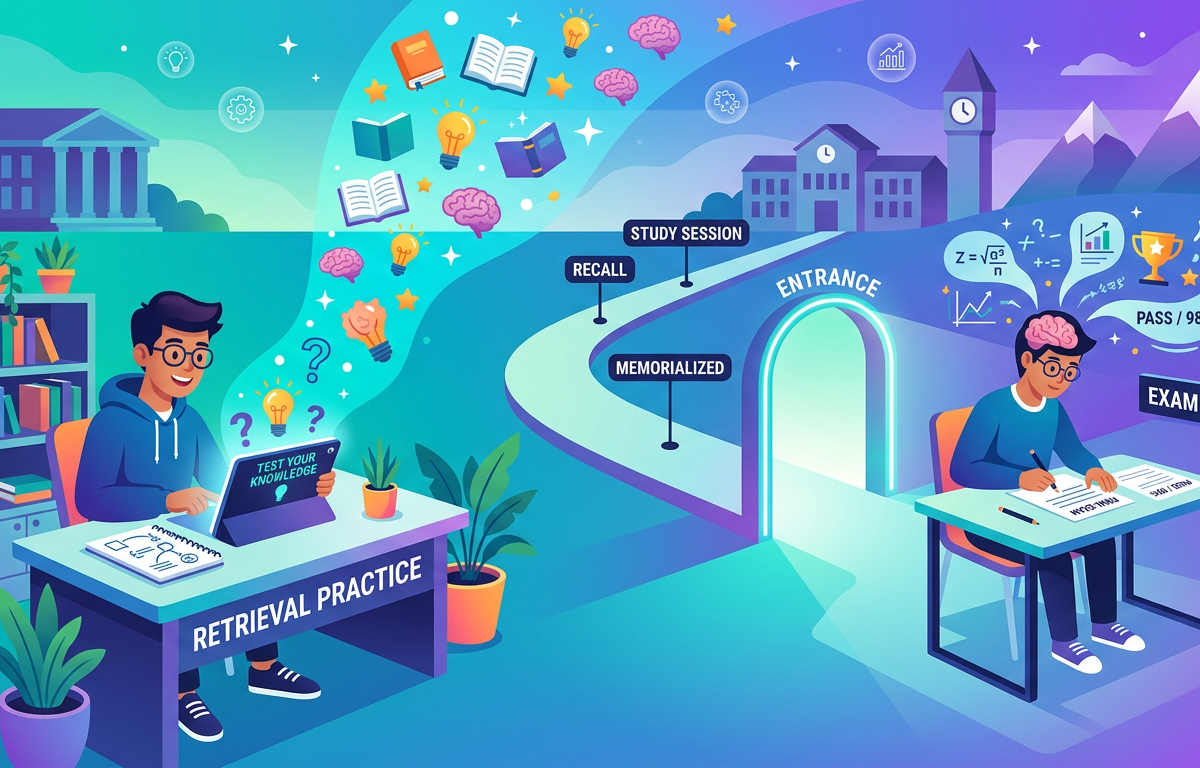
What is Retrieval Practice? The Science of Remembering
Retrieval practice is the act of pulling information out of your brain rather than trying to cram it in. Think of your memory as a massive library where the books are constantly being misplaced. Most students spend their time trying to buy more books (reading and highlighting), but they never practice the skill of actually finding them on the shelves. Retrieval Practice and Exam Performance are inextricably linked because the more often you find a piece of information, the stronger the path to that "book" becomes.
The cognitive psychology behind this process centers on effortful retrieval. When you struggle to remember a fact, your brain signals that the information is important. This effort triggers the "testing effect," a phenomenon where the very act of being tested strengthens your long-term memory more than additional study sessions. Active recall strategies force your neurons to fire in specific patterns, creating durable physiological changes in the brain’s architecture.
Passive learning feels good because it lacks friction. When you re-read a textbook chapter, the words look familiar, leading to a false sense of mastery. However, input (reading or listening) is not the same as output (recalling). Research published by the American Psychological Association demonstrates that students who engage in output-based learning consistently outperform those who rely on passive repetition. To win at academics, you must stop treating your brain like a sponge and start treating it like a muscle.
The Correlation Between Retrieval Practice and Exam Performance
Research consistently shows that retrieval practice is the single most effective predictor of high exam scores across all disciplines. In one landmark study, students who used retrieval practice remembered 50% more information a week later compared to students who used traditional study methods. This happens because retrieval builds "transfer-appropriate processing," which means the way you learn matches the way you will be expected to perform during the actual test.
The link between Retrieval Practice and Exam Performance is notably visible in high-stakes environments. For instance, mastering retrieval practice for medical students often means the difference between passing and failing the USMLE, where rote memorization fails against complex clinical scenarios. Whether it is a standardized SAT or a graduate-level thesis defense, the ability to reconstruct knowledge under pressure is what separates top performers from the rest of the pack.
Long-term retention is the ultimate goal of any education, yet most students optimize for the short-term "cram." While cramming might help you survive a quiz tomorrow, the information evaporates within 48 hours. Retrieval practice prevents this decay. By forcing the brain to reconstruct a concept multiple times, you move that data from fragile working memory into clinical, long-term storage. This is why retrieval practice and the testing effect are considered the gold standard of learning science.
Core Strategies for Implementing Retrieval Practice
Effective retrieval practice requires you to close your book and ask, "What did I just learn?" One of the most common ways to do this is through flashcards, specifically using platforms like Anki or physical cards. However, you must move beyond simple memorization and use cards to explain "why" and "how" rather than just "what."
The "Brain Dump," or free recall, is arguably the most powerful technique for building deep understanding. Take a blank sheet of paper and write down everything you know about a topic without looking at your notes. This method exposes gaps in your knowledge instantly. Once you can't remember anything else, open your book and use a different colored pen to fill in what you missed. Over time, you can see your metacognition and study habits improve as the "black ink" begins to cover the entire page.
Practice testing and mock exams are the final tier of this strategy. You shouldn't wait until the week of the exam to take a practice test. Instead, use small practice quizzes daily. This introduces "desirable difficulties"—the idea that since learning feels hard, it is actually working. If studying feels easy, you are likely wasting your time on passive methods that won't translate to real-world results.
Synergizing Retrieval with Spaced Repetition and Interleaving
Retrieval practice is most effective when it is timed to combat the "forgetting curve." This curve, first identified by Hermann Ebbinghaus, shows that we lose roughly 70% of new information within 24 hours if we don't actively review it. To maximize Retrieval Practice and Exam Performance, you must space your retrieval sessions out over days or weeks. This forces your brain to work harder to "re-find" the information, which paradoxically makes the memory stronger.
Implementing a retrieval practice study schedule is the best way to manage this timing. Instead of spending five hours on Biology on Monday, spend 30 minutes on Biology every day for ten days. This approach, known as spaced repetition, ensures you are hitting the information just as you are about to forget it. It creates a "reloading" effect in your neurons that cements the knowledge permanently.
Interleaving is another vital component that involves mixing different topics or types of problems in a single study session. If you are practicing math, don't do 50 fractions problems in a row. Mix in decimals, percentages, and geometry. This forces your brain to identify which strategy to use, rather than just mindlessly applying the same formula. Studies hosted by Harvard University suggest that interleaving significantly boosts problem-solving skills in complex subjects like physics and law.
Overcoming the 'Illusion of Competence'
The "illusion of competence" is the greatest enemy of the modern student. This occurs when you feel like you understand a topic because you've read about it three times, but you can't actually explain it when the book is closed. This "fluency trap" leads to devastating surprises on exam day. Realizing that retrieval practice feels hard for a reason is the first step toward true mastery.
Self-testing builds metacognitive awareness, which is simply the ability to think about your own thinking. When you use retrieval, you get immediate feedback. You either know the answer or you don't. There is no middle ground, no "I kind of knew that." This honesty allows you to focus your limited study time on your weakest areas rather than reviewing what you already know for a temporary ego boost.
Passive habits like highlighting feel productive because you are physically moving your hand and covering the page in bright colors. However, retrieval practice vs. highlighting studies show that highlighting provides almost zero benefit for long-term retention. It is a "low-utility" strategy. If you want to increase your GPA, you must replace the highlighter with a blank sheet of paper and a challenging question.
Retrieval Practice for Different Subjects and Skill Levels
In STEM subjects, retrieval practice looks like solving problems from scratch without looking at the solutions manual. For example, when trying to improve SAT math scores, you shouldn't just read the explanation for a missed question. You should wait ten minutes and then try to solve the entire problem again on a clean sheet of paper. This ensures you’ve learned the logic, not just the answer.
For the humanities, retrieval involves synthesizing themes and connecting dates. Rather than memorizing a timeline, try to explain the "why" behind an event to a friend (the Feynman Technique). If you are a pharmacy student, retrieval might involve recalling drug interactions or mechanisms of action without the aid of a reference sheet. The goal is to simulate the high-pressure environment where you will actually need to use the information.
Younger learners in K-12 also benefit from these cognitive psychology principles. Teachers can implement "entry tickets" where students write down one thing they remember from the previous day’s lesson. This small act of retrieval sets the stage for better learning. For older students, tackling medium-level practice questions serves as a bridge between basic recall and complex application.
Practical Challenges and How to Overcome Them
The most significant challenge with retrieval practice is the intense cognitive load. It is mentally exhausting to constantly quiz yourself. To manage this fatigue, keep your retrieval sessions short—25 to 30 minutes—followed by a five-minute break. This "Pomodoro" style approach prevents burnout and keeps your brain sharp for the next round of active recall.
Another hurdle is the frustration of forgetting. It feels discouraging to realize you’ve forgotten something you studied yesterday. However, forgetting is a necessary part of the learning process. According to the National Institutes of Health, the struggle to retrieve a "lost" memory is exactly what strengthens the neural connection when you finally re-learn it. Embrace the "uphill" feeling of the testing effect in education.
Finally, time management is often cited as a reason to stick to re-reading. Students feel they don't have time to quiz themselves because reading is "faster." While reading is faster in the moment, it is slower in the long run because you have to do it over and over again to make it stick. Efficiency is not about how fast you cover the material; it’s about how much of that material stays in your head. Transitioning from retrieval practice vs. re-reading is an investment that pays dividends in reduced total study hours and higher final grades.
Ready to Master Your Exams?
Stop passive studying and start using the science of retrieval. Our AI-powered tools generate customized practice questions from your notes in seconds.
Get Started FreeFrequently Asked Questions
What is the best way to do retrieval practice?
The most effective method is a mix of free recall (brain dumping) and practice testing. Start by writing everything you know on a blank page, then use flashcards or practice exam questions to target specific gaps. The key is to ensure you are producing the answer from memory without any cues or hints.
Does retrieval practice work for all subjects?
Yes, it is a universal cognitive principle. In math, it involves solving problems from scratch. In history, it means explaining the causes of events. In languages, it involves translating sentences without looking at a dictionary. If there is information to be learned, retrieval will help you learn it faster.
How is retrieval practice different from active recall?
In most educational contexts, these terms are used interchangeably. "Active recall" is the general concept of stimulating the memory, while "retrieval practice" is the specific instructional or study strategy used to trigger that recall. Both focus on the "output" of information rather than "input."
Why is retrieval practice more effective than re-reading?
Re-reading only builds "recognition," which is the ability to see something and realize you've seen it before. Retrieval builds "recollection," which is the ability to pull information out of your mind independently. Exams test recollection, not recognition, making retrieval the superior prep method.
How many times should I practice retrieval before an exam?
Aim for at least three successful retrievals spaced out over several days for each core concept. Once you can recall a concept perfectly after a two-day break, you can be reasonably confident that the information has moved into your long-term memory.
Can retrieval practice reduce test anxiety?
Absolutely. Much of test anxiety comes from the fear of the unknown and the "illusion of competence." By taking practice tests regularly, you desensitize yourself to the testing environment and gain objective proof of your knowledge, which significantly boosts confidence on the actual exam day.
Reviewed by
Michael Danquah, MS, PhD
Dr. Michael Danquah is a professor of pharmaceutical sciences and founder of several educational technology platforms focused on improving student learning and performance.
Enjoyed this article?
Share it with others who might find it helpful.
Related Articles

How to Solve Molarity Problems: Step-by-Step Mastery
Learn how to solve molarity problems step-by-step with formulas, unit tips, and worked examples so you can calculate concentration with confidence.
Mar 26, 2026

Avoid These 7 Common Molarity Mistakes in Chemistry
Master chemistry calculations! Avoid common molarity mistakes with our expert guide on unit conversions, dilution errors, and proper lab techniques.
Mar 26, 2026

What Is Molarity? The Complete Guide to Molar Concentration
Master molarity with our complete guide. Learn the formula, step-by-step calculations, and the critical differences between molarity and molality.
Mar 26, 2026

Why Molarity Matters: Converting Mass to Moles for Lab Solutions
Master chemistry with our guide to the molarity formula. Learn how to calculate concentration with step-by-step examples, units, and practical lab tips.
Mar 26, 2026

Molarity vs Molality: The Essential Difference Explained
Master the difference between molarity vs molality. Learn the formulas, key differences, and when to use each in this comprehensive chemistry guide.
Mar 26, 2026