NAPLEX Percentage Strength Practice Questions with Answers
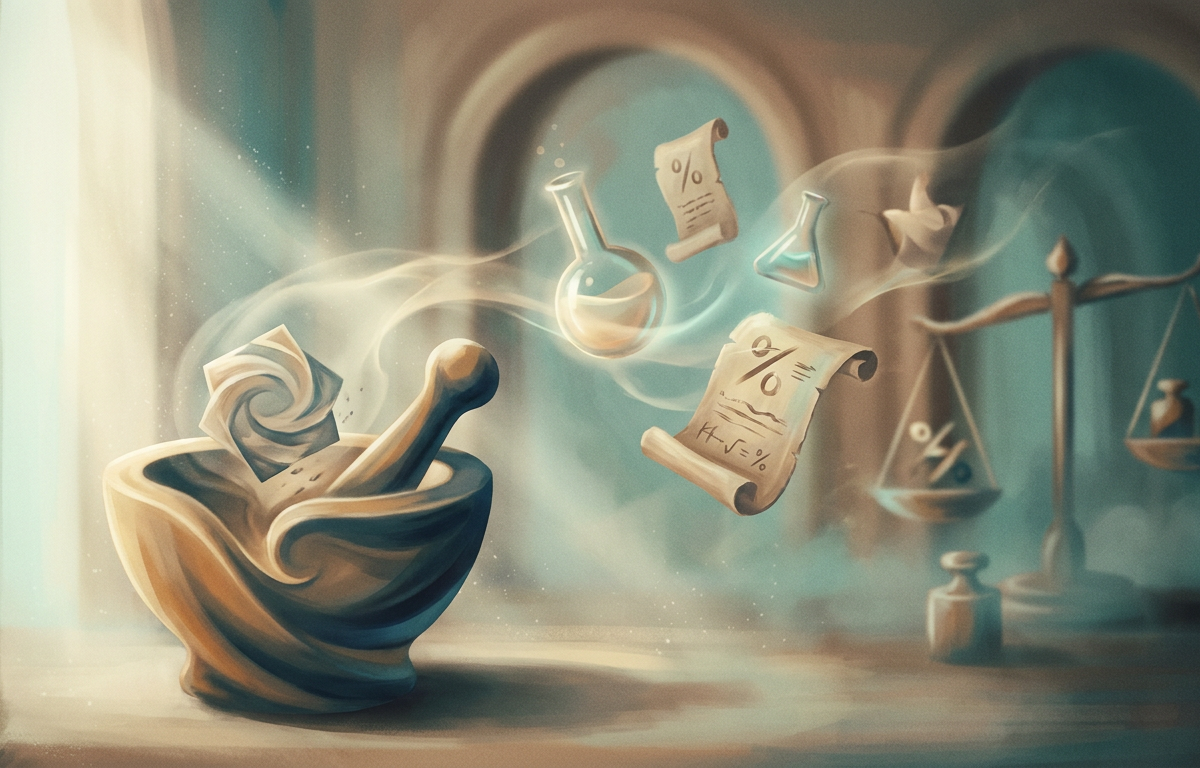
NAPLEX Percentage Strength Practice Questions with Answers
Mastering NAPLEX percentage strength calculations is a fundamental requirement for any pharmacy graduate preparing for licensure. These calculations represent the concentration of a substance within a mixture and are used daily in clinical practice to ensure patient safety when compounding medications or verifying IV concentrations. Whether you are calculating weight-in-weight (w/w), volume-in-volume (v/v), or weight-in-volume (w/v), understanding the underlying ratios is essential for passing the NAPLEX.
Concept Explanation
NAPLEX percentage strength is a method of expressing the concentration of a solute in a total amount of solution or mixture based on a standard of 100 parts.
In pharmaceutical calculations, percentage strength is categorized into three distinct types depending on the physical state of the ingredients:
- Weight-in-Volume (w/v): Expresses grams of solute in 100 mL of liquid. This is the most common form for liquid medications and IV fluids.
- Volume-in-Volume (v/v): Expresses milliliters of solute in 100 mL of liquid. This is typically used for mixtures of liquids, such as alcohol solutions.
- Weight-in-Weight (w/w): Expresses grams of solute in 100 grams of mixture. This is standard for ointments, creams, and powders.
The core formula used for these calculations is:
When solving these problems, always ensure your units are in grams for weight and milliliters for volume before applying the percentage. For more complex medication scenarios, you might find the hard NCLEX mixed medication practice questions helpful for building clinical intuition. If you struggle with the speed of these conversions, the Retrieval Challenge tool can help sharpen your mental math for the exam.
Solved Examples
1. Calculating w/v: How many grams of dextrose are in 250 mL of a 5% dextrose solution?
- Identify the definition: 5% w/v means 5 g of dextrose in every 100 mL of solution.
- Set up a proportion:
- Solve for :
- Result: There are 12.5 grams of dextrose in 250 mL.
2. Calculating v/v: A pharmacist adds 30 mL of pure glycerin to enough water to make 150 mL of solution. What is the percentage strength (v/v) of glycerin?
- Identify the components: Solute = 30 mL; Total Volume = 150 mL.
- Use the formula:
- Calculate:
- Result: The solution is 20% v/v.
3. Calculating w/w: An ointment is prepared by mixing 2 grams of hydrocortisone powder with 48 grams of petrolatum. What is the percentage strength (w/w)?
- Determine the total weight:
- Apply the formula:
- Calculate:
- Result: The ointment is 4% w/w.
Practice Questions
1. How many milligrams of sodium chloride are contained in a 10 mL vial of 0.9% Normal Saline?
2. A 200 g tube of cream contains 1% (w/w) of a drug. How many grams of the active drug are present in the tube?
3. If 500 mL of a liquid contains 25 mL of an active ingredient, what is the percentage strength (v/v)?
Master NAPLEX calculations faster.
Practice dosage calculations, IV flow rates, alligation, and pharmacokinetics with instant feedback.
Practice Calculations4. How many grams of potassium chloride are needed to prepare 2 liters of a 0.45% (w/v) solution?
5. A pharmacist mixes 5 grams of salicylic acid into 95 grams of an ointment base. What is the final percentage strength (w/w)?
6. You have a 1:1000 solution of epinephrine. Express this as a percentage strength.
7. How many milliliters of a 10% (w/v) stock solution are required to prepare 500 mL of a 2% (w/v) solution?
8. A patient is prescribed 1 liter of 0.225% NaCl. How many mEq of Na+ does this patient receive? (MW of NaCl = 58.5)
9. A topical solution contains 0.05% (w/v) of a steroid. How many micrograms are in 0.5 mL of this solution?
10. Convert 0.025% to a ratio strength.
Answers & Explanations
- 90 mg. 0.9% w/v means 0.9 g per 100 mL. For 10 mL: . Convert to mg: .
- 2 g. 1% w/w means 1 g per 100 g. For 200 g: .
- 5% v/v. Use the formula: .
- 9 g. 0.45% w/v is 0.45 g per 100 mL. 2 liters is 2000 mL. .
- 5% w/w. Total weight = 5 g + 95 g = 100 g. .
- 0.1%. 1:1000 ratio strength means 1 g in 1000 mL. .
- 100 mL. Use the dilution equation : . .
- 38.46 mEq. First, find grams of NaCl: . Convert to mg: 2250 mg. Use mEq formula: .
- 250 mcg. 0.05% means 0.05 g in 100 mL. For 0.5 mL: . Convert to mcg: .
- 1:4000. Ratio strength is 1 part per parts. . . So, 1:4000.
For more practice with complex clinical scenarios, check out our hard NCLEX mixed practice questions or use the AI Exam Simulator to generate a custom NAPLEX math quiz.
1. Which of the following represents a 0.25% (w/v) concentration?
Frequently Asked Questions
What is the difference between w/v and w/w in NAPLEX questions?
Weight-in-volume (w/v) measures grams of solid in milliliters of liquid, whereas weight-in-weight (w/w) measures grams of solid in grams of total mixture. You must check the units of the denominator to ensure you are using the correct percentage type for compounding calculations.
How do I convert ratio strength to percentage strength?
To convert a ratio strength like 1:2500 to a percentage, divide 1 by the second number and multiply by 100. For example, 1 divided by 2500 equals 0.0004, which when multiplied by 100 becomes 0.04%.
Are units always in grams and milliliters for these calculations?
Yes, the standard pharmaceutical convention for percentage strength assumes grams (g) for weight and milliliters (mL) for volume. If the problem provides milligrams or liters, you must convert them to grams or milliliters first to avoid calculation errors.
Why is percentage strength important for the NAPLEX?
Percentage strength is a core competency because it relates directly to dosing accuracy and patient safety. Miscalculating a percentage can lead to a ten-fold dosing error, which is a critical safety issue frequently tested on the board exam.
How do I handle problems where both the solute and solvent weights are given?
For weight-in-weight (w/w) problems, the percentage is based on the total weight of the final mixture. You must add the weight of the solute to the weight of the solvent (or base) to find the correct denominator before dividing.
Master NAPLEX calculations faster.
Practice dosage calculations, IV flow rates, alligation, and pharmacokinetics with instant feedback.
Practice CalculationsEnjoyed this article?
Share it with others who might find it helpful.
Related Articles

CrCl Calculations: Navigating Obese and Underweight Dosing Traps
Master complex renal dosing with these hard NAPLEX creatinine clearance practice questions, featuring obese, elderly, and underweight patient cases.
Jun 1, 2026

Hard NAPLEX Absolute Risk Reduction Practice Questions
Master Absolute Risk Reduction (ARR) for the NAPLEX with our hard practice questions, step-by-step solutions, and clear concept explanations.
Jun 1, 2026

NAPLEX Absolute Risk Reduction Practice Questions with Answers
Master Absolute Risk Reduction (ARR) for the NAPLEX with our comprehensive guide featuring solved examples, practice questions, and detailed explanations.
Jun 1, 2026

Hard NAPLEX Hepatic Dosing Practice Questions
Hard NAPLEX Hepatic Dosing Practice Questions
Jun 1, 2026
Hard NAPLEX Renal Dosing Practice Questions
Hard NAPLEX Renal Dosing Practice Questions
Jun 1, 2026
Hard NAPLEX Therapeutic Drug Monitoring Practice Questions
Hard NAPLEX Therapeutic Drug Monitoring Practice Questions
Jun 1, 2026

Solving Multi-Step Pharmacokinetics Problems for the NAPLEX
Hard NAPLEX Pharmacokinetics Calculation Practice Questions
Jun 1, 2026

Hard NAPLEX Elimination Rate Practice Questions
Hard NAPLEX Elimination Rate Practice Questions
Jun 1, 2026