Medium SAT Probability Practice Questions
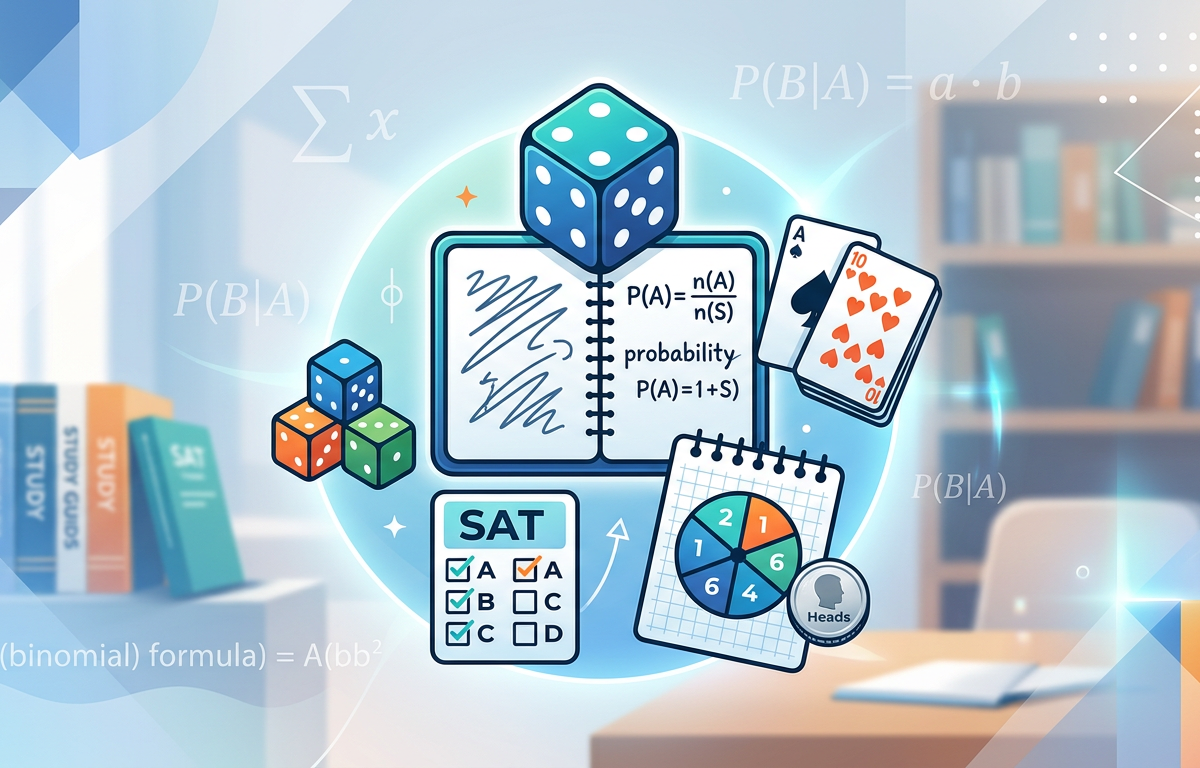
Medium SAT Probability Practice Questions
Mastering probability is essential for achieving a top score on the SAT Math section, as these questions often bridge the gap between simple arithmetic and complex data analysis. In this guide, we provide Medium SAT Probability Practice Questions designed to challenge your understanding of independent events, conditional probability, and data tables. By practicing these problems, you will develop the intuition needed to navigate the variety of ways the College Board presents statistical concepts.
Concept Explanation
Probability is a mathematical measure of the likelihood that a specific event will occur, calculated by dividing the number of favorable outcomes by the total number of possible outcomes. In the context of the SAT, probability is often expressed as a fraction, decimal, or percentage ranging from 0 (impossible) to 1 (certain). You will frequently encounter "two-way tables," which require you to filter data based on specific criteria before calculating the probability.
To solve medium-level problems, you must understand three core variations:
- Simple Probability: The basic ratio of .
- Joint Probability (AND): For independent events, you multiply the individual probabilities: .
- Conditional Probability: This involves finding the probability of an event given that another condition is already met. On the SAT, this usually means narrowing your "total outcomes" (the denominator) to a specific row or column in a table.
According to Wikipedia's definition of probability, the theory is used extensively in fields like statistics and gambling, but for the SAT, you primarily need to focus on discrete outcomes and data interpretation. If you find yourself struggling with the wording of these problems, reviewing Medium SAT Word Problems Practice Questions can help improve your reading comprehension for math contexts.
Solved Examples
Review these step-by-step solutions to understand the logic required for medium-difficulty probability questions.
- Example 1: The Two-Way Table
A survey asked 100 students if they prefer Math or English. 40 students are male, and of those, 15 prefer English. Of the female students, 20 prefer Math. If a student who prefers Math is chosen at random, what is the probability that the student is female?
Solution:- Organize the data. Total students = 100. Males = 40. Females = 60.
- Male English lovers = 15, so Male Math lovers = .
- Female Math lovers = 20.
- The question asks for the probability given the student prefers Math. Total Math lovers = .
- The favorable outcome is a female Math lover (20).
- Probability = .
- Example 2: Independent Events
A bag contains 5 red marbles and 3 blue marbles. If two marbles are chosen at random with replacement, what is the probability that both marbles are blue?
Solution:- Total marbles = .
- Probability of drawing a blue marble first = .
- Since the marble is replaced, the probability of drawing a blue marble second remains .
- Multiply the probabilities: .
- Example 3: Geometry and Probability
A square target has a side length of 10 inches. Inside it is a circle with a radius of 3 inches. If a point is chosen at random inside the square, what is the probability it lies outside the circle?
Solution:- Calculate the area of the square: .
- Calculate the area of the circle: .
- The area outside the circle but inside the square is .
- Probability = .
Practice Questions
Test your skills with these Medium SAT Probability Practice Questions. Ensure you read the constraints of each problem carefully.
1. A committee consists of 6 Democrats and 9 Republicans. If one person is chosen at random to be the chairperson and a second person is chosen at random to be the secretary, what is the probability that both are Democrats?
2. In a group of 50 people, 28 have brown hair, 15 have blue eyes, and 8 have both brown hair and blue eyes. If a person is chosen at random from the group, what is the probability that they have neither brown hair nor blue eyes?
3. A spinner is divided into 8 equal sectors numbered 1 through 8. If the spinner is spun twice, what is the probability that the sum of the numbers is exactly 5?
4. The table below shows the distribution of a class by gender and eye color. If a male student is selected at random, what is the probability that he has green eyes?
| Gender | Blue Eyes | Brown Eyes | Green Eyes | Total |
|---|---|---|---|---|
| Male | 12 | 15 | 3 | 30 |
| Female | 10 | 18 | 2 | 30 |
| Total | 22 | 33 | 5 | 60 |
5. A box contains 10 cards numbered 1 through 10. If two cards are drawn without replacement, what is the probability that both cards are prime numbers?
6. A researcher is studying the effects of a new medication. Out of 200 participants, 120 received the medication and 80 received a placebo. Of those who received the medication, 90 showed improvement. Of those who received the placebo, 20 showed improvement. If a participant who showed improvement is selected at random, what is the probability they received the placebo?
7. If is an integer selected at random from the set , what is the probability that ?
8. A jar contains 4 red, 6 white, and 10 blue marbles. If three marbles are drawn at random with replacement, what is the probability that none of them are red?
9. A fair six-sided die is rolled. If the result is an even number, what is the probability that it is also a multiple of 3?
10. In a survey of 120 people, 65% said they like coffee and 40% said they like tea. If 25% said they like both, what is the probability that a randomly selected person likes neither?
Answers & Explanations
- Answer: . Total = 15. Probability first is Democrat = . Probability second is Democrat = . Multiply: .
- Answer: (or 0.3). Use the principle of inclusion-exclusion: people have brown hair OR blue eyes. Total remaining = . Probability = . For more logic on totals and sets, see Medium SAT Algebra Word Practice Questions.
- Answer: . Total outcomes = . Pairs that sum to 5: (1,4), (2,3), (3,2), (4,1). There are 4 pairs. Probability = .
- Answer: (or 0.1). The condition is "If a male student is selected." The total for males is 30. Favorable outcomes (male with green eyes) = 3. Probability = .
- Answer: . Prime numbers between 1 and 10 are {2, 3, 5, 7}—total of 4. First draw probability = . Second draw probability = . Multiply: .
- Answer: . Total showing improvement = . Favorable outcome (placebo improvement) = 20. Probability = .
- Answer: . Solve the quadratic: . Solutions are and . There are 2 favorable outcomes out of 20. Probability = . If quadratics are tricky, check out Medium SAT Quadratic Equations Practice Questions.
- Answer: (or 0.512). Total marbles = 20. Non-red marbles = . Probability of one non-red = . Since it is with replacement, for three draws: .
- Answer: . Even numbers on a die are {2, 4, 6}. Total = 3. Multiple of 3 in that set is {6}. Favorable = 1. Probability = .
- Answer: 20% (or 0.2). Percentage who like coffee or tea = . Those who like neither = . Probability = 0.2.
1. A bag contains 4 red and 6 blue pens. If one pen is drawn and not replaced, then a second is drawn, what is the probability both are red?
Frequently Asked Questions
What is the difference between "with replacement" and "without replacement"?
"With replacement" means the item is put back before the next draw, keeping the total count and probabilities constant. "Without replacement" means the item is removed, which changes the denominator and potentially the numerator for subsequent events.
How do I identify a conditional probability question on the SAT?
Look for phrases like "given that," "if the student is female," or "of those who." These phrases indicate that you should only consider a specific subset of the total data as your denominator.
Can probability be greater than 1?
No, probability is always a value between 0 and 1, inclusive. If your calculation results in a number greater than 1, you likely added values that should have been multiplied or failed to account for overlapping sets.
What is the "complement" of a probability?
The complement is the probability that an event does not occur, calculated as . This is often the fastest way to solve questions asking for the probability of "at least one" or "none."
How do I handle "AND" vs "OR" in probability?
Generally, "AND" implies multiplication of probabilities for independent events, while "OR" implies addition. When using addition for "OR," remember to subtract any overlapping outcomes to avoid double-counting.
Enjoyed this article?
Share it with others who might find it helpful.
Related Articles

Hard SAT Probability Practice Questions
Hard SAT Probability Practice Questions
Apr 27, 2026
Easy SAT Probability Practice Questions
Easy SAT Probability Practice Questions
Apr 27, 2026

Hard SAT Standard Deviation Practice Questions
Hard SAT Standard Deviation Practice Questions
Apr 27, 2026

Solving Weighted Averages and Median Shifts on the Digital SAT
Hard SAT Mean Median Mode Practice Questions
Apr 27, 2026

SAT Stats: Solving for Margin of Error and Skewed Distributions
Hard SAT Statistics Practice Questions
Apr 27, 2026
Medium SAT Standard Deviation Practice Questions
Medium SAT Standard Deviation Practice Questions
Apr 27, 2026
Medium SAT Statistics Practice Questions
Medium SAT Statistics Practice Questions
Apr 27, 2026

Easy SAT Standard Deviation Practice Questions
Easy SAT Standard Deviation Practice Questions
Apr 27, 2026