Medium Protein Structure Questions Practice Questions
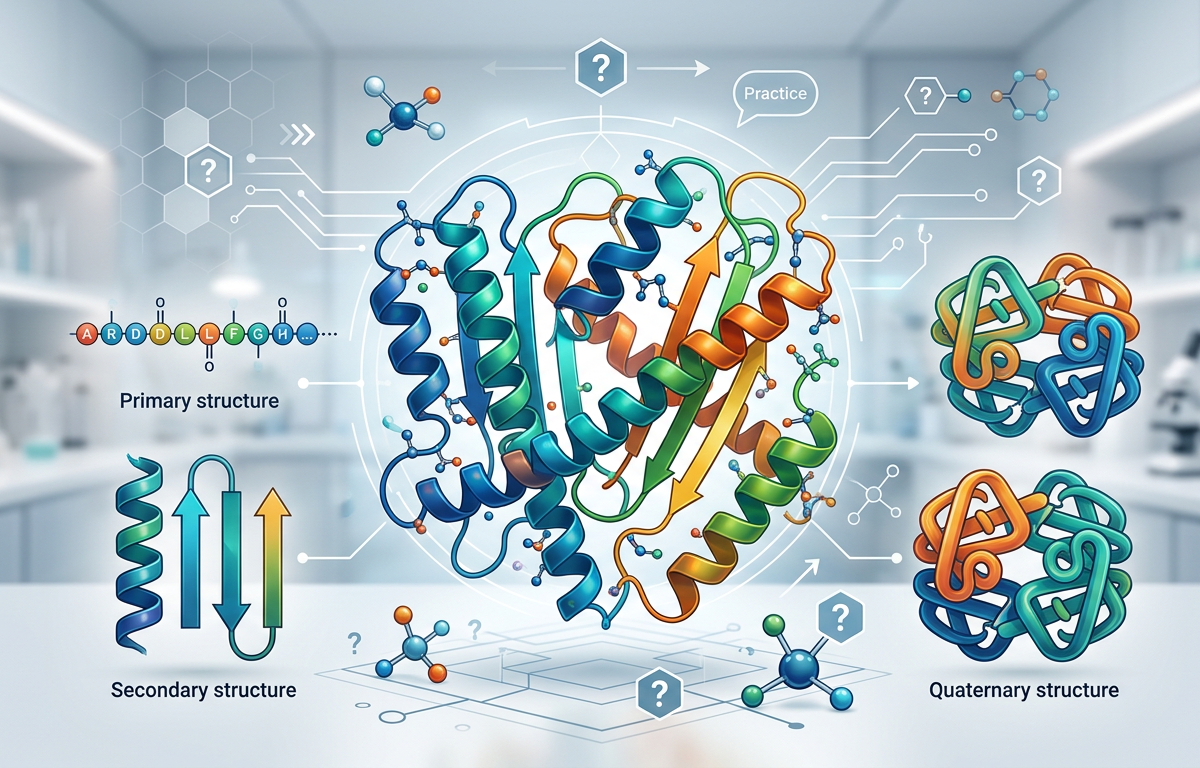
Understanding protein structure is fundamental to biology because the shape of a protein dictates its function within the cell. These Medium Protein Structure Questions will help you master the hierarchy of protein folding, from the linear sequence of amino acids to the complex three-dimensional arrangements that allow enzymes to catalyze reactions and antibodies to identify pathogens. Just as DNA replication ensures the continuity of genetic information, proper protein folding ensures that information is expressed correctly in a functional form.
Concept Explanation
Protein structure is defined as the unique three-dimensional arrangement of atoms in an amino acid chain, categorized into four distinct hierarchical levels: primary, secondary, tertiary, and quaternary. The primary structure consists of the specific sequence of amino acids linked by covalent peptide bonds, determined directly by the genetic code. The secondary structure refers to local spatial arrangements, such as alpha-helices and beta-pleated sheets, which are stabilized primarily by hydrogen bonds between the polypeptide backbone. Moving further, the tertiary structure represents the overall three-dimensional folding of a single polypeptide chain, driven by interactions between amino acid R-groups (side chains), including hydrophobic interactions, disulfide bridges, and ionic bonds. Finally, the quaternary structure occurs when multiple polypeptide subunits assemble into a single functional complex, such as the hemoglobin molecule. Understanding these levels is as critical to biology as knowing how organelles function together to maintain cellular life.
Solved Examples
- Identifying Bond Types: Which type of interaction is primarily responsible for stabilizing the alpha-helix in a protein's secondary structure?
- Identify the level of structure: Secondary structure involves the backbone of the polypeptide.
- Recall the stabilizing force: Hydrogen bonding occurs between the carbonyl oxygen (C=O) of one amino acid and the amide hydrogen (N-H) of another four residues away.
- Solution: Hydrogen bonds within the peptide backbone.
- Analyzing Denaturation: If a protein is treated with a reducing agent that breaks disulfide bonds, which level of protein structure is most directly affected?
- Determine what disulfide bonds are: They are covalent links between the sulfur atoms of two cysteine residues.
- Identify where these bonds act: Disulfide bridges stabilize the three-dimensional folding of a single chain or the connection between subunits.
- Solution: Tertiary and Quaternary structures.
- Calculating Peptide Length: A protein consists of 150 amino acids. How many water molecules were released during the synthesis of its primary structure?
- Recall the dehydration synthesis process: One water molecule is removed for every peptide bond formed.
- Calculate the number of bonds: In a linear chain, the number of bonds is always (n - 1), where n is the number of amino acids.
- Calculation: 150 - 1 = 149.
- Solution: 149 water molecules.
Practice Questions
- Which amino acid is known as a "helix breaker" because its rigid cyclic structure prevents it from fitting into a standard alpha-helix?
- In a globular protein located in the aqueous cytoplasm, where would you most likely find hydrophobic amino acids like Leucine and Valine?
- Describe the specific interaction that forms a disulfide bridge and name the amino acid involved.
- Compare the hydrogen bonding patterns in parallel versus anti-parallel beta-pleated sheets. Which is generally more stable?
- A mutation replaces an Ethionine (non-polar) with an Aspartic Acid (negatively charged) in the core of a protein. How might this affect the tertiary structure?
- What is the role of molecular chaperones in the context of protein folding?
- Distinguish between the "native state" of a protein and a "denatured" protein.
- Hemoglobin is a tetramer consisting of two alpha and two beta subunits. Which level of protein structure does this arrangement describe?
- How do changes in pH lead to the denaturation of a protein?
- Explain why the primary structure of a protein determines its final three-dimensional shape.
Answers & Explanations
- Proline: Proline has a unique side chain that bonds back to the nitrogen of the amino group, creating a ring structure. This prevents the N-H group from participating in the hydrogen bonding required for an alpha-helix, causing a "kink" in the chain.
- The interior (core) of the protein: Due to the hydrophobic effect, non-polar side chains cluster away from water to minimize entropy loss of the surrounding solvent, while hydrophilic groups face the exterior.
- Covalent bond between Cysteines: A disulfide bridge forms when the sulfhydryl (-SH) groups of two Cysteine residues undergo an oxidation reaction, forming a Cys-S-S-Cys bond that provides strong structural reinforcement.
- Anti-parallel is more stable: In anti-parallel sheets, the hydrogen bonds are collinear (straight), which is a stronger arrangement than the distorted, angled hydrogen bonds found in parallel sheets.
- Destabilization: Introducing a charged residue into the hydrophobic core is energetically unfavorable. The Aspartic Acid will likely attempt to move toward the aqueous surface, potentially causing the protein to misfold or lose its structural integrity.
- Assisting folding: Chaperones are specialized proteins that prevent non-specific aggregation of nascent polypeptide chains and provide an isolated environment for proteins to fold into their correct native conformations.
- Native vs. Denatured: The native state is the functional, correctly folded biological form. Denaturation involves the loss of secondary, tertiary, and quaternary structures (usually due to heat or chemicals) while keeping the primary sequence intact.
- Quaternary Structure: Any protein composed of more than one polypeptide chain working together as a functional unit is exhibiting quaternary structure.
- Disruption of ionic bonds: Changes in pH alter the ionization state of amino acid side chains (e.g., -COO⁻ becoming -COOH). This disrupts the salt bridges and ionic interactions that stabilize the tertiary structure.
- Amino acid sequence dictation: The primary sequence contains the specific R-groups whose chemical properties (charge, polarity, size) determine exactly how the chain will fold and interact with itself and its environment, as described by Anfinsen's dogma.
1. Which level of protein structure is LEAST likely to be affected by a disruption in hydrogen bonding?
Frequently Asked Questions
What is the difference between tertiary and quaternary structure?
Tertiary structure is the full 3D fold of a single polypeptide chain, while quaternary structure is the arrangement and interaction of multiple polypeptide chains (subunits) in a multi-subunit protein complex.
Why is the primary structure so important?
The primary structure is the linear sequence of amino acids that contains all the necessary chemical information to guide the protein into its correct functional 3D shape. A single change here, like in sickle cell anemia, can completely alter protein function.
Can a protein function if it is denatured?
Generally, no. A protein's function is strictly dependent on its specific 3D shape; once it loses that shape through denaturation, it can no longer bind to its substrate or perform its biological role.
What are the two most common types of secondary structure?
The alpha-helix, a right-handed coil, and the beta-pleated sheet, consisting of laterally packed strands, are the two most prevalent secondary structures found in proteins. Both are stabilized by backbone hydrogen atoms.
How do R-groups affect protein folding?
R-groups (side chains) have various chemical properties like charge, hydrophobicity, and size that interact through ionic bonds, hydrogen bonds, and van der Waals forces to lock the protein into its final tertiary structure.
Enjoyed this article?
Share it with others who might find it helpful.
Related Articles
Hard Le Chatelier’s Principle Practice Questions
Master Hard Le Chatelier’s Principle Practice Questions with our comprehensive guide featuring solved examples, practice problems, and detailed explanations.
Mar 30, 2026

Hard Reaction Quotient (Q) Practice Questions
Hard Reaction Quotient (Q) Practice Questions
Mar 30, 2026
Grams to Moles Practice Questions with Answers
Master grams to moles conversions with our comprehensive guide. Includes step-by-step examples, practice questions, and detailed answers for chemistry students.
Mar 26, 2026
Avogadro’s Number Practice Questions with Answers
Master the mole concept with our Avogadro’s Number practice questions. Includes step-by-step solved examples, a quick quiz, and detailed explanations.
Mar 26, 2026

Empirical Formulas: Solving Ratios from Mass and Percent Data
Master empirical formula calculations with 10 practice questions, worked answers, and a free step-by-step calculator for mass, percentage, and combustion problems.
Mar 26, 2026