Predicting SN1 vs SN2 Outcomes: Sterics, Solvents, and Symmetry
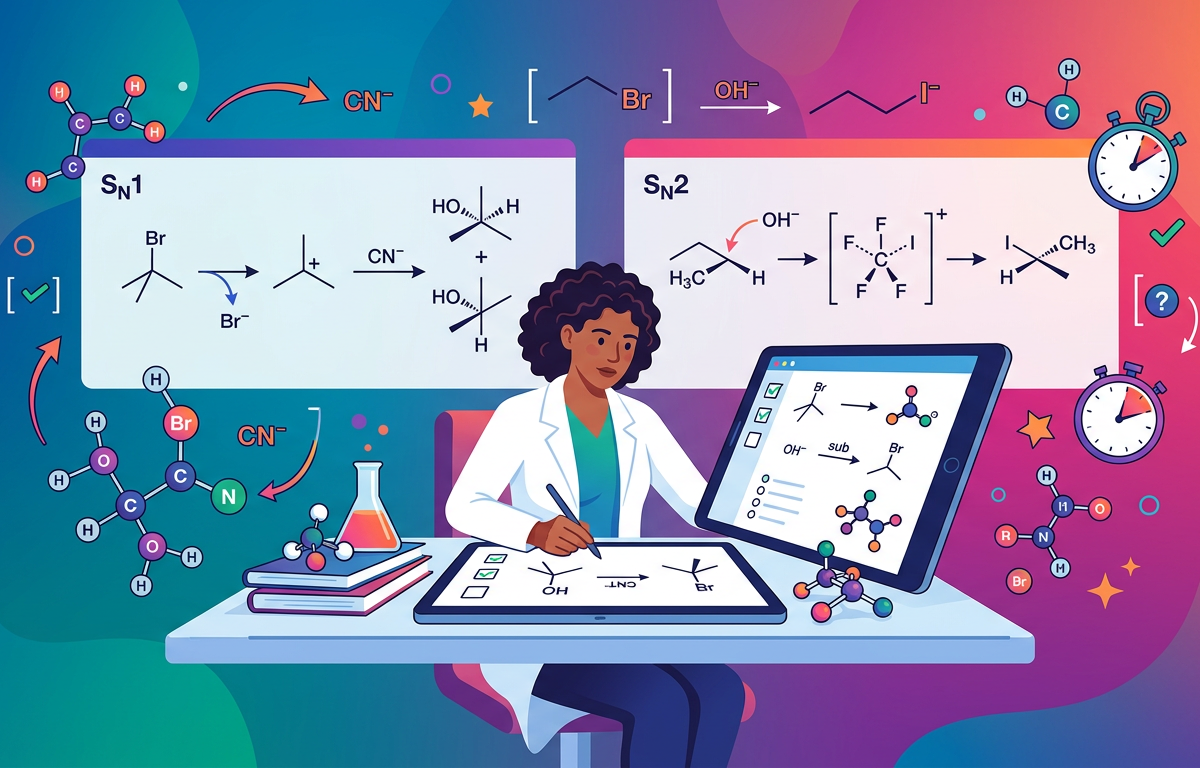
Imagine you are looking at (S)-3-chloro-3-methylhexane dissolved in water. If you assume the nucleophile will simply swap places with the chlorine, you might expect a single, predictable product. However, the MCAT thrives on the fact that this tertiary substrate forces a two-step mechanism. The chlorine leaves first, creating a planar carbocation intermediate that effectively erases the molecule's original spatial orientation. Because the incoming water molecule can attack this flat center from either the top or the bottom, you end up with a 50/50 racemic mixture rather than a clean inversion.
The difficulty in these medium-level problems usually lies in the competition between factors. You must decide if the solvent—such as polar aprotic DMSO versus polar protic ethanol—is enough to overcome the substrate's structural preference. While a primary carbon almost always dictates an SN2 pathway, a secondary carbon is a diagnostic crossroads where the strength of the nucleophile and the dielectric constant of the solvent determine the final stereochemical configuration. Mastering these questions requires moving beyond simple definitions to weigh these conflicting variables simultaneously.
Competing Mechanisms and Transition States
Nucleophilic substitution reactions, specifically and , are fundamental organic chemistry pathways where a nucleophile replaces a leaving group on a carbon atom. Understanding the competition between these two mechanisms is essential for the MCAT, as it tests your ability to predict reaction rates, stereochemical outcomes, and the influence of solvent and substrate structure. The (Substitution Nucleophilic Unimolecular) mechanism occurs in two steps via a carbocation intermediate, favoring tertiary carbons and polar protic solvents. In contrast, the (Substitution Nucleophilic Bimolecular) mechanism is a concerted one-step process that involves a backside attack, favoring primary carbons and polar aprotic solvents while resulting in an inversion of stereochemical configuration.
To master these concepts, students often benefit from retrieval practice for medical students to cement the specific conditions that favor one pathway over the other. The following table summarizes the key differences:
| Feature | ||
|---|---|---|
| Kinetics | First order: | Second order: |
| Substrate Preference | ||
| Stereochemistry | Racemization (loss of chirality) | Inversion (Walden Inversion) |
| Solvent | Polar Protic (e.g., ) | Polar Aprotic (e.g., DMSO, Acetone) |
Substrate stability is dictated by the Hammond Postulate, which relates the transition state of a reaction to the nearest stable intermediate. In , the stability of the carbocation intermediate is the rate-determining factor, whereas in , steric hindrance in the transition state governs the reaction speed.
Solved Examples
- Example 1: Predicting the Rate Change
If the concentration of the nucleophile is doubled in an reaction between methyl iodide and sodium hydroxide, how does the rate change?
- Identify the rate law for : .
- Since the reaction is first-order with respect to the nucleophile, doubling results in a direct doubling of the rate.
- Final Answer: The rate doubles.
- Example 2: Stereochemical Outcome
An optically pure sample of (S)-3-chloro-3-methylhexane is reacted with water. What is the stereochemistry of the product?
- Analyze the substrate: 3-chloro-3-methylhexane is a tertiary () alkyl halide.
- Analyze the conditions: Water is a weak nucleophile and a polar protic solvent, favoring .
- In , the leaving group departs to form a planar carbocation. The nucleophile can attack from either side.
- Final Answer: A racemic mixture of (R) and (S) alcohols is formed.
- Example 3: Solvent Effects
Which solvent would most significantly increase the rate of the reaction between 1-bromopropane and sodium cyanide?
- Identify the reaction type: Primary alkyl halide with a strong nucleophile () indicates .
- Recall that reactions are accelerated by polar aprotic solvents because they do not solvate the nucleophile strongly, leaving it "naked" and more reactive.
- Compare solvents like methanol (protic) vs. DMF (aprotic).
- Final Answer: DMF (Dimethylformamide) or DMSO.
Practice Questions
- Which of the following substrates is most reactive toward an mechanism?
- 2-bromo-2-methylpropane
- 2-bromopropane
- 1-bromopropane
- 1-bromo-2,2-dimethylpropane
- A reaction is performed where (R)-2-bromobutane is treated with in acetone. What is the configuration of the product?
- In an reaction, which step is considered the rate-determining step?
Study smarter for the MCAT.
Turn practice into performance with AI-powered MCAT tools designed to help students retain more and score higher.
Start Learning Free- Rank the following leaving groups in order of increasing reactivity: .
- Why are tertiary alkyl halides virtually unreactive in reactions?
- How would increasing the concentration of the substrate affect the rate of an reaction?
- What effect does a polar protic solvent have on the nucleophilicity of halide ions in an reaction?
- Predict the major product and mechanism for the reaction of 1-iodo-1-methylcyclohexane with methanol.
- True or False: A carbocation rearrangement is possible during an reaction.
- Which of the following is a better nucleophile in a polar aprotic solvent: or ?
Answers & Explanations
- Answer: C. reactivity is highest for primary substrates with the least steric hindrance. 1-bromopropane is a primary alkyl halide with less branching than 1-bromo-2,2-dimethylpropane (which has a bulky neopentyl group).
- Answer: (S)-2-iodobutane. The reaction of a secondary alkyl halide with a strong nucleophile in a polar aprotic solvent (acetone) follows the pathway, resulting in a complete inversion of configuration.
- Answer: The formation of the carbocation. The first step, where the leaving group departs to form a high-energy carbocation intermediate, has the highest activation energy and thus limits the rate.
- Answer: . Better leaving groups are weaker bases. Since is the strongest acid in the group, is the weakest base and the best leaving group.
- Answer: Steric Hindrance. In an mechanism, the nucleophile must perform a backside attack. In a tertiary halide, the bulky methyl groups block the path to the electrophilic carbon.
- Answer: The rate increases. The rate law for is . Doubling the substrate concentration doubles the rate.
- Answer: It decreases nucleophilicity. Protic solvents engage in hydrogen bonding with the nucleophile, creating a "solvent shell" that the nucleophile must break through to attack the electrophile. This is especially true for small, highly basic ions like .
- Answer: 1-methoxy-1-methylcyclohexane via . The substrate is tertiary, and methanol is a weak nucleophile/polar protic solvent. This setup favors the formation of a carbocation followed by nucleophilic attack.
- Answer: False. Rearrangements occur when a carbocation is formed. Since is a concerted one-step process with no intermediate, rearrangements cannot occur.
- Answer: . In polar aprotic solvents, nucleophilicity correlates with basicity because there is no hydrogen bonding to stabilize the ions. is a stronger base than and thus a better nucleophile in these conditions.
For more strategies on how to approach complex organic chemistry problems, check out our guide on retrieval practice for STEM subjects.
1. Which rate law corresponds to an SN2 reaction?
Frequently Asked Questions
What is the difference between a nucleophile and a base?
A nucleophile is a species that donates an electron pair to an electrophilic carbon to form a bond, while a base donates an electron pair to a proton. Nucleophilicity is a kinetic property related to reaction rates, whereas basicity is a thermodynamic property related to equilibrium constants.
How do I identify a polar aprotic solvent?
Polar aprotic solvents have a dipole moment but lack an O-H or N-H bond, meaning they cannot donate hydrogen bonds. Common examples used in organic chemistry include acetone, DMSO, DMF, and acetonitrile.
Can a secondary alkyl halide undergo both SN1 and SN2?
Yes, secondary alkyl halides are the most ambiguous and can follow either pathway depending on the conditions. Strong nucleophiles and aprotic solvents favor , while weak nucleophiles and protic solvents favor .
Why is iodide a better nucleophile than fluoride in water?
In protic solvents like water, fluoride is heavily solvated by hydrogen bonds, which hinders its ability to attack a carbon. Iodide is larger and less solvated, allowing it to remain more reactive as a nucleophile despite being a weaker base.
What is the role of the leaving group in these reactions?
The leaving group stabilizes the negative charge after departing from the substrate; better leaving groups are generally the conjugate bases of strong acids. A good leaving group lowers the activation energy for both and mechanisms, increasing the overall reaction rate.
Study smarter for the MCAT.
Turn practice into performance with AI-powered MCAT tools designed to help students retain more and score higher.
Start Learning FreeReviewed by
Michael Danquah, MS, PhD
Dr. Michael Danquah is a professor of pharmaceutical sciences and founder of several educational technology platforms focused on improving student learning and performance.
Enjoyed this article?
Share it with others who might find it helpful.
Related Articles
Predicting MCAT Organic Products: From PCC to SN2 Mechanisms
Easy MCAT Organic Reactions Practice Questions
May 11, 2026

Predicting O-Chem Reaction Outcomes on the MCAT
MCAT Organic Chemistry Practice Questions with Answers
May 10, 2026

Hard MCAT Philosophy Passage Practice Questions
Master Hard MCAT Philosophy Passage Practice Questions with our comprehensive guide featuring solved examples, practice questions, and expert explanations.
May 17, 2026

Hard MCAT Humanities Passage Practice Questions
Master Hard MCAT Humanities Passage Practice Questions with our comprehensive guide featuring solved examples, practice questions, and expert strategies.
May 17, 2026

Hard MCAT Critical Analysis Practice Questions
Hard MCAT Critical Analysis Practice Questions
May 17, 2026

Hard MCAT Reading Comprehension Practice Questions
Hard MCAT Reading Comprehension Practice Questions
May 17, 2026

Hard MCAT CARS Passage Practice Questions
Master high-difficulty MCAT CARS passages with our expert guide featuring solved examples, practice questions, and detailed logical analysis.
May 17, 2026

Hard MCAT CARS Practice Questions
Master Hard MCAT CARS Practice Questions with our comprehensive guide featuring solved examples, practice passages, and expert reasoning strategies.
May 17, 2026