Medium MCAT Optics Practice Questions
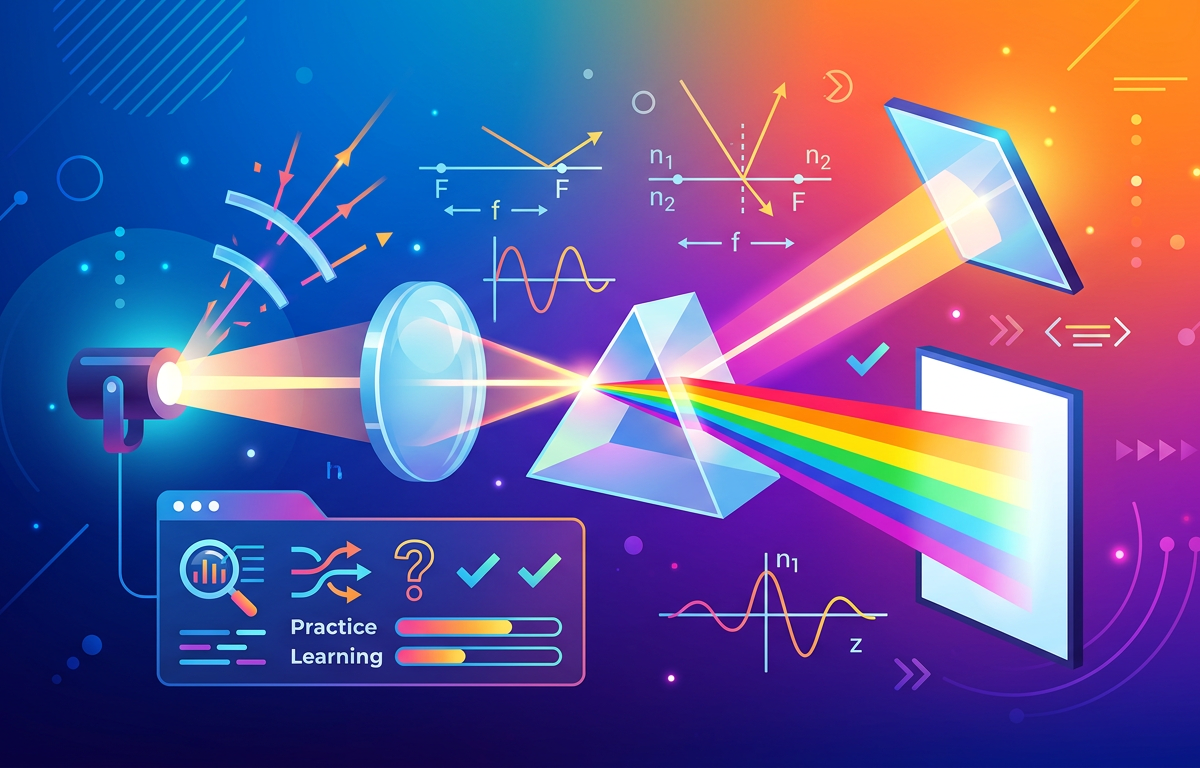
Concept Explanation
Optics on the MCAT involves the study of how light behaves as it interacts with various media, specifically focusing on reflection, refraction, and the formation of images by mirrors and lenses. At its core, optics is governed by the principle that light travels in straight lines until it encounters a boundary, where it can change direction according to Snell's Law or the Law of Reflection. Understanding these behaviors allows pre-medical students to predict where an image will form, whether it will be real or virtual, and how its size compares to the original object.
Key variables include the focal length , object distance , and image distance , which are related by the thin lens equation . Additionally, the magnification is defined as . In the context of the human eye, which is a major focus for optical physics, the lens must adjust its focal length to keep images focused on the retina, a process known as accommodation. Mastery of these concepts is essential for solving Medium MCAT Optics Practice Questions, as they often require combining algebraic manipulation with conceptual knowledge of sign conventions.
Solved Examples
- Example 1: Converging Lens Calculation
An object is placed 15 cm in front of a converging lens with a focal length of 10 cm. Determine the image distance and describe the image.
Solution:- Identify the given values: and .
- Use the thin lens equation:
- Rearrange to solve for :
- Therefore, . Since is positive, the image is real and inverted.
- Example 2: Magnification and Mirror Type
A concave mirror has a radius of curvature of 40 cm. If an object is placed 10 cm from the mirror, what is the magnification?
Solution:- Find the focal length: .
- Use the mirror equation:
- Solve for : , so .
- Calculate magnification: . The image is virtual, upright, and twice the size of the object.
- Example 3: Snell's Law and Refraction
Light travels from air () into a glass block () at an incident angle of . What is the sine of the refracted angle?
Solution:- Apply Snell's Law:
- Substitute the values:
- Since :
- Solve for the sine: .
Practice Questions
1. A diverging lens has a focal length of -20 cm. If an object is placed 60 cm from the lens, where is the image formed?
2. A ray of light passes from water () into a mysterious plastic medium. If the critical angle for total internal reflection is , what is the refractive index of the plastic?
3. An object is placed at the center of curvature of a concave mirror. What are the characteristics of the resulting image?
Track your MCAT progress intelligently.
Use Bevinzey’s analytics and AI-powered feedback to identify weaknesses and improve faster.
See My Progress4. A student uses a magnifying glass (converging lens) with a power of 10 Diopters. If the object is held 5 cm from the lens, what is the image distance?
5. Which of the following changes would increase the focal length of a spherical mirror?
6. Light with a wavelength of 600 nm in a vacuum enters a medium with a refractive index of 2.0. What is the wavelength of the light in this medium?
7. A convex mirror is used as a security mirror in a store. If a person stands 4 meters away from the mirror which has a focal length of -1 meter, what is the magnification?
8. Hyperopia (farsightedness) is corrected using which type of lens, and where does the lens shift the image?
9. A beam of light strikes a flat glass plate at an angle of to the normal. If the glass has , what is the angle of refraction? (Note: )
10. If an object is placed 12 cm from a lens and a virtual image is formed 4 cm from the lens on the same side as the object, what is the focal length?
Answers & Explanations
- Answer: -15 cm. Using , we have . Rearranging gives . Thus, . This is consistent with Khan Academy's lens tutorials which state diverging lenses always produce virtual images.
- Answer: 0.94. The critical angle formula is . Here, . Since , then . Note: A refractive index below 1.0 is physically impossible for standard materials in vacuum, suggesting the light must be moving from a denser to a less dense medium.
- Answer: Real, inverted, and same size. At the center of curvature (), the mirror equation yields , which simplifies to . Magnification .
- Answer: -10 cm. Power . Given , then . Using the lens equation: . Thus, .
- Answer: Increasing the radius of curvature. For a mirror, . Therefore, increasing the radius of curvature directly increases the focal length. This is a common conceptual point in general chemistry and physics review.
- Answer: 300 nm. The wavelength in a medium is given by . So, . The frequency remains constant.
- Answer: +0.2. First find : . Thus . Magnification .
- Answer: Converging lens; shifts image forward onto the retina. Hyperopic eyes focus light behind the retina. A converging lens adds refractive power to focus the light earlier.
- Answer: . Snell's Law: . Since , we have . Thus , so .
- Answer: -6 cm. Using and (virtual image): . Thus . This is a diverging lens.
1. Which of the following is true for a real image formed by a single lens?
Frequently Asked Questions
What is the sign convention for mirrors and lenses on the MCAT?
For both mirrors and lenses, object distance is positive when the object is on the side the light comes from. Image distance is positive for real images (opposite side for lenses, same side for mirrors) and negative for virtual images.
How do I distinguish between a concave and convex mirror?
A concave mirror curves inward like a cave and is converging, while a convex mirror curves outward and is diverging. Concave mirrors can form real or virtual images, but convex mirrors only form virtual, upright, reduced images.
What is the difference between myopia and hyperopia?
Myopia is nearsightedness where the eye is too long and images focus in front of the retina, requiring a diverging lens. Hyperopia is farsightedness where the eye is too short and images focus behind the retina, requiring a converging lens.
Does frequency change when light enters a new medium?
No, the frequency of light remains constant when it passes from one medium to another. Only the velocity and wavelength change in proportion to the refractive index of the material.
What is total internal reflection?
Total internal reflection occurs when light travels from a higher refractive index medium to a lower one at an angle greater than the critical angle. In this case, no light is refracted into the second medium; all of it reflects back.
Why is the power of a lens measured in Diopters?
Diopters represent the inverse of the focal length in meters (). This unit is standard in clinical optometry because it allows for easy addition of the refractive power of multiple lenses in a system.
Track your MCAT progress intelligently.
Use Bevinzey’s analytics and AI-powered feedback to identify weaknesses and improve faster.
See My ProgressReviewed by
Michael Danquah, MS, PhD
Dr. Michael Danquah is a professor of pharmaceutical sciences and founder of several educational technology platforms focused on improving student learning and performance.
Enjoyed this article?
Share it with others who might find it helpful.
Related Articles
Hard MCAT Optics Practice Questions
Hard MCAT Optics Practice Questions
May 17, 2026
Easy MCAT Optics Practice Questions
Easy MCAT Optics Practice Questions
May 17, 2026

Hard MCAT Thermodynamics Practice Questions
Hard MCAT Thermodynamics Practice Questions
May 17, 2026

Hard MCAT Kinematics Practice Questions
Hard MCAT Kinematics Practice Questions
May 17, 2026
Medium MCAT Thermodynamics Practice Questions
Master thermodynamics with medium-level MCAT practice questions covering Gibbs Free Energy, enthalpy, entropy, and the laws of thermodynamics with full explanations.
May 17, 2026

Medium MCAT Circuits Practice Questions
Medium MCAT Circuits Practice Questions
May 17, 2026
Medium MCAT Kinematics Practice Questions
Medium MCAT Kinematics Practice Questions
May 17, 2026
Medium MCAT Physics Practice Questions
Master medium-level MCAT physics with our comprehensive guide featuring solved examples, practice questions, and detailed explanations of core concepts.
May 17, 2026