Medium MCAT Kinetics Practice Questions

Medium MCAT Kinetics Practice Questions
Mastering chemical kinetics is a fundamental requirement for success on the Chemical and Physical Foundations of Biological Systems section of the MCAT. This guide provides Medium MCAT Kinetics Practice Questions designed to bridge the gap between basic definitions and complex passage-based analysis. By engaging with these problems, you will refine your ability to interpret rate laws, understand activation energy, and analyze reaction mechanisms.
Concept Explanation
MCAT kinetics focuses on the study of reaction rates, the factors affecting these rates, and the microscopic pathways reactions follow to reach completion. Unlike thermodynamics, which determines the spontaneity and equilibrium position of a reaction, kinetics describes the speed at which a reaction occurs. The core of this topic involves the Rate Law, generally expressed as , where is the rate constant and the exponents represent the reaction order with respect to each reactant.
Key variables influencing kinetics include reactant concentration, temperature, the presence of a catalyst, and the medium of the reaction. According to Collision Theory, for a reaction to occur, molecules must collide with sufficient energy (the activation energy, ) and proper orientation. The Arrhenius Equation, , mathematically links the rate constant to temperature and activation energy. Understanding these relationships is vital when using retrieval practice for medical students to memorize and apply formulas under timed conditions.
Reaction Orders and Graphs
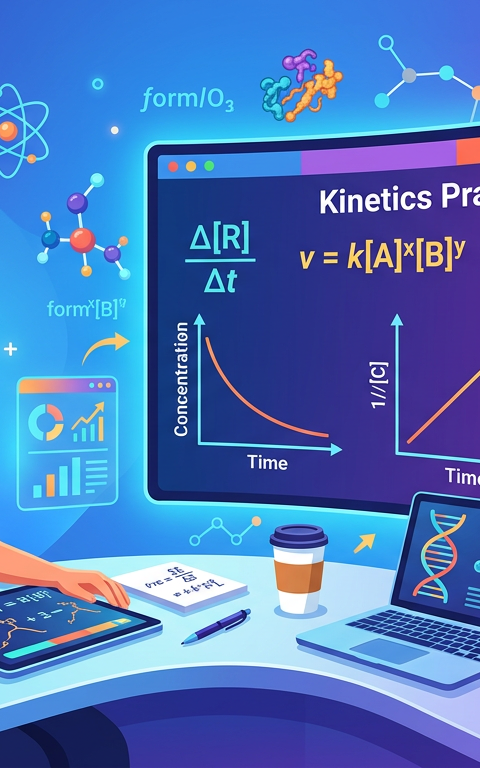
- Zero-order: Rate is independent of concentration. A plot of vs. time is linear.
- First-order: Rate is proportional to one reactant. A plot of vs. time is linear.
- Second-order: Rate is proportional to the square of a reactant or the product of two. A plot of vs. time is linear.
Solved Examples
Example 1: Determining Rate Law from Initial Rates
Given the reaction , find the rate law based on the following data:
Exp 1:
Exp 2:
Exp 3:
- Compare Exp 1 and 2: doubles, rate quadruples (). Therefore, the reaction is second-order with respect to .
- Compare Exp 1 and 3: doubles, rate remains constant (). Therefore, the reaction is zero-order with respect to .
- Combine for the rate law: .
Example 2: Calculating Activation Energy
If a reaction's rate constant doubles when the temperature increases from 300 K to 310 K, what is the approximate activation energy? (Use )
- Use the logarithmic form of the Arrhenius equation: .
- Substitute values: .
- Calculate: .
- Solve for : or .
Example 3: Reaction Mechanisms
Consider the mechanism:
Step 1: (Slow)
Step 2: (Fast)
What is the predicted rate law?
- Identify the rate-determining step (RDS), which is the slowest step.
- The rate law is derived from the stoichiometry of the RDS reactants.
- Result: .
Practice Questions
1. A reaction is found to be second-order overall. If the concentration of the single reactant is tripled, by what factor does the reaction rate change?
2. In a first-order reaction, the half-life is 20 minutes. If the initial concentration is 0.8 M, what will be the concentration after 60 minutes?
3. Consider the reaction . If the rate of disappearance of is , what is the rate of appearance of ?
Create your MCAT study system.
Get a personalized MCAT study experience with quizzes, active recall tools, and intelligent study guidance.
Build My Study Plan4. A catalyst is added to a reaction at equilibrium. Which of the following will change? (A) The equilibrium constant , (B) The enthalpy of reaction , (C) The rate of the forward reaction, or (D) The position of equilibrium.
5. A graph of versus time yields a straight line with a slope of . What is the order of the reaction and the value of the rate constant ?
6. For the reaction , the rate law is . If the volume of the reaction vessel is halved at constant temperature, how does the rate change?
7. The decomposition of a drug follows zero-order kinetics with . If a pharmacy stocks a 1.0 M solution, how many years will it take for the concentration to reach 0.8 M?
8. Which of the following statements best describes the effect of increasing temperature on an endothermic reaction?
9. A reaction mechanism has two steps. Step 1: (fast equilibrium). Step 2: (slow). Derive the rate law in terms of reactants and .
10. If the activation energy of a forward reaction is and the of the reaction is , what is the activation energy of the reverse reaction?
Answers & Explanations
- Answer: 9. For a second-order reaction . If is tripled (), the new rate is . The rate increases by a factor of 9.
- Answer: 0.1 M. After 60 minutes (3 half-lives), the concentration is halved three times: .
- Answer: . According to stoichiometry, for every 2 moles of consumed, 4 moles of are produced. The rate of appearance is twice the rate of disappearance: .
- Answer: (C) The rate of the forward reaction. Catalysts lower activation energy, increasing both forward and reverse rates equally. They do not affect thermodynamic properties like , , or the equilibrium position. For more on how to optimize your study of these concepts, check out our guide on retrieval practice vs practice tests.
- Answer: First-order; . A linear plot of vs. time is characteristic of first-order kinetics. The slope of this line is , so .
- Answer: Increases by a factor of 8. Halving the volume doubles the concentration of all gaseous or aqueous reactants. The new rate is .
- Answer: 10 years. For zero-order: . Substituting: . Solving for : , so .
- Answer: Both the rate constant and the rate increase. Increasing temperature increases the kinetic energy of molecules, leading to more frequent and energetic collisions, regardless of whether the reaction is endothermic or exothermic.
- Answer: . The slow step is the RDS: . From the fast equilibrium: , so . Substituting into the RDS rate law gives .
- Answer: 100 kJ/mol. The activation energy of the reverse reaction is . Since is negative (exothermic), .
1. Which of the following factors will increase the rate constant k of a reaction?
Frequently Asked Questions
What is the difference between reaction order and molecularity?
Reaction order is an experimentally determined value relating concentration to rate, while molecularity refers to the number of molecules colliding in a single elementary step. Order can be fractional or zero, but molecularity must be a whole number.
How does temperature affect the rate constant?
According to the Arrhenius equation, increasing temperature increases the rate constant exponentially. This is because a higher fraction of molecules possess the kinetic energy required to surpass the activation energy barrier.
Can the rate law be determined from the balanced chemical equation?
No, the rate law cannot be determined from the overall balanced equation; it must be determined experimentally or from the slowest step of a known mechanism. For more on effective study habits for these complex topics, see our guide on retrieval practice vs highlighting notes.
What is a reaction intermediate?
A reaction intermediate is a species that is produced in one step of a mechanism and consumed in a subsequent step. Unlike transition states, intermediates have finite lifetimes and can sometimes be isolated or detected.
How does a catalyst affect the equilibrium constant?
A catalyst has no effect on the equilibrium constant or the final concentrations of reactants and products. It only increases the speed at which the system reaches that equilibrium state by lowering the activation energy for both directions.
Create your MCAT study system.
Get a personalized MCAT study experience with quizzes, active recall tools, and intelligent study guidance.
Build My Study PlanReviewed by
Michael Danquah, MS, PhD
Dr. Michael Danquah is a professor of pharmaceutical sciences and founder of several educational technology platforms focused on improving student learning and performance.
Enjoyed this article?
Share it with others who might find it helpful.
Related Articles

Hard MCAT Kinetics Practice Questions
Hard MCAT Kinetics Practice Questions
May 9, 2026
Easy MCAT Kinetics Practice Questions
Easy MCAT Kinetics Practice Questions
May 9, 2026

MCAT Kinetics Practice Questions with Answers
MCAT Kinetics Practice Questions with Answers
May 9, 2026

Hard MCAT Philosophy Passage Practice Questions
Master Hard MCAT Philosophy Passage Practice Questions with our comprehensive guide featuring solved examples, practice questions, and expert explanations.
May 17, 2026

Hard MCAT Humanities Passage Practice Questions
Master Hard MCAT Humanities Passage Practice Questions with our comprehensive guide featuring solved examples, practice questions, and expert strategies.
May 17, 2026

Hard MCAT Critical Analysis Practice Questions
Hard MCAT Critical Analysis Practice Questions
May 17, 2026

Hard MCAT Reading Comprehension Practice Questions
Hard MCAT Reading Comprehension Practice Questions
May 17, 2026

Hard MCAT CARS Passage Practice Questions
Master high-difficulty MCAT CARS passages with our expert guide featuring solved examples, practice questions, and detailed logical analysis.
May 17, 2026