Medium MCAT Amino Acid Practice Questions
Concept Explanation
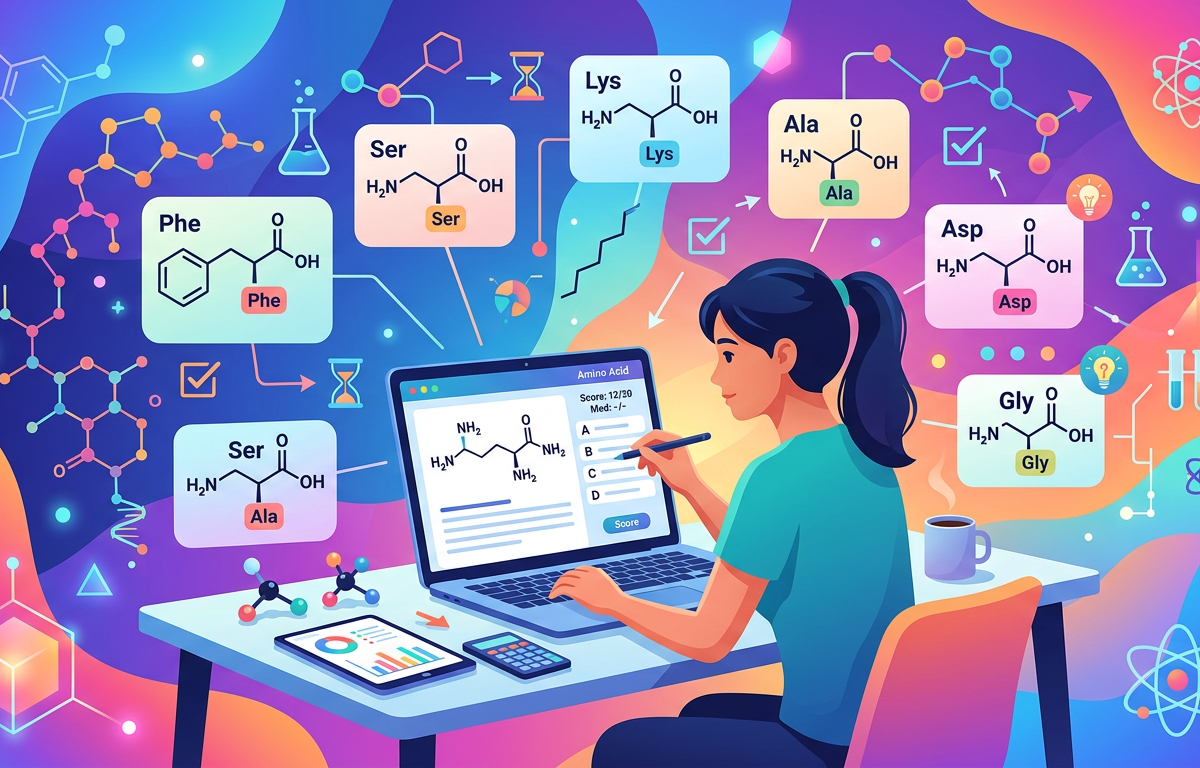
Amino acids are the fundamental building blocks of proteins, consisting of a central carbon atom (the alpha-carbon) bonded to an amino group, a carboxyl group, a hydrogen atom, and a unique side chain known as the R-group. In the context of the MCAT, understanding the 20 standard amino acids is essential, as their chemical properties dictate protein folding, enzyme catalysis, and metabolic pathways.
These molecules are typically categorized by their R-group properties: nonpolar (hydrophobic), polar uncharged (hydrophilic), acidic (negatively charged at physiological pH), and basic (positively charged at physiological pH). Most amino acids are chiral, specifically in the L-configuration in biological systems, which corresponds to an (S) absolute configuration for 18 of the 19 chiral amino acids (cysteine being the exception). Mastery of their pKa values is also vital, as the protonation state of the amino and carboxyl groups changes depending on the surrounding pH, leading to the formation of zwitterions at neutral pH. For those looking to master general chemical principles alongside biochemistry, reviewing Medium MCAT General Chemistry Practice Questions can provide a solid foundation for understanding acid-base behavior.
Solved Examples
Determining the Net Charge: Calculate the net charge of Glutamic Acid at pH 7.0. The pKa values are approximately: , , and .
Compare the pH to each pKa. If pH > pKa, the group is deprotonated. If pH < pKa, the group is protonated.
At pH 7.0: The carboxyl group (2.1) is deprotonated ( charge).
The amino group (9.5) is protonated ( charge).
The side chain carboxyl (4.1) is deprotonated ( charge).
Sum the charges: . The net charge is -1.
Isoelectric Point Calculation: Find the pI of Lysine. Given pKa values: , , and .
Identify the two pKa values that surround the zwitterionic (neutral) form. For basic amino acids, this is the average of the two highest pKa values (the amino group and the side chain).
Calculation: .
Result: .
Stereochemistry Identification: Why is Cysteine the only L-amino acid with an (R) configuration?
In the Cahn-Ingold-Prelog system, priority is assigned by atomic number.
In most amino acids, the R-group (carbon-based) is priority #3, while the carboxyl group (carbon bonded to oxygens) is priority #2, and the amino group (nitrogen) is priority #1.
In Cysteine, the side chain contains a sulfur atom (). Sulfur has a higher atomic number than the oxygens in the carboxyl group.
This flips the priority of the side chain to #2, changing the (S) configuration of the L-isomer to (R).
Practice Questions
1. Which of the following amino acids contains a secondary amine in its backbone structure, leading to significant steric constraints in alpha-helices?
2. A peptide with the sequence Asp-Lys-Gly-Arg is placed in an electrophoresis gel at pH 6.0. Toward which electrode will the peptide migrate?
3. Which amino acid is most likely to be found in the interior of a globular protein, away from the aqueous environment?
[CTA_BLOCK_0]
4. Calculate the isoelectric point (pI) of Aspartic Acid given: , , and .
5. Which amino acid possesses a side chain capable of forming disulfide bridges, which are critical for tertiary and quaternary protein structure?
6. At which pH would the amino acid Histidine () have a net neutral charge?
7. Considering the Medium MCAT Stereochemistry Practice Questions, which of the 20 standard amino acids is achiral?
8. Which amino acid side chain contains an imidazole ring that can act as both an acid and a base near physiological pH?
9. A mutation replaces a Valine residue with an Isoleucine residue. What is the most likely effect on the protein's hydrophobicity?
10. During the formation of a peptide bond, what type of functional group is created? (Hint: See Medium MCAT Functional Group Practice Questions for reference).
Answers & Explanations
Proline: Proline's side chain is cyclic and bonds back to the nitrogen of the amino group, forming a secondary amine. This creates a rigid structure that often breaks alpha-helices.
The Cathode (Negative Electrode): At pH 6.0: Aspartic acid (), Lysine (), Glycine (0), and Arginine (). Net charge = . Cations migrate toward the negative cathode.
Leucine (or other nonpolar amino acids): Hydrophobic amino acids like Leucine, Isoleucine, and Valine sequester themselves in the protein core to avoid water, driven by the hydrophobic effect.
3.0: For acidic amino acids, the pI is the average of the two lowest pKa values. .
Cysteine: The thiol () group of cysteine can be oxidized to form a covalent disulfide bond (S-S) with another cysteine residue.
Approximately 7.6: For Histidine, the pI is the average of the amino group pKa (~9.2) and the side chain pKa (~6.0). .
Glycine: Glycine's R-group is a simple hydrogen atom. Since the alpha-carbon is bonded to two hydrogen atoms, it is not a chiral center.
Histidine: The imidazole ring has a pKa near 6.0, allowing it to transition between protonated and deprotonated states easily at physiological pH (~7.4).
Minimal change: Both Valine and Isoleucine are nonpolar, branched-chain amino acids. While Isoleucine is slightly more hydrophobic due to an extra carbon, the overall impact on the protein core is usually conservative.
Amide: A peptide bond is an amide linkage formed via a dehydration reaction between the carboxyl group of one amino acid and the amino group of another.
1. Which amino acid is classified as basic?
Frequently Asked Questions
What is a zwitterion in the context of amino acids?
A zwitterion is a molecule that contains an equal number of positively and negatively charged functional groups, resulting in a net charge of zero. For amino acids, this typically occurs at the isoelectric point when the amino group is protonated and the carboxyl group is deprotonated.
How do you calculate the isoelectric point (pI) for a neutral amino acid?
For neutral amino acids, the pI is calculated by taking the mathematical average of the pKa of the carboxyl group and the pKa of the amino group. This represents the specific pH at which the molecule carries no net electrical charge.
Why is Glycine unique among the 20 standard amino acids?
Glycine is unique because its side chain is a single hydrogen atom, making it the only achiral amino acid. This small R-group also grants it high conformational flexibility within protein structures.
What are the three-letter and one-letter codes for Tryptophan?
Tryptophan is denoted by the three-letter code "Trp" and the one-letter code "W". It is an essential aromatic amino acid featuring a bulky indole ring system.
Which amino acids contain sulfur?
Only two of the standard 20 amino acids contain sulfur: Cysteine and Methionine. Cysteine is capable of forming disulfide bonds, whereas Methionine usually functions as the start codon in translation.
Feel more confident on exam day.
Practice with realistic MCAT-style questions and strengthen your understanding before test day arrives.
Practice Free NowReviewed by
Michael Danquah, MS, PhD
Dr. Michael Danquah is a professor of pharmaceutical sciences and founder of several educational technology platforms focused on improving student learning and performance.
Enjoyed this article?
Share it with others who might find it helpful.
Related Articles
Hard MCAT Amino Acid Practice Questions
Hard MCAT Amino Acid Practice Questions
May 14, 2026

Easy MCAT Amino Acid Practice Questions
Easy MCAT Amino Acid Practice Questions
May 14, 2026
Hard MCAT Citric Acid Practice Questions
Hard MCAT Citric Acid Practice Questions
May 14, 2026
Medium MCAT Citric Acid Practice Questions
Medium MCAT Citric Acid Practice Questions
May 14, 2026
Easy MCAT Citric Acid Practice Questions
Easy MCAT Citric Acid Practice Questions
May 14, 2026
MCAT Citric Acid Practice Questions with Answers
MCAT Citric Acid Practice Questions with Answers
May 14, 2026

Hard MCAT Philosophy Passage Practice Questions
Master Hard MCAT Philosophy Passage Practice Questions with our comprehensive guide featuring solved examples, practice questions, and expert explanations.
May 17, 2026

Hard MCAT Humanities Passage Practice Questions
Master Hard MCAT Humanities Passage Practice Questions with our comprehensive guide featuring solved examples, practice questions, and expert strategies.
May 17, 2026