Medium Enzyme Questions Practice Questions

Concept Explanation
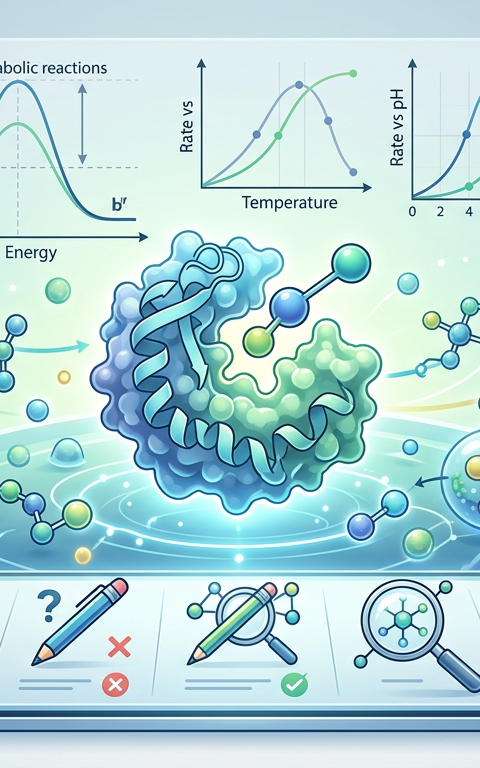
Enzymes are biological catalysts, typically proteins, that accelerate chemical reactions by lowering the activation energy required for a reaction to proceed. These molecules are highly specific, meaning they only interact with particular substrates that fit into their active site—a concept often described by the "induced fit" model. In this model, the enzyme slightly changes shape to snugly bind the substrate, forming an enzyme-substrate complex. This process is essential for life, as it allows metabolic reactions to occur at speeds necessary for survival under physiological conditions. Enzymes do not change the equilibrium of a reaction, nor are they consumed in the process; they simply provide an alternative pathway with a lower energy barrier. Understanding these mechanisms is as fundamental to biology as mastering cell membrane transport or the complexities of DNA replication.
Several factors influence enzymatic activity, including temperature, pH, and the concentration of both substrate and enzyme. Most enzymes have an "optimal" range where they function most efficiently. If conditions deviate too far from this range—for instance, if the temperature becomes too high—the enzyme may undergo denaturation. This involves the breaking of hydrogen bonds and other non-covalent interactions, leading to the loss of the protein's three-dimensional structure and, consequently, its catalytic function. Furthermore, enzymes can be regulated through inhibition. Competitive inhibitors mimic the substrate and block the active site, while non-competitive inhibitors bind to an allosteric site, changing the enzyme's shape and reducing its efficacy.
Solved Examples
- Calculating Reaction Rate Change: An enzyme-catalyzed reaction has a rate of 2.5 mmol/min at 25°C. If the temperature is increased to 35°C (assuming the enzyme remains stable), and the Q10 (temperature coefficient) is 2, what is the new reaction rate?
- Identify the Q10 rule: For every 10°C increase, the reaction rate typically doubles.
- Apply the coefficient: 2.5 mmol/min × 2 = 5.0 mmol/min.
- Final Answer: The new rate is 5.0 mmol/min.
- Determining Inhibition Type: In a laboratory experiment, adding a specific molecule decreases the Vmax of a reaction but leaves the Km (Michaelis constant) unchanged. What type of inhibition is occurring?
- Analyze the parameters: Competitive inhibition increases Km but keeps Vmax the same. Non-competitive inhibition decreases Vmax but keeps Km the same.
- Match the observation: Since Vmax decreased and Km stayed the same, the molecule is a non-competitive inhibitor.
- Final Answer: Non-competitive inhibition.
- Substrate Concentration Effects: If an enzyme is currently working at its maximum velocity (Vmax), what will happen to the reaction rate if the substrate concentration is doubled?
- Recall the definition of Vmax: This is the point where all enzyme active sites are saturated with substrate.
- Evaluate the change: Adding more substrate cannot increase the rate because there are no free enzymes available to process it.
- Final Answer: The reaction rate will remain unchanged.
Practice Questions
- Explain why a fever of 42°C (107.6°F) can be lethal to human cells in terms of enzymatic function.
- Compare and contrast the "Lock and Key" model with the "Induced Fit" model of enzyme action.
- A researcher observes that increasing the substrate concentration overcomes the effect of an inhibitor. Identify the type of inhibitor being used.
- Define the term "allosteric site" and explain how binding at this site affects the active site.
- If an enzyme's optimal pH is 2.0 (like pepsin in the stomach), what happens to its structure and function when it moves into the small intestine where the pH is approximately 8.0?
- How does the presence of a co-factor or co-enzyme differ from the enzyme's primary protein structure?
- Describe the relationship between activation energy and the transition state of a chemical reaction.
- In a metabolic pathway, the final product often inhibits the first enzyme in the sequence. What is this regulatory mechanism called?
- Why does the rate of an enzyme-catalyzed reaction eventually plateau even if you keep increasing the substrate concentration?
- Explain the difference between reversible and irreversible inhibition.
Answers & Explanations
- Answer: High temperatures cause enzymes to denature. Explanation: At 42°C, the thermal energy is high enough to disrupt the weak hydrogen bonds maintaining the enzyme's secondary and tertiary structures. Once the shape of the active site is lost, the enzyme can no longer bind its substrate, halting essential metabolic processes.
- Answer: The Lock and Key model suggests a rigid fit; Induced Fit suggests flexibility. Explanation: While the Lock and Key model implies the substrate fits perfectly into a static active site, the Induced Fit model (proposed by Daniel Koshland) explains that the enzyme undergoes a conformational change upon binding to improve the catalytic fit.
- Answer: Competitive inhibitor. Explanation: Competitive inhibitors compete with the substrate for the active site. By significantly increasing the substrate concentration, the probability of a substrate molecule hitting the active site instead of the inhibitor increases, eventually reaching Vmax.
- Answer: An allosteric site is a binding site other than the active site. Explanation: When a molecule binds to the allosteric site, it induces a conformational change in the protein that either hides or alters the shape of the active site, thereby inhibiting (or sometimes activating) the enzyme.
- Answer: The enzyme will denature and lose function. Explanation: pH affects the ionization of amino acid side chains. A shift from pH 2 to pH 8 changes the charge distribution, disrupting the ionic bonds that stabilize the enzyme, leading to denaturation.
- Answer: Co-factors are non-protein helpers. Explanation: While the enzyme is made of amino acids, co-factors (like metal ions) or co-enzymes (organic molecules like vitamins) are required for some enzymes to become active. The protein part alone is called an apoenzyme; the whole active unit is a holoenzyme.
- Answer: Enzymes lower activation energy to reach the transition state faster. Explanation: The transition state is the high-energy, unstable state during a reaction. Enzymes stabilize this state, reducing the energy "hump" that reactants must overcome to become products.
- Answer: Feedback inhibition (or End-product inhibition). Explanation: This is a form of negative feedback where the accumulation of a product slows down its own production by inhibiting an upstream enzyme, preventing the wasteful overproduction of metabolites.
- Answer: Saturation of active sites. Explanation: At a certain point, every available enzyme molecule is occupied by a substrate. This is the saturation point where the reaction reaches its maximum velocity (Vmax).
- Answer: Reversible inhibition involves non-covalent binding; irreversible is usually covalent. Explanation: Reversible inhibitors can dissociate from the enzyme. Irreversible inhibitors (like certain toxins or pesticides) form permanent chemical bonds with the enzyme, permanently deactivating it.
1. Which of the following best describes the effect of an enzyme on the activation energy of a reaction?
Frequently Asked Questions
What is the difference between an enzyme and a catalyst?
An enzyme is a specific type of biological catalyst made of protein (or sometimes RNA), whereas "catalyst" is a broad term for any substance that increases a reaction rate without being consumed. Enzymes are highly specific to their substrates and function under mild physiological conditions, unlike many inorganic catalysts.
Can enzymes function outside of a living cell?
Yes, enzymes can function in vitro (outside a living organism) as long as the environmental conditions such as temperature, pH, and ionic strength are maintained within their functional range. This property is widely used in food processing, laundry detergents, and biotechnology applications like PCR.
What is the Michaelis constant (Km)?
The Michaelis constant, or Km, is the substrate concentration at which the reaction rate is exactly half of its maximum velocity (Vmax). A low Km indicates a high affinity between the enzyme and its substrate, meaning the enzyme can reach half-saturation at a low substrate concentration.
Why are enzymes considered specific?
Enzymes are specific because the shape and chemical environment of their active site only allow molecules with a complementary structure to bind. This specificity ensures that the cell can control distinct metabolic pathways without interference from unrelated chemical reactions.
How does pH affect enzyme activity?
pH levels affect the charge of amino acid functional groups within the enzyme, which can disrupt the ionic bonds holding the protein's shape. If the pH deviates significantly from the enzyme's optimum, the active site may change shape or the enzyme may denature entirely, losing its catalytic ability.
What is the difference between a co-factor and a co-enzyme?
While both are non-protein components required for enzyme activity, co-factors are usually inorganic ions like zinc or iron, whereas co-enzymes are small organic molecules, often derived from vitamins. Both are essential for the structural integrity or chemical functionality of certain enzymes.
Enjoyed this article?
Share it with others who might find it helpful.
Related Articles

Hard Enzyme Questions Practice Questions
Master complex biochemistry with these hard enzyme questions. Cover Michaelis-Menten kinetics, inhibition types, and Lineweaver-Burk plots with solved examples.
Apr 26, 2026
Enzyme Questions Practice Questions with Answers
Master enzyme kinetics and function with our comprehensive guide. Includes solved examples, practice questions, and detailed answers on biological catalysts.
Apr 26, 2026

Hard Microbiology Practice Questions Practice Questions
Hard Microbiology Practice Questions Practice Questions
Apr 26, 2026

Medium Microbiology Practice Questions Practice Questions
Master microbiology with our medium-level practice questions covering bacterial growth, genetics, and metabolism. Includes solved examples and a quick quiz.
Apr 26, 2026

Easy Microbiology Practice Questions Practice Questions
Easy Microbiology Practice Questions Practice Questions
Apr 26, 2026

Microbiology Practice Questions Practice Questions with Answers
Master microbiology with our comprehensive guide featuring concept explanations, solved examples, and practice questions with detailed answers.
Apr 26, 2026

Hard Physiology Practice Questions Practice Questions
Dive into hard physiology practice questions to master complex bodily functions, regulatory systems, and cellular mechanisms.
Apr 25, 2026

Medium Physiology Practice Questions Practice Questions
Boost your understanding of physiological processes with these medium physiology practice questions covering homeostasis, organ systems, and cellular functions.
Apr 25, 2026