Medium DNA Replication Questions Practice Questions
Concept Explanation
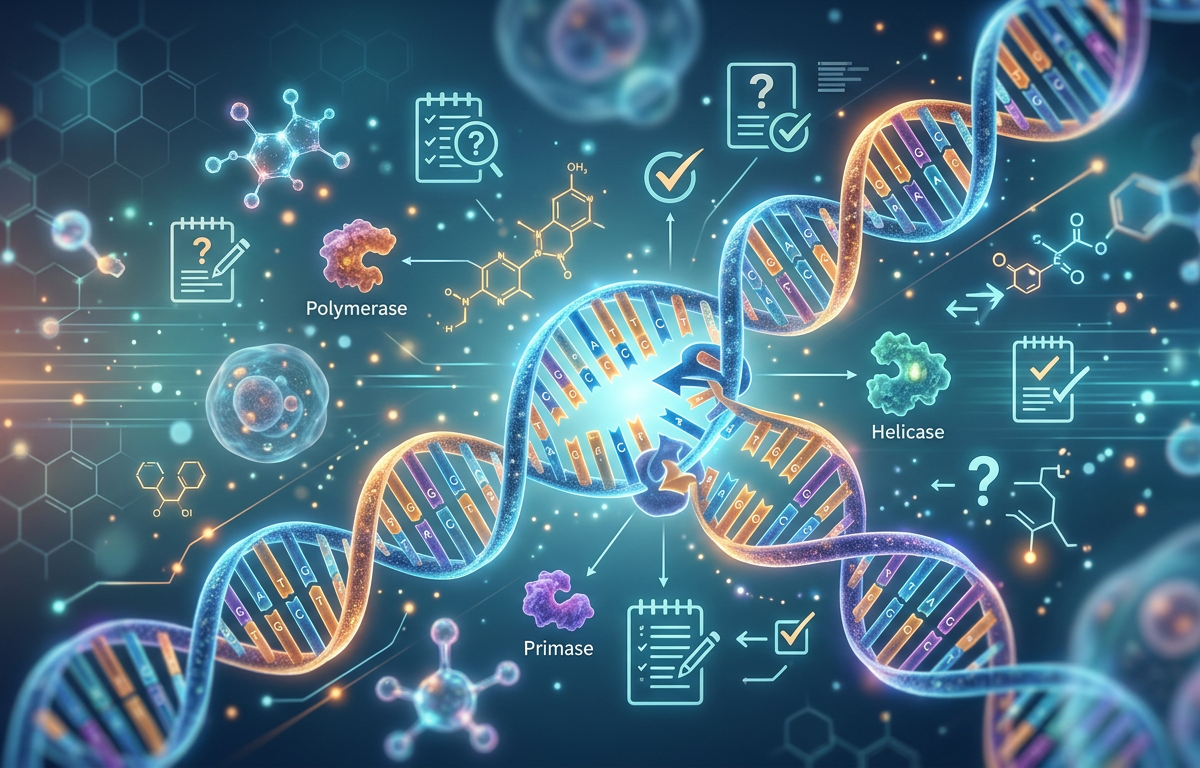
DNA replication is the biological process of producing two identical replicas of DNA from one original DNA molecule, ensuring that genetic information is accurately passed from a parent cell to its daughter cells during cell division. This fundamental mechanism occurs during the S-phase of the cell cycle and is described as semi-conservative because each new double helix consists of one original strand and one newly synthesized strand. The process is orchestrated by a complex suite of enzymes, including helicase, which unwinds the double helix at the origin of replication, and DNA polymerase, which adds nucleotides in a 5' to 3' direction. Because the two strands of DNA are antiparallel, replication proceeds differently on each: the leading strand is synthesized continuously, while the lagging strand is synthesized in short pieces called Okazaki fragments. This topic is a cornerstone of Genetics Practice Questions and is essential for understanding how life propagates. For a deeper look at the molecular structures involved, you might also find Hard Organelles Questions relevant as they discuss the nucleus where this process occurs.
Solved Examples
Understanding the mechanics of replication requires looking at how enzymes interact with the DNA template. Here are three worked examples to illustrate key concepts.
- Determining the Complementary Strand: Given a template strand sequence of 5'-ATCGGCTA-3', what is the sequence of the newly synthesized complementary strand?
- Identify the base-pairing rules: Adenine (A) pairs with Thymine (T), and Cytosine (C) pairs with Guanine (G).
- Determine the antiparallel orientation: The new strand must run 3' to 5' relative to the template.
- Match the bases: A-T, T-A, C-G, G-C, G-C, C-G, T-A, A-T.
- The complementary sequence is 3'-TAGCCGAT-5', or 5'-TAGCCGAT-3' when written in standard notation.
- Calculating Replication Speed: If a bacterial genome consists of 4.6 million base pairs and replication occurs at a rate of 1,000 nucleotides per second per fork, how long does it take to replicate the circular chromosome with two replication forks?
- Calculate the total rate: 2 forks × 1,000 nucleotides/sec = 2,000 nucleotides/sec.
- Divide the total base pairs by the rate: 4,600,000 / 2,000 = 2,300 seconds.
- Convert to minutes: 2,300 / 60 ≈ 38.3 minutes.
- Identifying Enzyme Function: A cell has a mutation that prevents the joining of Okazaki fragments. Which enzyme is likely defective?
- Recall that Okazaki fragments are short DNA sequences on the lagging strand.
- DNA Polymerase III synthesizes the fragments, and DNA Polymerase I replaces the RNA primers.
- The enzyme responsible for "gluing" or sealing the phosphodiester backbone between fragments is DNA ligase.
- Conclusion: DNA ligase is the defective enzyme.
Practice Questions
Test your knowledge with these medium-level DNA replication questions. These questions assume a basic understanding of DNA structure, which is often paired with DNA Replication Questions Practice Questions with Answers.
- In which direction does DNA polymerase always synthesize a new DNA strand?
- What is the role of Single-Strand Binding Proteins (SSBs) during the replication process?
- Explain why the lagging strand must be synthesized in fragments rather than continuously.
- Which enzyme is responsible for relieving the torsional strain (overwinding) caused by the unwinding of the DNA double helix?
- What provides the energy required for the formation of the phosphodiester bond during DNA synthesis?
- Contrast the function of DNA Polymerase I and DNA Polymerase III in prokaryotic replication.
- What is the significance of the "Origin of Replication," and how does it differ between prokaryotes and eukaryotes?
- Define "semi-conservative replication" and briefly mention the experiment that proved this model.
- Why is an RNA primer necessary for the start of DNA replication?
- What happens to the telomeres of linear chromosomes after multiple rounds of replication in somatic cells?
Answers & Explanations
- 5' to 3' direction: DNA polymerase can only add new nucleotides to the free 3'-hydroxyl (-OH) group of an existing nucleotide chain.
- Stabilization: SSBs bind to the separated DNA strands to prevent them from re-annealing (snapping back together) or being degraded by nucleases before replication is complete.
- Antiparallel orientation: DNA polymerase only works in the 5' to 3' direction. Since the lagging strand template runs 5' to 3' toward the replication fork, the polymerase must move away from the fork to synthesize in the 5' to 3' direction, resulting in discontinuous fragments.
- Topoisomerase (or DNA Gyrase): This enzyme cuts and rejoins the DNA strands to relax the supercoiling that occurs ahead of the replication fork.
- Nucleoside Triphosphates (dNTPs): The hydrolysis of the two terminal phosphates (pyrophosphate) from the incoming dNTP provides the exergonic energy needed for the polymerization reaction.
- Polymerase Roles: DNA Polymerase III is the primary enzyme for elongation (adding the bulk of nucleotides). DNA Polymerase I removes the RNA primers and replaces them with DNA nucleotides.
- Origins: The origin is the specific sequence where replication begins. Prokaryotes usually have a single origin (e.g., oriC in E. coli), while eukaryotes have multiple origins per chromosome to speed up the replication of their much larger genomes.
- Semi-conservative: Each daughter DNA molecule contains one old (parental) strand and one new strand. This was proved by the Meselson-Stahl experiment using nitrogen isotopes.
- Primer requirement: DNA polymerase cannot start a new chain from scratch; it requires a 3'-OH end to attach the first nucleotide. Primase (an RNA polymerase) can start a chain without a 3'-OH.
- Shortening: Because the RNA primer at the very end of the lagging strand cannot be replaced by DNA (no 3'-OH available for extension), telomeres shorten with each cell division, eventually leading to cellular senescence.
1. Which enzyme is responsible for unwinding the DNA double helix?
Frequently Asked Questions
What is the difference between the leading and lagging strands?
The leading strand is synthesized continuously in the same direction as the replication fork movement, while the lagging strand is synthesized discontinuously in short Okazaki fragments in the opposite direction. This occurs because DNA polymerase can only add nucleotides in the 5' to 3' direction.
Why is DNA replication called semi-conservative?
It is called semi-conservative because the two resulting double-stranded DNA molecules each contain one original strand from the parent molecule and one newly synthesized strand. This ensures high fidelity in the transmission of genetic information as described by Nature Education.
What happens if DNA polymerase makes a mistake?
DNA polymerase has a proofreading ability (3' to 5' exonuclease activity) that allows it to remove incorrectly paired nucleotides immediately. If a mistake survives this stage, mismatch repair mechanisms in the cell identify and correct the error after replication.
What are telomeres and why are they important in replication?
Telomeres are repetitive DNA sequences at the ends of linear chromosomes that protect genes from being lost during replication. Because the lagging strand cannot be replicated to the very end, telomeres shorten over time, acting as a biological clock for the cell.
How does prokaryotic DNA replication differ from eukaryotic?
Prokaryotic replication occurs in the cytoplasm, involves a single origin of replication, and uses different polymerases (like Pol III). Eukaryotic replication occurs in the nucleus, involves multiple origins of replication, and utilizes more complex protein assemblies to handle histones and linear chromosome ends.
Enjoyed this article?
Share it with others who might find it helpful.
Related Articles
Hard DNA Replication Questions Practice Questions
Challenge yourself with hard DNA replication questions. Explore enzymatic mechanisms, Okazaki fragments, and telomeres with solved examples and a quiz.
Apr 25, 2026
Easy DNA Replication Questions Practice Questions
Master the basics of DNA replication with our easy practice questions, solved examples, and clear explanations of enzymes like helicase and polymerase.
Apr 25, 2026
Hard Microbiology Practice Questions Practice Questions
Hard Microbiology Practice Questions Practice Questions
Apr 26, 2026
Medium Microbiology Practice Questions Practice Questions
Master microbiology with our medium-level practice questions covering bacterial growth, genetics, and metabolism. Includes solved examples and a quick quiz.
Apr 26, 2026

Easy Microbiology Practice Questions Practice Questions
Easy Microbiology Practice Questions Practice Questions
Apr 26, 2026

Hard Enzyme Questions Practice Questions
Master complex biochemistry with these hard enzyme questions. Cover Michaelis-Menten kinetics, inhibition types, and Lineweaver-Burk plots with solved examples.
Apr 26, 2026

Medium Enzyme Questions Practice Questions
Master enzyme kinetics and regulation with our Medium Enzyme Questions Practice Questions. Includes solved examples, detailed explanations, and a quick quiz.
Apr 26, 2026
Enzyme Questions Practice Questions with Answers
Master enzyme kinetics and function with our comprehensive guide. Includes solved examples, practice questions, and detailed answers on biological catalysts.
Apr 26, 2026