MCAT Thermodynamics Practice Questions with Answers

Concept Explanation
MCAT thermodynamics is the study of energy, heat, and work transformations within chemical and biological systems, governed by the laws of energy conservation and entropy. To master this topic, students must understand the relationship between state functions like enthalpy (), entropy (), and Gibbs free energy (). These variables determine whether a reaction will occur spontaneously under specific conditions. According to the Laws of Thermodynamics, energy cannot be created or destroyed, and the total entropy of the universe is constantly increasing.
Key concepts include the First Law (), which relates internal energy to heat and work, and the Second Law, which introduces the concept of disorder. For the MCAT, you must be able to calculate thermochemistry values such as the heat of reaction and distinguish between kinetic and thermodynamic control. While kinetics deals with the speed of a reaction, thermodynamics tells us about the stability of products and the equilibrium position.
Gibbs Free Energy is perhaps the most critical equation to memorize: If is negative, the reaction is exergonic and spontaneous. If it is positive, the reaction is endergonic and non-spontaneous. Understanding how temperature influences spontaneity when and have the same sign is a frequent testing point on the exam.
Solved Examples
The following examples demonstrate how to apply thermodynamic principles to typical MCAT-style problems.
- Calculating Internal Energy Change: A gas system absorbs 400 J of heat and performs 150 J of work on its surroundings. What is the change in internal energy ()?
- Identify the First Law of Thermodynamics: .
- Determine the signs: Heat absorbed is positive (). Work performed by the system is positive in this convention ().
- Substitute the values: .
- Final Answer: .
- Predicting Spontaneity: A reaction has an enthalpy change () of and an entropy change () of . Is the reaction spontaneous at ?
- Use the Gibbs Free Energy equation: .
- Convert units so they match: .
- Calculate: .
- Solve: .
- Conclusion: Since , the reaction is spontaneous at this temperature.
- Hess's Law Application: Find the for the reaction given:
- Recognize that enthalpy is a state function; the path does not matter.
- Sum the intermediate reactions: .
- Sum the enthalpy changes: .
- Final Answer: .
Practice Questions
1. Which of the following conditions always results in a spontaneous reaction at all temperatures?
2. A rigid container holds an ideal gas. If heat is added to the system, which of the following is true regarding work ()?
3. Calculate the change in entropy () for a process where 6000 J of heat is added reversibly to a system at a constant temperature of 300 K.
Track your MCAT progress intelligently.
Use Bevinzey’s analytics and AI-powered feedback to identify weaknesses and improve faster.
See My Progress4. In an adiabatic process, the exchange of heat () between the system and surroundings is equal to:
5. If a reaction is endothermic and results in a decrease in entropy, under what conditions will it be spontaneous?
6. Standard Gibbs free energy () is related to the equilibrium constant () by which equation?
7. A reaction has a and . As the temperature increases, the reaction becomes:
8. What is the sign of for the following reaction: ?
9. According to the Third Law of Thermodynamics, what is the entropy of a pure crystalline substance at absolute zero (0 K)?
10. If the work done on a system is 200 J and the internal energy increases by 500 J, how much heat was added to the system?
Answers & Explanations
1. Answer: Negative and Positive . According to , if enthalpy is negative (exothermic) and entropy is positive (increasing disorder), will remain negative regardless of the value of .
2. Answer: . In a rigid container, the volume is constant (). Since work in expansion/compression is defined as , no work is done.
3. Answer: 20 J/K. Entropy change for a reversible isothermal process is calculated as . Thus, .
4. Answer: Zero. By definition, an adiabatic process is one in which no heat is transferred into or out of the system ().
5. Answer: Never spontaneous. If is positive and is negative, the expression will always be positive, making positive at all temperatures.
6. Answer: . This equation relates the standard state free energy change to the ratio of products to reactants at equilibrium. You may also see it used in electrochemistry contexts.
7. Answer: More spontaneous. When both terms are positive, the term becomes more negative as increases, eventually outweighing the positive .
8. Answer: Negative. The reaction converts 4 moles of gas into 2 moles of gas. A decrease in the number of gas moles corresponds to a decrease in disorder, hence .
9. Answer: Zero. The Third Law states that the entropy of a perfect crystal at absolute zero is exactly zero, representing a state of perfect order.
10. Answer: 300 J. Using , and noting that work done "on" the system is typically treated as in the formula (or simply adding it to energy). If and (work done on system), then , so .
1. Which state function is defined as the total heat content of a system?
Frequently Asked Questions
What is the difference between intensive and extensive properties?
Intensive properties, like temperature and density, do not depend on the amount of matter present. Extensive properties, such as mass and volume, change based on the sample size.
How does the MCAT define work in a PV diagram?
Work is represented as the area under the curve on a Pressure-Volume (PV) graph. If the volume increases, the system does work; if the volume decreases, work is done on the system.
What is the difference between and ?
refers to the free energy change under standard conditions (1 M, 1 atm, 298 K), while represents the change under any specific, non-standard conditions. They are related by the reaction quotient in the equation .
Why is entropy often called the "arrow of time"?
The Second Law of Thermodynamics states that total entropy always increases in a spontaneous process. This unidirectional increase provides a thermodynamic distinction between the past and the future.
Can a non-spontaneous reaction ever occur in a cell?
Yes, biological systems frequently perform non-spontaneous reactions by coupling them to highly spontaneous ones. The most common example is the hydrolysis of ATP, which provides the necessary negative to drive endergonic processes like protein synthesis.
Track your MCAT progress intelligently.
Use Bevinzey’s analytics and AI-powered feedback to identify weaknesses and improve faster.
See My ProgressEnjoyed this article?
Share it with others who might find it helpful.
Related Articles

Hard MCAT Thermodynamics Practice Questions
Hard MCAT Thermodynamics Practice Questions
May 17, 2026
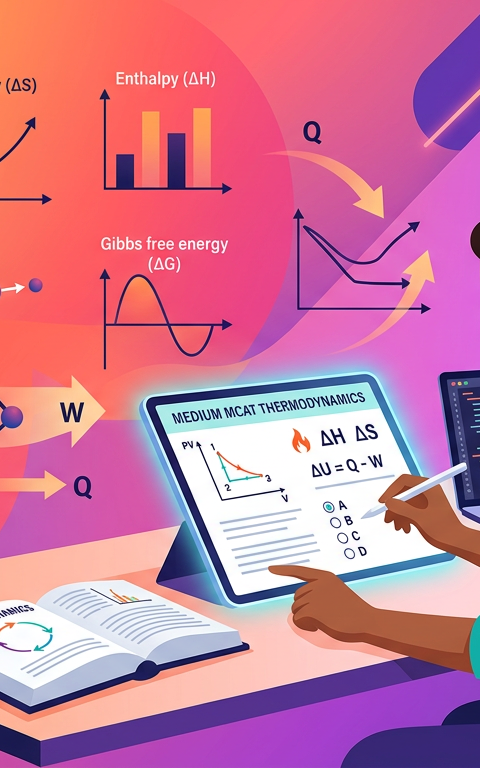
Medium MCAT Thermodynamics Practice Questions
Master thermodynamics with medium-level MCAT practice questions covering Gibbs Free Energy, enthalpy, entropy, and the laws of thermodynamics with full explanations.
May 17, 2026

Hard MCAT Optics Practice Questions
Hard MCAT Optics Practice Questions
May 17, 2026

Hard MCAT Kinematics Practice Questions
Hard MCAT Kinematics Practice Questions
May 17, 2026

Medium MCAT Optics Practice Questions
Medium MCAT Optics Practice Questions
May 17, 2026

Medium MCAT Circuits Practice Questions
Medium MCAT Circuits Practice Questions
May 17, 2026

Medium MCAT Kinematics Practice Questions
Medium MCAT Kinematics Practice Questions
May 17, 2026

Medium MCAT Physics Practice Questions
Master medium-level MCAT physics with our comprehensive guide featuring solved examples, practice questions, and detailed explanations of core concepts.
May 17, 2026