MCAT Kinematics Practice Questions with Answers

MCAT Kinematics Practice Questions with Answers
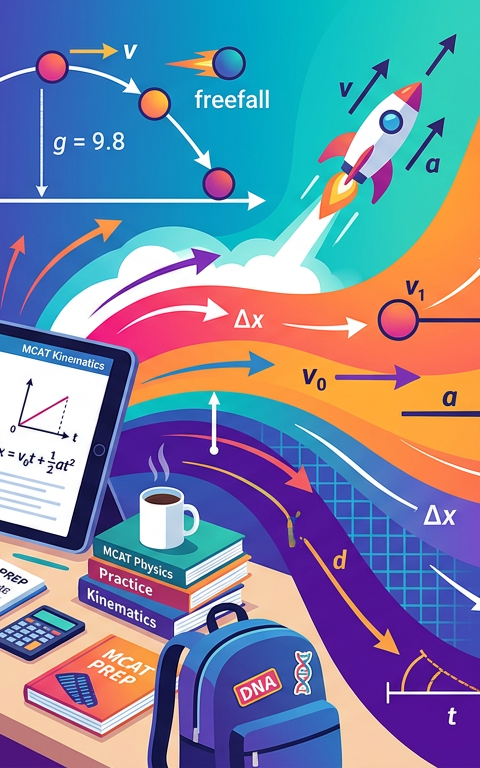
Mastering MCAT Kinematics is a foundational requirement for scoring well on the Chemical and Physical Foundations of Biological Systems section. This branch of classical mechanics describes the motion of objects without considering the forces that cause the motion, focusing instead on variables like displacement, velocity, acceleration, and time. Whether you are calculating the flight path of a projectile or the deceleration of blood flow in an artery, these principles apply across the board.
In this guide, we provide a deep dive into the core concepts, followed by rigorous practice questions designed to mimic the complexity of the actual exam. If you are also preparing for the general chemistry portion, you might find our Medium MCAT General Chemistry Practice Questions helpful for rounding out your study schedule.
Concept Explanation
Kinematics is the study of motion in terms of position, velocity, and acceleration as functions of time, governed by a specific set of equations for constant acceleration. To excel in MCAT Kinematics, you must distinguish between scalars (magnitude only) and vectors (magnitude and direction). For example, distance and speed are scalars, while displacement and velocity are vectors.
The Big Five Equations
When acceleration is constant, four primary equations describe linear motion. These are often referred to as the kinematic equations:
Free Fall and Projectile Motion
Free fall is a specific case of linear kinematics where the only acceleration acting on an object is gravity ( on the MCAT). Projectile motion extends this into two dimensions. The horizontal component of motion usually has zero acceleration (if air resistance is ignored), meaning horizontal velocity remains constant. The vertical component is subject to constant gravitational acceleration. According to Wikipedia's entry on Kinematics, the independence of horizontal and vertical motions is a key principle for solving complex 2D problems.
Graphical Analysis
The MCAT frequently tests your ability to interpret graphs. The slope of a position-vs-time graph represents velocity. The slope of a velocity-vs-time graph represents acceleration. Furthermore, the area under a velocity-vs-time graph represents the displacement of the object.
Solved Examples
Example 1: Linear Deceleration
A car traveling at applies its brakes and comes to a complete stop over a distance of . What is the magnitude of the car's acceleration?
Identify knowns: , , .
Choose the equation without time: .
Substitute values: .
Simplify: .
Solve for : . The magnitude is .
Example 2: Vertical Projectile
A ball is thrown straight up with an initial velocity of . How long does it take to reach its maximum height? (Use )
Identify knowns: , (at peak), .
Choose the equation: .
Substitute values: .
Solve for : .
Example 3: Horizontal Displacement
A rock is kicked horizontally off a tall cliff with a horizontal velocity of . How far from the base of the cliff does it land?
Find time in air using vertical components: . Since it's kicked horizontally, .
.
.
Find horizontal distance: .
Practice Questions
1. A runner accelerates from rest to a velocity of in . What is the total displacement of the runner during this time interval, assuming constant acceleration?
2. A medical drone drops a package from a height of . Neglecting air resistance, what is the velocity of the package immediately before it hits the ground?
3. An object moves according to the velocity-time graph where the velocity increases linearly from to over , then remains constant at for another . What is the total distance traveled?
Track your MCAT progress intelligently.
Use Bevinzey’s analytics and AI-powered feedback to identify weaknesses and improve faster.
See My Progress4. A projectile is launched at an angle of to the horizontal with an initial speed of . What is the vertical component of its velocity at the moment of launch?
5. If a car is traveling at and decelerates at a constant rate of , how much time is required for the car to stop?
6. An astronaut on the moon (where ) drops a hammer from a height of . How long does it take for the hammer to hit the lunar surface?
7. A train moves at a constant velocity of for . It then undergoes a constant deceleration of until it stops. What is the total distance covered by the train from the start of the 2-minute period?
8. A ball is thrown upward with an initial speed . If the initial speed is doubled to , by what factor does the maximum height increase?
9. A particle's position is given by the equation . What is the instantaneous velocity of the particle at ?
10. Which of the following describes an object with a negative velocity and a positive acceleration?
Answers & Explanations
1. Answer: 16 m
Using the equation : . Alternatively, find acceleration , then use .
2. Answer: 40 m/s
Use . Here , , and .
. Taking the square root gives .
3. Answer: 75 m
The area under the v-t graph: For the first 5s (triangle), . For the next 5s (rectangle), . Total distance = .
4. Answer: 20 m/s
The vertical component is found using sine: .
.
5. Answer: 5 seconds
Use . Here .
.
6. Answer: 2 seconds
Use .
.
.
7. Answer: 6625 m
Distance 1 (constant velocity): .
Distance 2 (deceleration): .
. Total = .
8. Answer: Factor of 4
From , at max height . Thus, . Height is proportional to the square of the initial velocity. If velocity doubles (), height increases by .
9. Answer: 10 m/s
Velocity is the derivative of position: . At , .
10. Answer: An object moving left and slowing down.
Negative velocity implies motion in the negative direction (e.g., left). Positive acceleration is in the opposite direction of motion, which causes the object to slow down.
1. Which of the following is a vector quantity?
Frequently Asked Questions
What is the difference between average speed and average velocity?
Average speed is the total distance traveled divided by time, whereas average velocity is the total displacement (change in position) divided by time. Because displacement only considers the start and end points, average velocity can be zero even if the object moved a great distance.
Does the MCAT provide kinematic equations on the exam?
No, the MCAT does not provide a formula sheet, so you must memorize the primary kinematic equations. Understanding how to derive them or relate them to graphs can help you recall them during the high-pressure environment of the AAMC MCAT exam.
How do I handle signs (positive and negative) in kinematics?
Define a coordinate system before starting a problem; typically, up and right are positive, while down and left are negative. Consistency is key, especially in free fall where acceleration due to gravity is always directed downward ().
When can I use the constant acceleration equations?
These equations are only valid when acceleration does not change over the time interval being studied. If acceleration varies, you would need calculus or a different set of physical laws, which are rarely required on the MCAT unless presented in a passage. For more on rate laws, see our Easy MCAT Kinetics Practice Questions.
What is terminal velocity?
Terminal velocity occurs when the force of air resistance equals the force of gravity acting on a falling object, resulting in a net force of zero. At this point, the object stops accelerating and falls at a constant speed, which is a concept often tested in the context of Newton's Laws.
Track your MCAT progress intelligently.
Use Bevinzey’s analytics and AI-powered feedback to identify weaknesses and improve faster.
See My ProgressReviewed by
Michael Danquah, MS, PhD
Dr. Michael Danquah is a professor of pharmaceutical sciences and founder of several educational technology platforms focused on improving student learning and performance.
Enjoyed this article?
Share it with others who might find it helpful.
Related Articles

Hard MCAT Kinematics Practice Questions
Hard MCAT Kinematics Practice Questions
May 17, 2026
Medium MCAT Kinematics Practice Questions
Medium MCAT Kinematics Practice Questions
May 17, 2026

Hard MCAT Thermodynamics Practice Questions
Hard MCAT Thermodynamics Practice Questions
May 17, 2026

Hard MCAT Optics Practice Questions
Hard MCAT Optics Practice Questions
May 17, 2026

Medium MCAT Thermodynamics Practice Questions
Master thermodynamics with medium-level MCAT practice questions covering Gibbs Free Energy, enthalpy, entropy, and the laws of thermodynamics with full explanations.
May 17, 2026

Medium MCAT Optics Practice Questions
Medium MCAT Optics Practice Questions
May 17, 2026

Medium MCAT Circuits Practice Questions
Medium MCAT Circuits Practice Questions
May 17, 2026

Medium MCAT Physics Practice Questions
Master medium-level MCAT physics with our comprehensive guide featuring solved examples, practice questions, and detailed explanations of core concepts.
May 17, 2026